
Bone gains from 2800 IU of vitamin D in pregnancy had faded by age 13 - RCT
Prenatal high-dose vitamin D supplementation and offspring bone mineral content and density at age 13 years: a secondary analysis of a randomised clinical trial
The Lancet Regional Health – Europe 2026;71:101870 (Elsevier), December 2026, https://doi.org/10.1016/j.lanepe.2026.101870
Nicklas Brustad, Tamo Sultan, Nilo Vahman, Signe Kjeldgaard Jensen, Rebecca Vinding, Kristina Aagaard, Peter Michael Gørtz, Christian Haarmark, Klaus Bønnelykke, Bo Chawes
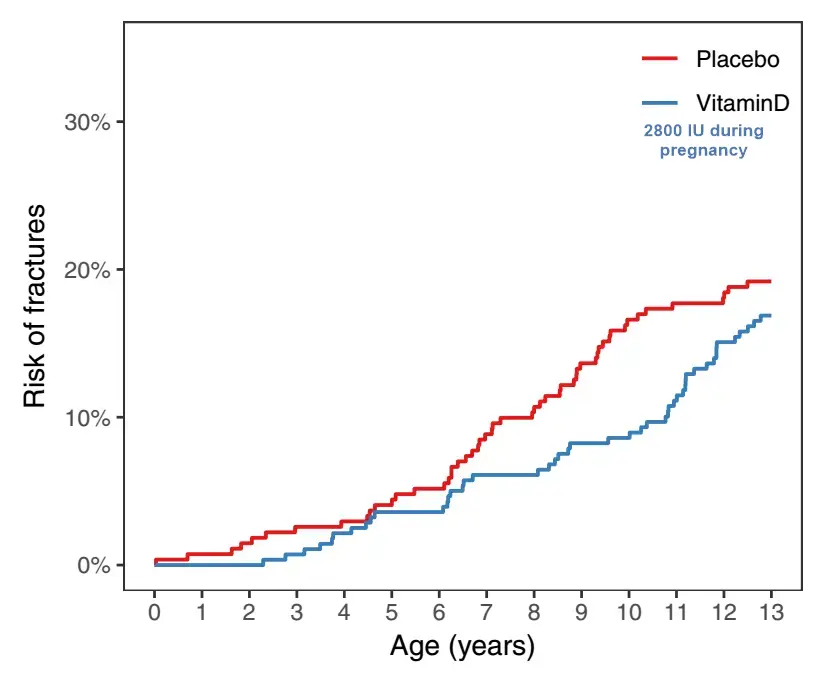
Fracture risk from birth to age 13. "Placebo" mothers also took the standard 400 IU/day. The gap between ages 6 and 11 was not statistically significant (HR 0.85, 95% CI 0.57–1.25, p = 0.40) and had mostly closed by age 13.
Summary by Claude Opus 5.5 - September 2026
Bottom line: Children whose mothers took 2800 IU/day of vitamin D in late pregnancy had stronger bones at ages 3 and 6 (reported earlier). By age 13 that advantage was gone. Bone mineral content, bone density, and fracture risk were statistically the same as in children whose mothers took the standard 400 IU/day.
This is a 13-year follow-up of the Danish COPSAC2010 trial, a double-blinded RCT of 623 pregnant women (584 children). Mothers took 2400 IU/day of vitamin D3 or placebo, on top of the 400 IU/day recommended to everyone, from pregnancy week 24 until 1 week after birth. That is about 4 months in total. Maternal 25(OH)D rose in the high-dose group, but this paper does not report the achieved levels. Bone was a prespecified secondary outcome; the trial itself was designed around asthma/wheeze.
At age 13, 416 children (71%) had a whole-body DXA scan:
- Total body bone mineral content: +6.7 g (95% CI −28.3 to +41.6), p = 0.71
- Total body bone density: −0.003 g/cm² (−0.017 to +0.011), p = 0.68
- No difference by sex, birth season (including winter births), or mother's starting vitamin D level
- Fractures from birth to age 13 (post hoc analysis, 550 children): 53 vs 61 fractures, HR 0.85 (0.57–1.25), p = 0.40
The authors now describe "a transient beneficial effect only observed in younger children."
One exploratory hint came from within the high-dose group. Children whose own 25(OH)D was ≥75 nmol/L at 6 months had higher bone mineral at 13 than those below 75 nmol/L (interaction p = 0.002 for bone mineral content). This suggests that vitamin D after birth may be needed to keep the prenatal gain, but it is a hypothesis, not a trial result.
What this does NOT show
- Whether a higher dose, a start before conception or in the first trimester, or continued vitamin D through infancy would give a lasting benefit. None of these were tested.
- That the gap in the fracture curves is real. It was not statistically significant, the analysis was added after the fact, there were few fractures, and physical activity was not accounted for.
- That vitamin D status at 6 months causes better bones. Infant levels were not randomized and may reflect family habits.
- That prenatal vitamin D is useless for bone. The benefit at ages 3–6 was real; it just did not persist.
- Other limits: 29% of children had no scan at 13, the trial was not powered for bone outcomes, areal bone density is hard to interpret during the puberty growth spurt, and only a Danish population was studied.
Related in VitaminDWiki
- [Overview Pregnancy and vitamin D]
- Prenatal Vitamin B12 improves brains, 13 of 19 studies
- Vitamin D during pregnancy increased child’s bone mineral density – meta-analysis
- 2800 IU of Vitamin D in late pregnancy resulted in 3X fewer fractures, 4X fewer enamel defects in offspring – RCT
- Prenatal Vitamin D and lungs (VDAART, Dr. Weiss) Interview and transcript - Feb 2026
- Vitamin D given while pregnant helps child for about 3 years