
Atrial Fibrillation strongly associated with some vitamin D binding protein
Genetically deprived vitamin D exposure predisposes to atrial fibrillation.
Europace. 2017 Dec 1;19(suppl_4):iv25-iv31. doi: 10.1093/europace/eux312.
Chan YH1, Yiu KH1,2, Hai JJ1, Chan PH1, Lam TH3, Cowling BJ3, Sham PC4, Lau CP1, Lam KS2,5, Siu CW1,2, Tse HF1,2.
VitaminDWiki pages with ATRIAL OR AFIB OR ARRHY in title (15 as of Sept 2022)
Download the PDF from VitaminDWiki
AIMS:
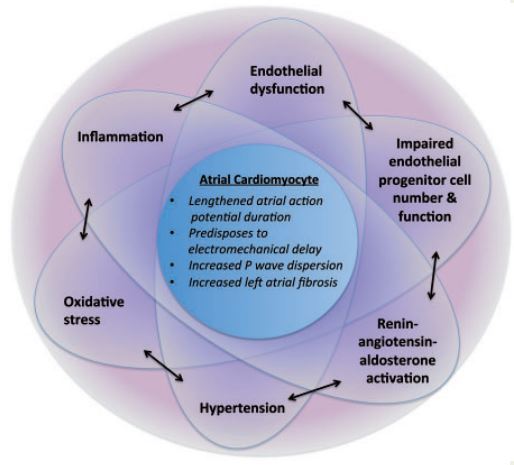
Low vitamin D level is associated with atrial fibrillation (AF) and may be implicated in its pathogenesis.
METHODS AND RESULTS:
We studied single nucleotide polymorphisms (SNPs) of vitamin D mechanistic pathways and serum 25-hydroxyvitamin D [25(OH)D] levels in an age- and gender-matched case-control study (controls without AF: mean age 68.6 ± 8.7 years, female 25%; n = 1019; with AF: mean age 69.7 ± 9.5 years, female 30%; n = 156) recruited from a Chinese clinical cohort of patients with stable coronary artery disease. Twelve SNPs involved in the vitamin D mechanistic pathways were studied [
biosynthetic: rs4646536, rs10877012, rs3829251, rs1790349;
activation: rs2060793, rs1993116;
vitamin D-binding protein (VBP)/group-specific component (GC): rs4588, rs7041, rs2282679, rs1155563; and
vitamin D receptor: rs1544410, rs10735810].
A genetic risk score (GRS) (0-8) was constructed from SNPs associated with serum 25(OH)D as a proxy to lifelong vitamin D-deficient state.
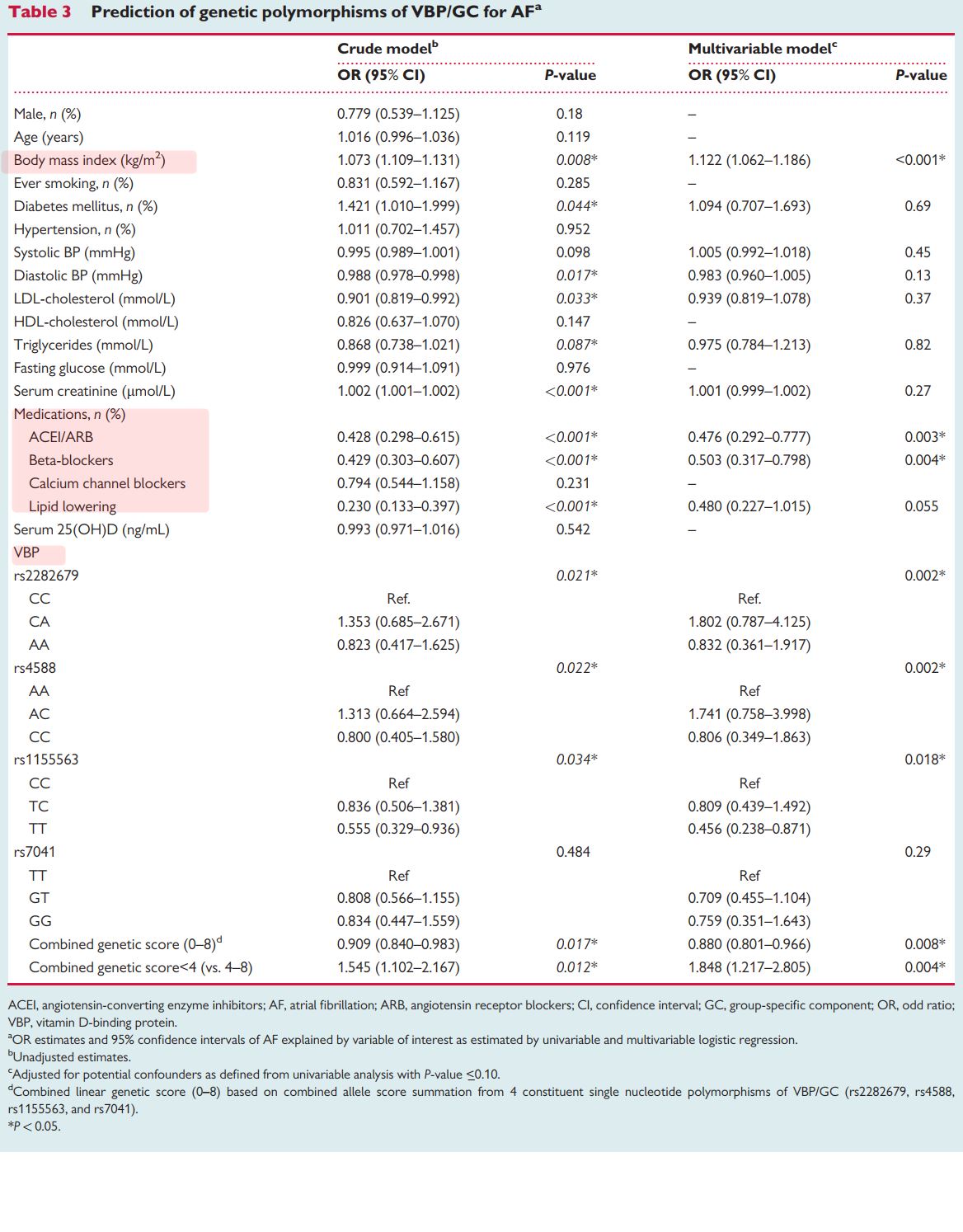
All 4 SNPs involved in the VBP/GC were significantly associated with serum 25(OH)D (rs4588, P < 0.001; rs2282679, P < 0.001; rs7041, P = 0.011; rs1155563, P < 0.001; all other SNPs, P > 0.05). Vitamin D GRS (points 0-8) generated from these 4 SNPs was independently predictive of serum 25(OH)D [B = 0.54, 95% confidence interval (CI) 0.30-0.79; P < 0.001]. Genetically deprived vitamin D status as denoted by a low GRS (0-3) independently predicted an increased risk of AF, compared to a high GRS (4-8) (odds ratio = 1.848, 95% CI 1.217-2.805; P = 0.004).
CONCLUSION:
Genetically deprived vitamin D exposure predisposes to increased AF among patients with coronary artery disease. Whether VBP/GC may alter the risk of AF via alternative mechanisms warrants further studies.