
6 types of Alzheimer's
Alzheimer’s: Six Subtypes, Many Root Causes - Nov 2026
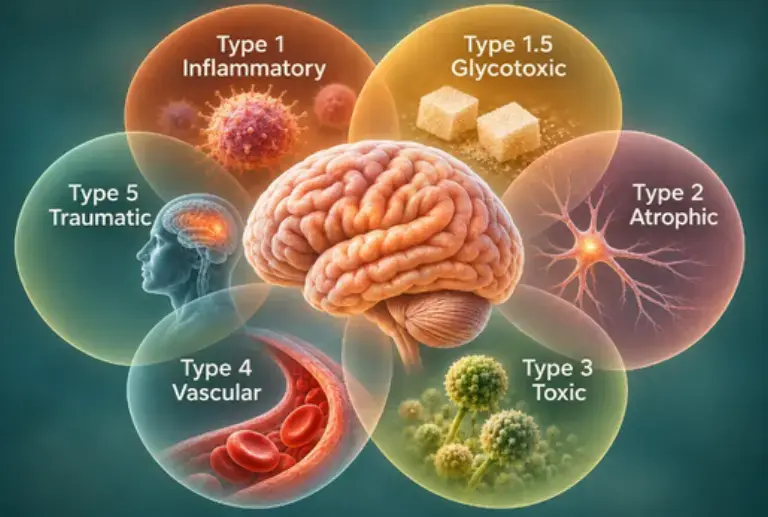
Type 1 – Inflammatory is characterized by chronic inflammation that can damage neurons and interfere with the brain’s ability to maintain healthy synaptic connections.
Type 1.5 – Glycotoxic is driven by insulin resistance and elevated blood sugar, combining elements of both inflammation and atrophy.
Type 2 – Atrophic is characterized by a lack of the essential nutrients, hormones, and growth factors needed to maintain healthy neurons and synaptic connections.
Type 3 – Toxic is characterized by exposure to environmental toxins combined with a reduced ability to effectively eliminate them.
Type 4 – Vascular is characterized by reduced blood flow to the brain, depriving neurons of the oxygen and nutrients they need to function optimally.
Type 5 – Traumatic is associated with a history of traumatic brain injury (TBI), including concussions, repetitive head impacts, and more severe injuries.
Table of 6 types and Vitamin D - Claude Opus AI
| Type | Core pathology | Vitamin D evidence for incidence | Vitamin D evidence for treatment | Evidence strength | Key refs |
|---|---|---|---|---|---|
| Type 1 Inflammatory ("hot") | Chronic systemic and neuroinflammation (hs-CRP, IL-6, TNF-α), NF-κB-driven APP processing, often APOE4 | Indirect: cohorts and MR of all-cause dementia; NACC benefit smaller in APOE4 carriers | Mixed RCT meta-analyses on CRP and cytokines; no subtype trial | Moderate (mechanistic strong, clinical indirect) | Ghahremani 2023 Chen 2014 hs-CRP meta-analysis Obese-adult cytokine meta-analysis 2024 |
| Type 1.5 Glycotoxic ("sweet") | Hyperglycemia, insulin resistance, glycation plus inflammation | Indirect: RCT IPD meta-analysis shows 15% lower progression to type 2 diabetes | Inflammatory markers fall in abnormal-glucose RCTs; no AD-specific trial | Moderate (indirect RCT) | Pittas 2023 IPD Abnormal-glucose meta-analysis 2021 |
| Type 2 Atrophic ("cold") | Loss of trophic support: vitamin D, sex hormones, thyroid, insulin, NGF/BDNF | Prospective cohorts, nonlinear MR (contested), NACC 40% lower incidence; null RCTs in replete adults | Two 12-month RCTs at 800 IU/day improved cognition and Aβ biomarkers | Strongest of the six (moderate overall) | Bredesen 2016 Navale 2022 Jia 2019 Kang 2021 VITAL |
| Type 3 Toxic ("vile") | Mycotoxins, metals (Hg, Pb, Cd), CIRS, low zinc | Cross-sectional NHANES interaction only | Animal studies only (Pb, Cd neuroprotection) | Very weak; possible harm via metal absorption | Hoseinrad 2021 Moon 1994 review NHANES micronutrient study 2026 |
| Type 4 Vascular ("pale") | Small-vessel disease, BBB leak, hypoperfusion, cardiovascular disease | Cross-sectional link to WMH, lacunes, microbleeds; MR null | Not reported | Weak (observational, not supported by MR) | Chung 2015 Stroke CSVD MR study Navale 2022 |
| Type 5 Traumatic ("dazed") | Prior TBI or repeated concussion, chronic post-traumatic neuroinflammation | Not reported (no data on TBI-to-AD conversion) | 80% insufficient after TBI; small RCTs; pooled SMD 0.37, NS | Weak | Jamall 2016 Aminmansour 2012 Ongko Wijaya 2026 |
Related in VitaminDWiki
- Overview Alzheimer's-Cognition and Vitamin D
- End of Alzheimer's videos, transcripts - many studies
- Alzheimer’s 1.6X more likely if vitamin D is less than 25 ng – meta-analysis
- 2X higher risk of Alzheimer’s if poor Vitamin D Receptor – Meta-analysis
- Alzheimer's Disease more likely with low vitamin D – meta-analysis
- Decrease of Alzheimer’s biomarker halted by Resveratrol (perhaps due to vitamin D) – RCT
- Vitamin D may protect the Alzheimer's brain through 5 pathways - review 2026
- Some men lose their Y chromosome with age: (10X increase in Alzheimer's, etc )
- Alzheimer's risk increased 2X if high PM2.5 air pollution
- Alzheimer’s Is Now Optional - Bredesen
- Alzheimer’s Is Now Optional - Dr. Bredesen video and transcript
- Alzheimer's disease 9X more likely in females with a poor Vitamin D Receptor