
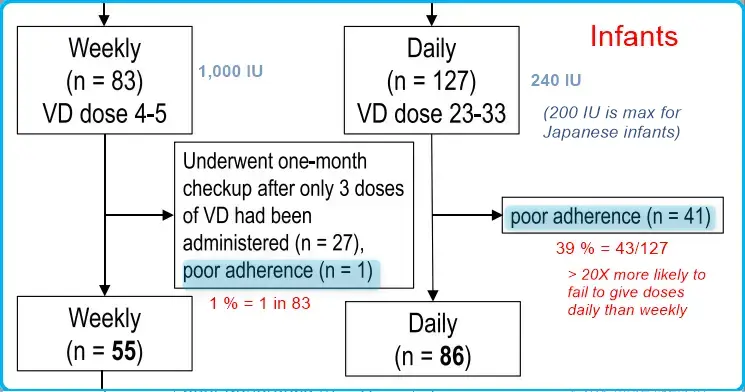
20 X more likely to remember to give infant Vitamin D weekly than daily (Japan)
Weekly vitamin D supplementation during early infancy as a potential strategy to prevent vitamin D insufficiency: A two-center retrospective study
Multicenter Study Pediatr Neonatol. 2026 Mar;67(2):203-209. doi: 10.1016/j.pedneo.2025.08.002.
Kaori Hara-Isono 1, Kazumi Morisawa 2, Mariko Hida 2, Shintaro Iwamoto 3, Kazushige Ikeda 4
Background: For preventing Vitamin D (VD) insufficiency, several VD supplementation guidelines were established worldwide. In Japan, no nationwide guidelines for preventing VD insufficiency have been implemented, whereas guidelines for preventing vitamin K (VK) deficiency-related bleeding recommend weekly supplementation of VK. The aim of this study is to clarify whether weekly VD plus VK supplementation during the early neonatal period prevents VD insufficiency at one month of age.
Methods: We retrospectively analyzed serum 25-hydroxyvitamin D (25(OH)D) levels of 555 one-month-old infants born between 2017 and 2023. Infants were classified into the control group (not supplemented), weekly group (1000 IU/week), and daily group (240 IU/day). We compared serum 25(OH)D levels among the three groups. Multivariable logistic regression analyses adjusted for formula intake and BMI were performed to better estimate the effect of VD supplementation on the prevention of VD insufficiency.
Results: We included 414, 55, and 86 infants in the control, weekly, and daily groups, respectively. All infants received weekly supplementation of VK. Serum 25(OH)D levels in the weekly and daily groups were higher than those in the control group (median (ng/mL): control 9.7 vs weekly 22.2, P < 0.001; control vs daily 23.0, P < 0.001). The frequencies of VD insufficiency were 370/414 (89.4 %), 11/55 (20.0 %), and 22/86 (25.6 %) in the control, weekly, and daily groups, respectively. Adjusted odds ratios of VD insufficiency compared to the control were 0.038 (95 % confidence intervals (95 %CI): 0.017, 0.085) and 0.036 (95 %CI: 0.019, 0.067) in the weekly and daily groups, respectively. No infant with VD excess was observed.
Conclusion: Our results demonstrated that combined weekly supplementation of VD and VK during early infancy can prevent VD insufficiency at one month of age without causing VD excess. This finding may provide evidence for the development of nationwide prophylaxis for VD insufficiency in regions lacking specific guidelines.
Related in VitaminDWiki
- Weekly, Monthly Vitamin D are typically better than daily - many studies
- Weekly Vitamin D better than daily – lower cost, less pill burden, perhaps 1.5X better response – meta-analysis
- Better than Daily
- Vitamin D dosing - weekly may be better than daily – video
- Children's Cancer hospital now testing vitamin D frequently and supplementing weekly
- 100,000 IU Vitamin D weekly for 4 weeks is safe and effective for children
- Better than Daily
- Weekly Vitamin D better than daily – lower cost, less pill burden, perhaps 1.5X better response – meta-analysis
- Monthly vitamin D dosing better for children than daily (again)
- Vitamin D for infants – 100,000 IU monthly is better than 400 IU daily – RCT
- Vitamin D every 25 days may be BETTER than daily – RCT
- Liposomal is better than standard Vitamin D in 10 ways (1 includes Liposomal Vitamin K)
- Liposomal Vitamin D appears to have a 3X faster and better response
- Infant Vitamin D: 1000 IU weekly is better than 240 IU daily (better compliance) previous look at this study
Note: Japanese mothers are used to weekly supplementation of their infants with Vitamin K2
So weekly Vitamin D is easily added to weekly Vitamin K2 (MK4), while daily Vitamin D is not
Note 1: Vitamin K1 injections (to prevent bleeding) have been given just after most US births since 1961
Note 2: ~20% of Japanese adults take any supplements
Note 3: Founder of VitaminDWiki takes only 3 supplements every day