
1 in 5 US children ages 3-11 are obese - and their vitamin D is lower - observational
Hidden nutritional inadequacy in U.S. children with obesity: Evidence from National Health and Nutrition Examination Survey 2021–2023
Obesity Pillars (Elsevier / Obesity Medicine Association), 1 August 2026, https://doi.org/10.1016/j.obpill.2026.100312
John T. Stutts, Yong S. Choe, Linlin Fan
Graphical Summary
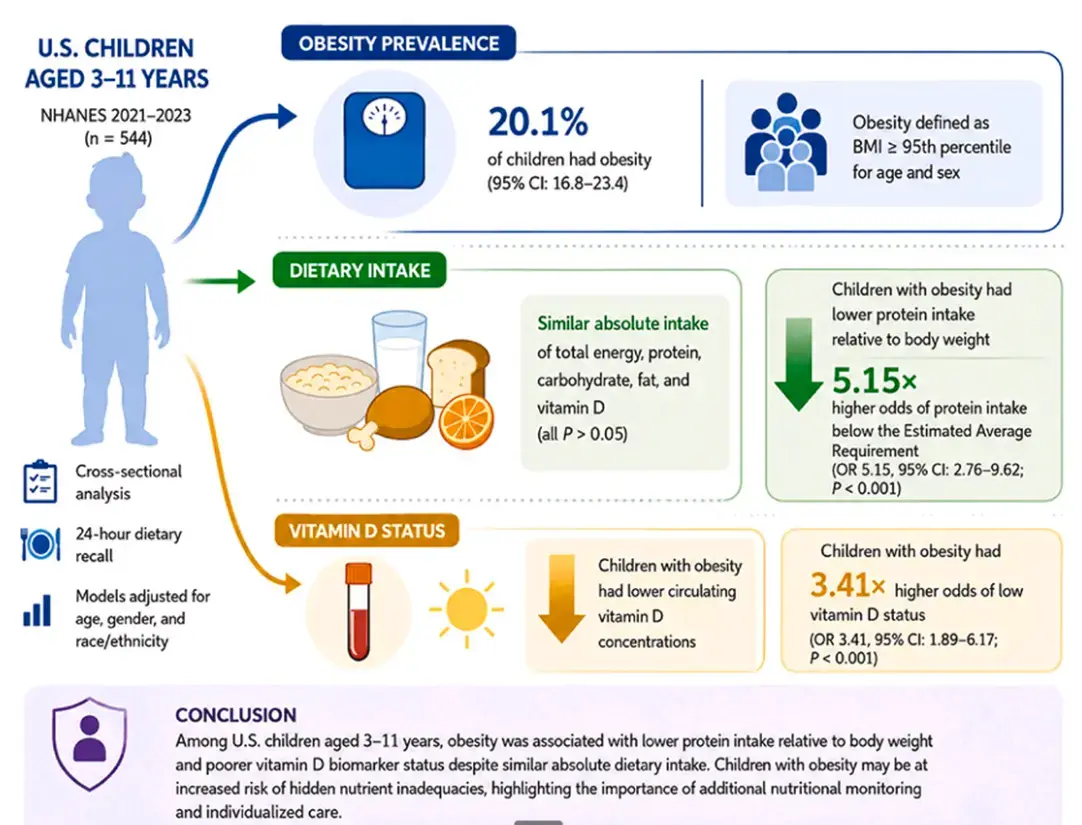
Summary by Claude - August, 2026
Children with obesity ate just as much vitamin D as their normal-weight peers — but had measurably less of it in their blood. This cross-sectional analysis of NHANES 2021–2023 covered 544 US children aged 3–11 who reported no supplement use in the prior 30 days (125 with obesity, 419 without). Blood was available for only 316 of them.
Dietary vitamin D was statistically identical between groups (5.4 vs 4.5 mcg/day, P = 0.309), and both groups sat far below the 10 mcg/day EAR — 94% of all children fell short, regardless of weight. Yet serum 25(OH)D2+D3 was lower in the obesity group (58.6 ± 1.7 vs 62.8 ± 1.2 nmol/L, P = 0.013), and the odds of being under 50 nmol/L were 3.41 X higher (95% CI 1.89–6.17). The authors attribute the gap to volumetric dilution, adipose sequestration, and reduced bioavailability. The parallel protein finding was similar in shape: same grams per day, but 1.6 vs 2.3 g/kg body weight, giving 5.15 X higher odds of falling below the protein EAR.
What this does not show / limitations. Cross-sectional — no causation, and reverse causation (low D promoting adiposity) is equally consistent with the data. The mean serum difference is only 4.2 nmol/L; the 3.41 odds ratio comes from a threshold crossing, not a large shift. No adjustment for season, latitude, sun exposure, skin pigmentation, or activity — the authors concede this. Single 24-hour recall, parent-reported. Overweight children were pooled with normal weight. Supplement users were excluded, limiting generalizability. Two of three authors are Abbott Nutrition employees and stockholders, and the protein-inadequacy conclusion points toward Abbott's pediatric nutrition products.
Related in VitaminDWiki
- Overweight children are 3.4 X more likely to have low Vitamin D
identical to the study on this page - Childhood BMI decreased when add a little Vitamin D – meta-analysis
- Overweight children associated with low vitamin D during pregnancy – 2015, 2018
- Less obese child if supplemented with Vitamin D as an infant– meta-analysis
- The Convergence of Two Epidemics: Vitamin D Deficiency in Obese School-aged Children
- Obese children – 71 percent had low vitamin D
- Obama task force told that childhood Obesity linked to Vitamin D Deficiency
- Obese children and youths need more vitamin D – Review