
CYP2R1 gene reduces response to Vitamin D - many studies
People with a poor CYP2R1 genes are poor Vitamin D responders
Possible solution: take larger doses of Vitamin D
VitaminDWiki - Genetics chart shows the vitamin D genes
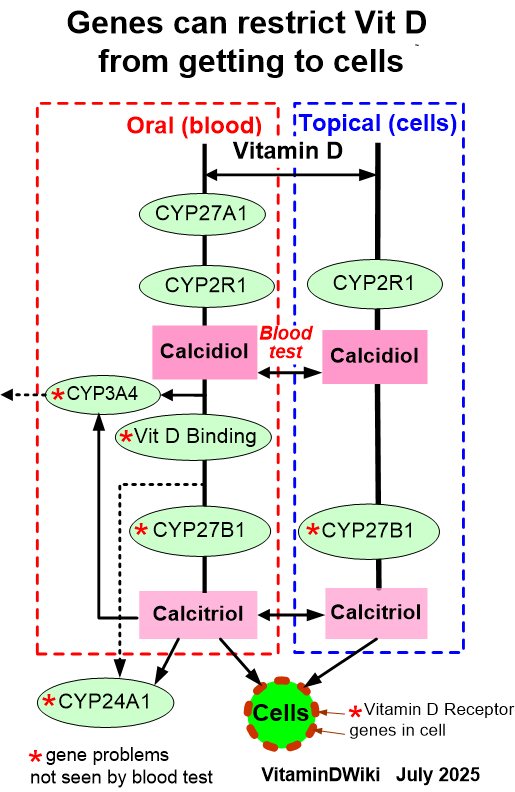
Genes and other reasons for poor blood response to Vitamin D supplementation
Poor or no response to vitamin D was associated with poor genes (cystic fibrosis, 4 genes) Sept 2022
Autistics have half of the response to Vitamin D – RCT Oct 2018
Poor CYP2R1 gene reduces blood response to Vitamin D supplementation – Aug 2019
Poor Vitamin D response 4X more likely if poor Vitamin D binding proteins - July 2019
Vitamin D Nutrigenomics - High, Medium, and Low Responders - March 2019
Vitamin D non-responders may have one or more poor genes: GC, LIPC, CYP24A1, and PDE3B – Oct 2022
CYP2R1 problems: 1 in 12 in the tropics, 1 in 143 African-Americans, 1 in 333 Caucasians
Heterozygous carriers of CYP2R1 variants with decreased 25-hydroxylase activity are more common but still relatively rare in Western populations:
| Population | Frequency of Decreased-Activity CYP2R1 Alleles |
|---|---|
| Caucasians (US) | 3 per 1,000 (~1 in 333)[^4][^5] |
| African Americans | 7 per 1,000 (~1 in 143)[^4][^5] |
| Equatorial populations (e.g., Sierra Leone) | Up to 8% (~1 in 12)[^5] |
These heterozygous carriers have a 30–60% reduction in circulating 25(OH)D and show diminished response to vitamin D supplementation. They may benefit from calcidiol but can often achieve adequate levels with higher doses of vitamin D3.[^5]
More information and references at Perplexity AI
24+ VitaminDWiki pages with CYP2R1 in title
This list is automatically updated
{LIST()}
CYP2R1 was the gene most associated with increased risk of Ischemic Stroke - Feb 2023
Whole-Exome Sequencing Analyses Support a Role of Vitamin D Metabolism in Ischemic Stroke
Stroke . 2023 Feb 10. doi: 10.1161/STROKEAHA.122.040883 PDF of Preprint
Yuhan Xie # 1, Julián N Acosta # 2, Yixuan Ye 3, Zachariah S Demarais 4, Carolyn J Conlon 4, Ming Chen 1, Hongyu Zhao 1 3, Guido J Falcone 2

Background: Ischemic stroke (IS) is a highly heritable trait, and genome-wide association studies have identified several commonly occurring susceptibility risk loci for this condition. However, there are limited data on the contribution of rare genetic variation to IS.
Methods: We conducted an exome-wide study using whole-exome sequencing data from 152 058 UK Biobank participants , including 1777 IS cases. We performed single-variant analyses for rare variants and gene-based analyses for loss-of-function and deleterious missense rare variants. We validated these results through
(1) gene-based testing using summary statistics from MEGASTROKE-a genome-wide association study of IS that included 67 162 IS cases and 454 450 controls,
(2) gene-based testing using individual-level data from 1706 IS survivors, including 142 recurrent IS cases, enrolled in the VISP trial (Vitamin Intervention for Stroke Prevention); and
(3) gene-based testing against neuroimaging phenotypes related to cerebrovascular disease using summary-level data from 42,310 UK Biobank participants with available magnetic resonance imaging data.
Results: In single-variant association analyses, none of the evaluated variants were associated with IS at genome-wide significance levels (P<5×10⁻⁸). In the gene-based analysis focused on loss-of-function and deleterious missense variants, rare genetic variation at CYP2R1 was significantly associated with IS risk (P=2.6×10⁻⁶), exceeding the Bonferroni-corrected threshold for 16 074 tests (P<3.1×10⁻⁶). Validations analyses indicated that CYP2R1 was associated with IS risk in MEGASTROKE (gene-based test, P=0.003), with IS recurrence in the VISP trial (gene-based test, P=0.001) and with neuroimaging traits (white matter hyperintensity, mean diffusivity, and fractional anisotropy) in the UK Biobank neuroimaging study (all gene-based tests, P<0.05).
Conclusions: Because CYP2R1 plays an important role in vitamin D metabolism and existing observational evidence suggests an association between vitamin D levels and cerebrovascular disease, our results support a role of this pathway in the occurrence of IS.