
Vitamin D fell 0.26 ng/mL per degree of latitude in Chile, and many cancer deaths rose - mandatory fortification June 2026
Association of Vitamin D Status With Total and Site-Specific Cancer Mortality From Tropical to Subantarctic Latitudes: A Nationwide Population-Based Study in Chile
Cancer Medicine (Wiley), Sept 2026; 15:e72273, https://doi.org/10.1002/cam4.72273
Gonzalo Muñoz, Juan Pablo Fraga, Ignacia S. Núñez-Ulloa, Alvaro Passi-Solar, Bruno Nervi, Sebastián Mondaca, Paula Margozzini, Carlos A. Camargo Jr., Arturo Borzutzky
Summary by Claude Opus 5 - September, 2026
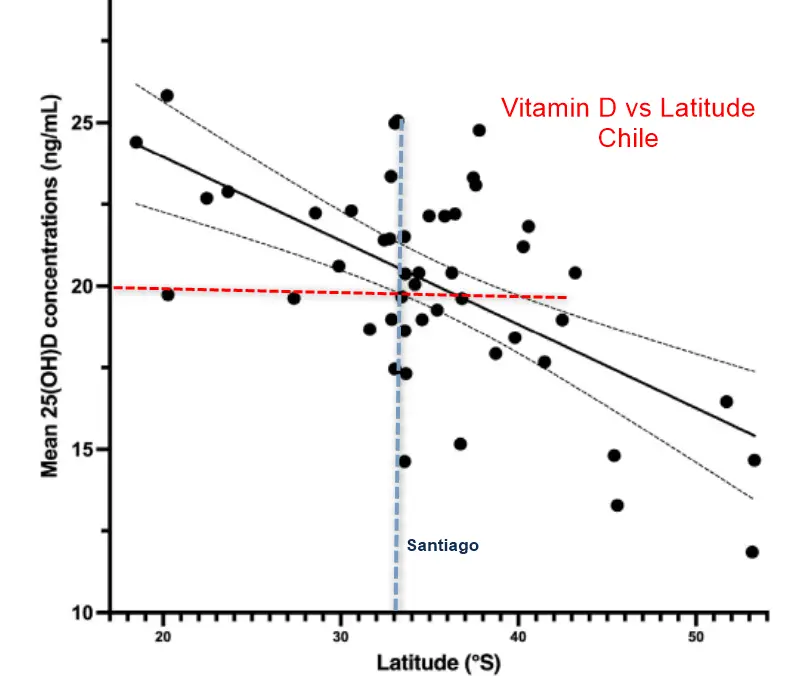
Takeaway: Across 48 Chilean provinces, the lower the average vitamin D level, the higher the death rate from many specific cancers. After adjusting for BMI and smoking, 21 of 27 cancer types had significant inverse associations. The strongest were endometrial, thyroid, colorectal, liver, kidney, and larynx. There were no significant positive associations.
Study: Ecological (population-level) study of 446,237 cancer deaths in 2002–2020. Chile spans 17°S to 56°S, and its provincial mean 25(OH)D ranged from 11.8 to 25.8 ng/mL. Vitamin D was measured by LC-MS in 1,567 women aged 15–49 (2017 national survey; national mean 20.1 ng/mL). Vitamin D dropped 0.26 ng/mL per degree of latitude (r = −0.61).
Size of effect: Each 1 ng/mL higher provincial 25(OH)D was linked to about 0.2 fewer colorectal cancer deaths per 100,000. Across the observed 14 ng/mL spread, that works out to roughly 2.8 per 100,000 (editor's estimate). Colorectal death rates run about 6–11 per 100,000, so this is sizable. In women, estimates were about twice as large for endometrial, thyroid, and kidney cancer.
Authors' interpretation: About half the provinces averaged below 20 ng/mL, the range where earlier cohorts found the most risk. The authors suggest the target is "correcting VD deficiency, rather than maximizing 25(OH)D concentrations beyond sufficiency." They argue VITAL and D-Health found little because participants already averaged about 30 ng/mL. Chile began national vitamin D food fortification in June 2026, so this study serves as a baseline.
What this does NOT show / limitations
- Ecological associations between provinces cannot show that any individual's vitamin D level affected their cancer risk.
- Vitamin D came from one 2017 blood survey of young women only. It was used as a proxy for both sexes and all ages over 18 years of deaths, most of them in people over 60.
- Provincial samples were small (mean 34 people), and the survey was not designed to represent each province.
- There was no adjustment for income, education, healthcare access, diet, or ancestry, all of which also vary with latitude.
- 81 tests were run without correction for multiple comparisons.
- All cancers combined showed NO association (p = 0.74).
- Mortality mixes incidence and survival, so the study can't tell which one vitamin D might affect.
Chile began mandatory vitamin D fortification in June 2026
Since June 2026, all liquid milk, powdered milk, and wheat flour in Chile must contain vitamin D3. [BioBioChile]
- Levels: liquid milk 1 µg (40 IU) per 100 mL; powdered milk 10 µg per 100 g; wheat flour 2.25 µg per 100 g
- Goal: raise average intake by about 400 IU/day and keep more than 90% of Chileans out of severe deficiency (below 12 ng/mL) [El Dínamo]
- Before fortification, 16% of women aged 15–49 and 21% of older adults were severely deficient; in Magallanes (53°S), more than half of women of reproductive age were [The Clinic]
- The law passed in 2022; the start was postponed from 2024 to June 2026 [Decreto 29]
- The policy grew out of 15+ years of advocacy led by Dr. Arturo Borzutzky, the corresponding author of this cancer study [UC Medicina]
Why this matters: This study's 2002–2020 death rates are a pre-fortification baseline. The south, with the least sun and lowest vitamin D, should gain the most. If vitamin D really affects cancer deaths, the south's excess colorectal, breast, and kidney cancer mortality should shrink compared with the north over the coming decade.
Caution: 400 IU/day is a modest dose. It typically raises 25(OH)D by only about 3–5 ng/mL, enough to lift many people out of severe deficiency but far below 30–40+ ng/mL. Any effect on cancer deaths will take years to show and has not been demonstrated.
Related in VitaminDWiki
- Fewer deaths (All-cause, Cardiovascular, Cancer) when Vitamin D levels are above 36 ng
- Cancer incidence and death reduced by both Vitamin D and UVB – Grant
- Vitamin D reduced Breast Cancer mortality in 9 out of 9 studies, yet still no consensus
- Cancer incidence and mortality is decreased if 40-60 ng of Vitamin D