
Reasons why the US consumes the most Ultra-processed food
Perplexity AI Jan 2026
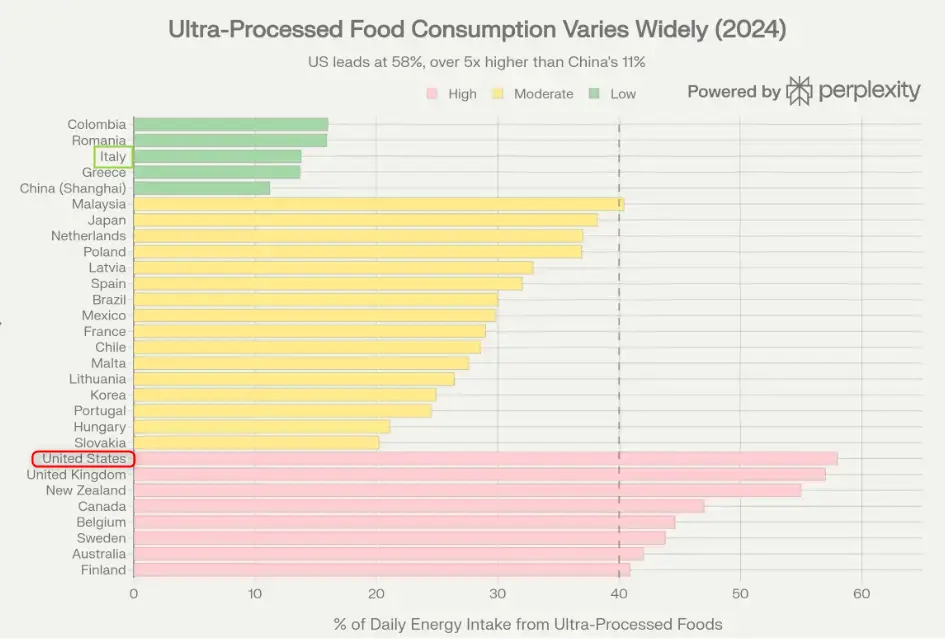
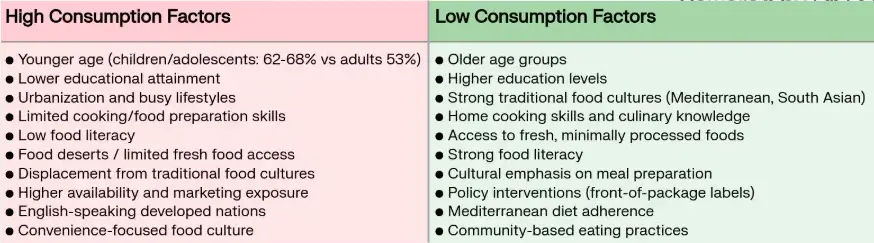
Ultra-processed foods (UPFs)—industrially manufactured products containing ingredients rarely used in home cooking and multiple additives—now dominate food systems worldwide, yet consumption patterns vary dramatically across countries. This analysis reveals stark geographic disparities: high-income English-speaking nations consume 42-58% of daily calories from UPFs, while Mediterranean and South Asian countries maintain consumption below 20%. This five-fold variation reflects complex interactions between economic development, traditional food cultures, policy interventions, and demographic factors. globalfoodresearchprogram
The global landscape divides into three distinct tiers. The United States and United Kingdom lead consumption at 58% and 57% respectively, followed by Canada (47%), New Zealand (55%), Australia (42%), and Sweden (44%). At the opposite extreme, Italy (13.8%), Romania (15.9%), Colombia (16%), and China (11.2%) demonstrate that modernized economies can maintain predominantly traditional diets. Between these extremes lies a middle tier—including much of continental Europe, Latin America, and parts of Asia—where UPFs contribute 20-40% of dietary energy. bmj
Geographic Distribution and Regional Patterns
High-Consumption Nations: The Anglosphere and Nordic Exception
The United States exemplifies the UPF-dominant food system, with 58% of daily energy intake derived from ultra-processed products. This reflects six decades of food industry transformation, aggressive marketing, and cultural normalization of convenience foods. Between 2007 and 2016, UPF consumption increased from 57.6% to 59.7% despite growing public health awareness. The pattern extends across the English-speaking developed world: the United Kingdom (57%), Canada (47%), Australia (42%), and New Zealand (55%) form a distinct high-consumption cluster. globalfoodresearchprogram
Nordic countries present an intriguing exception to European patterns. Despite strong welfare systems and health consciousness, Sweden (43.8%), Finland (40.9%), and Norway (approximately 60%) report consumption levels rivaling or exceeding North American rates. This paradox likely reflects cold-climate limitations on year-round fresh produce availability, making shelf-stable processed foods more economically rational. The contrast with neighboring Denmark and southern European nations suggests climate and food supply infrastructure significantly influence dietary patterns independent of income levels. pmc.ncbi.nlm.nih
Western and Central Europe occupies intermediate territory. Belgium leads at 44.6%, followed by the Netherlands (37%), Germany (37%), and Poland (36.9%). These nations balance traditional food cultures with urbanized, time-constrained lifestyles that favor convenience products. The gradient from northern to southern Europe is striking: while Belgium's UPF consumption approaches Anglo-American levels, Mediterranean nations maintain fundamentally different food systems. brilliantmaps
Mediterranean Europe: Bastions of Traditional Diets
Southern European nations demonstrate that high-income economies need not default to UPF dominance. Italy leads this resistance with just 13.8% of dietary energy from UPFs—a five-fold difference from the United States. Greece (13.7%), Portugal (10.2%), and France (14.2%) similarly preserve traditional dietary patterns centered on fresh, minimally processed ingredients. Spain presents a cautionary tale: consumption has risen from 11% to 32% over recent decades as younger generations adopt Westernized eating patterns. This shift threatens the Mediterranean diet's UNESCO-recognized cultural heritage. pmc.ncbi.nlm.nih
The Mediterranean diet's protective effect against UPF consumption operates through multiple mechanisms. Research among Spanish children found that high adherence to the Mediterranean diet associated with 5-8.5% lower energy intake from UPFs. Olive oil consumption, daily fruit and vegetable intake, frequent fish consumption, and emphasis on home-cooked meals create food environments structurally resistant to ultra-processing. Crucially, 71.6% of variability in free sugar intake stems from UPF consumption, meaning traditional Mediterranean patterns inherently minimize exposure to these products. journals.sagepub
However, even in Italy—the lowest-consuming developed nation—UPF intake increased gradually from 2006-2020, with UPFs contributing 23% of total energy despite representing only 6% of food weight. This demonstrates that no country remains immune to the global nutrition transition, though traditional food cultures provide meaningful buffering. pmc.ncbi.nlm.nih
Latin America: Rapid Transition with Policy Leadership
Latin American countries typically consume 20-30% of daily energy from UPFs—substantially lower than the United States or UK but rising rapidly. Brazil (30%), Mexico (29.8%), and Chile (28.6%) cluster at the upper range, while Colombia (16%) maintains the lowest consumption in the region. Between 2000 and 2013, retail sales of ultra-processed products increased dramatically across 13 Latin American nations, driven by urbanization, foreign investment, and market deregulation. globalfoodresearchprogram
This rapid transition carries profound public health implications. Mexico experienced a 2.7 percentage-point increase in diabetes prevalence (10.8% to 13.5%) between 2000-2013, while Brazil saw a 4 percentage-point rise (6.4% to 10.4%). The ecological correlation between per capita UPF sales and diabetes prevalence invites discussion of causation, though multiple factors contribute to these trends. pmc.ncbi.nlm.nih
Remarkably, Latin America has emerged as the global leader in evidence-based policy responses. Chile pioneered comprehensive front-of-package warning labels in 2016, mandating black octagonal labels on products high in sugar, salt, saturated fat, or calories. The policy's effectiveness exceeded expectations: consumers purchased 24% fewer calories, 37% less salt, and 27% less saturated fat from labeled foods, with 10% reduction in overall sugar consumption. Peru (2019), Uruguay (2020), Mexico (2020), Argentina (2022), Brazil (2022), and Colombia (2022) have since implemented similar systems. novaramedia
Colombia advanced beyond warning labels in 2024 by introducing a broad tax on ultra-processed foods—starting at 10% and rising to 20% in 2025—a global first closely watched by policymakers worldwide. The muscling in by Western firms evokes memories of colonialism for many Latin Americans, accelerating political will for regulatory action. Policymakers view current consumption levels (20-30%) as a last chance to preserve rich traditional food cultures increasingly threatened by globalized agribusiness. novaramedia
Asia: Heterogeneity and Rapid Growth
Asian countries display extraordinary heterogeneity in UPF consumption, reflecting diverse economic development stages, cultural food traditions, and urbanization patterns. Japan (38.2%) and Malaysia (40.4%) approach Western consumption levels, while South Korea (24.9%) occupies middle ground. Southeast Asian nations show wide variation: only 18.9% of commercially produced complementary foods were ultra-processed in Thailand, compared to 60-63% in the Philippines and Vietnam. globalfoodresearchprogram
China presents a complex picture. In Shanghai—an international metropolis potentially aligned with developed nation dietary patterns—UPFs contribute 11.2% of overall energy intake. However, 5.6% of residents obtain ≥42% of calories from UPFs, approaching Western levels. This bimodal distribution suggests simultaneous maintenance of traditional patterns among older populations and rapid adoption by younger, urban professionals. Between 2004-2023, large-scale food manufacturing enterprises in China increased 103.5%, from 4,950 to 10,075. The 28.5% of daily energy from processed foods (excluding condiments) signals significant market penetration. pmc.ncbi.nlm.nih
South Asia maintains the lowest consumption globally among regions with comprehensive data. Among consumers in Bangladesh, Sri Lanka, North India, Pakistan, and South India, UPFs contribute 13-17% of total energy intake. However, consumption prevalence varies dramatically: approximately 75% of participants in Bangladesh, Sri Lanka, and North India reported consuming UPFs during the previous day, compared to just 41% in South India and Pakistan. Biscuits emerge as the common UPF source across regions, with sweetened beverages varying by locality. sciencedirect
The critical factor is growth trajectory. Between 2009-2019, Asian countries topped the list of UPF sales growth: India (7.8%), Pakistan (6.3%), and Indonesia (4.5%) far exceeded stagnant Western markets like Germany (0.0%) and the United States (0.4%). South and Southeast Asia experienced 67.3% increases in UPF volume sales and 120% growth in ultra-processed drinks—the highest globally. This suggests Asian markets, while currently low-consuming, face accelerating nutrition transitions potentially more rapid than Latin America experienced. iatp
Africa and Middle East: Limited Data, Rising Concern
Comprehensive UPF consumption data remains scarce for African countries, though available evidence indicates rising trends. South Africa—not assessed in major multi-country analyses—has experienced a "shockingly steep rise" in consumption. The continent faces a double burden of malnutrition: while approximately 250 million Africans (20% of the population) experience food insecurity, overweight and obesity rates climb as increased food demand flows disproportionately to processed and ultra-processed foods. accesstonutrition
African rural areas, traditionally insulated from processed food markets, now experience rising UPF consumption driven by agricultural mechanization, increased non-farm employment income, and growing opportunity costs of time favoring convenience. Many processed foods are high in sugar, salt, saturated fats, and preservatives, contributing to surging non-communicable diseases including diabetes, cardiovascular disease, and cancer. ifpri
Middle Eastern data is similarly limited. Jordan provides a data point: UPFs account for approximately 40% of caloric intake among children and adolescents. Lebanon shows even higher consumption at 49.9% for school-age children and adolescents. A study across five Mediterranean countries (including Egypt) found that children and adolescents display "preeminent" unhealthy UPF consumption associated with overall unhealthy lifestyles. pmc.ncbi.nlm.nih
Demographic Patterns and Vulnerable Populations
Age: The Youth Ultra-Processing Gap
Age represents the strongest demographic predictor of UPF consumption globally. American youth ages 1-18 consume 61.9% of daily calories from UPFs compared to 53.0% for adults 19 and older—an 8.9 percentage-point gap. British adolescents reach 68% UPF consumption, while younger children approach these levels. This pattern persists across countries: longitudinal studies in seven nations found UPF intake ranging from 18% of total calories (children in Colombia) to 68% (adolescents in the United Kingdom). globalfoodresearchprogram
The age gradient operates consistently. In France, UPF consumption decreased with age across all adult cohorts. Brazilian, Chilean, and Mexican studies replicate this finding. Multiple mechanisms drive youth vulnerability. Younger individuals demonstrate greater sensitivity to industrial marketing and heavily promoted products. Adolescents lack fully developed prefrontal cortex regions governing impulse control and long-term planning, making hyperpalatable foods particularly appealing. School food environments often prioritize convenience and cost over nutritional quality. Finally, generational dietary socialization increasingly normalizes UPFs as default rather than exceptional food choices. journals.sagepub
The public health implications are profound. Early socialization to unhealthy discretionary foods and UPFs potentially establishes lifelong dietary preferences favoring high sugar and excess sodium. A microsimulation study estimated that reducing UPFs in American children's diets could decrease overweight prevalence from 37% to 21% and obesity from 20% to 11% among 7-18 year-olds. Larger BMI and weight reductions would occur among boys, adolescents, non-Hispanic Black and Hispanic youth, and those with lower parental education and family income. pubmed.ncbi.nlm.nih
Socioeconomic Status: Complex and Context-Dependent
Unlike many health behaviors showing clear socioeconomic gradients, UPF consumption demonstrates complex, context-dependent patterns varying by country and measurement approach. In the United States, consumption shows modest inverse association with income and education: college-educated individuals consume slightly fewer UPFs, and consumption decreases mildly with income. However, the gradient is surprisingly small given stereotypes about "junk food" and poverty. Non-Hispanic Black and White Americans show highest consumption (approximately 60%), while Hispanic and other groups consume 53.5-57.7%. bmjopen.bmj
The United Kingdom displays clearer socioeconomic patterning. Adults of lower socioeconomic status—indicated by occupational class, household income, educational attainment, and neighborhood deprivation—demonstrate increased UPF consumption. This likely reflects "food deserts" in low-income neighborhoods, where ultra-processed foods dominate available options while fresh, minimally processed alternatives remain expensive or inaccessible. resolve.cambridge
Conversely, in Chile and Mexico, UPF consumption increases with income and socioeconomic status. Chilean consumption rose from 25.8% to 30.1% across income quintiles. This pattern reflects early-stage nutrition transitions where processed foods signal modernity and upward mobility. As Western-style products penetrate middle-income markets, wealthier households initially adopt them as status markers before health consciousness later reverses the gradient—a phenomenon observed historically in high-income countries. bmjopen.bmj
Brazil demonstrates regional heterogeneity: some areas show higher SES associated with higher UPF intake, while others show no clear pattern. This within-country variation underscores that local food environments, cultural factors, and stage of economic development interact complexly with individual socioeconomic position. pmc.ncbi.nlm.nih
Education consistently shows stronger associations than income. Lower educational attainment predicts higher UPF consumption across most studied populations. This likely operates through food literacy, nutritional knowledge, cooking skills, and capacity to navigate complex food environments. Individuals with higher education possess better tools to critically evaluate marketing claims, understand nutrition labels, and prepare meals from whole ingredients—skills that substantially reduce UPF reliance. pmc.ncbi.nlm.nih
Gender and Household Factors
Gender shows minimal association with UPF consumption in most populations. Large American studies found no significant sex differences. Where small differences emerge, they typically show women consuming slightly more UPFs (approximately 0.7 percentage points in one study). However, these differences pale compared to age and education effects. bmjopen.bmj
Marital status and household composition show modest associations. Among South Asian consumers, married or cohabiting individuals consumed fewer UPFs than single people across all regions. This likely reflects shared meal preparation, social eating norms, and household economies of scale favoring cooking from whole ingredients. Urban-rural residence shows inconsistent patterns varying by country context. pubmed.ncbi.nlm.nih
Protective Factors: What Shields Populations from Ultra-Processing?
Traditional Food Cultures and Culinary Heritage
The most powerful defense against UPF dominance appears to be robust traditional food cultures emphasizing fresh ingredients, home cooking, and communal eating. Mediterranean dietary patterns—characterized by olive oil, vegetables, fruits, nuts, legumes, minimally processed cereals, moderate fish consumption, and limited meat—structurally resist ultra-processing. These patterns don't simply avoid UPFs; they create food systems where ultra-processing finds no ecological niche. journals.sagepub
Evidence from Spanish children demonstrates this protection quantitatively. Those with high versus low Mediterranean diet adherence reported 8.5% lower energy intake from UPFs (95% CI: 5.2-11.9%). The relationship operates bidirectionally: high UPF consumption associates with lower fruit, vegetable, and legume intake, creating a nutritional displacement effect. Importantly, Mediterranean diet adherence predicts not only lower UPF consumption but also reduced free sugar intake, as 71.6% of free sugar variability derives from UPF consumption. pmc.ncbi.nlm.nih
Similar protective effects emerge from other traditional food cultures. Canadian adults from racial and ethnic minority groups—maintaining cultural food practices from nations with traditional cuisines—showed higher diet quality and lower UPF intake than White adults between 2004-2015. These communities retained healthful aspects of traditional food practices despite living in UPF-saturated food environments. Conversely, Indigenous Canadians—experiencing displacement from traditional lands and foods—showed higher UPF intake and lower diet quality. This tragic contrast illustrates how traditional food systems provide tangible public health protection when maintained but leave populations vulnerable when disrupted. pmc.ncbi.nlm.nih
Cooking Skills and Food Literacy
Food literacy—encompassing knowledge, skills, and behaviors required to select, prepare, and consume food healthily—powerfully predicts UPF consumption independent of demographics. Individuals with strong culinary skills, production and quality knowledge, selection and planning ability, and environmental safety awareness consume significantly fewer UPFs. This relationship operates mechanistically: UPFs require minimal culinary knowledge or preparation skills, creating an unhealthy default for those lacking cooking competency. pmc.ncbi.nlm.nih
Research among Turkish young adults found high cooking and food preparation skills significantly associated with Mediterranean diet adherence and reduced UPF consumption. These skills don't merely enable healthier choices; they fundamentally alter individuals' relationships with food. Those comfortable preparing meals from whole ingredients perceive cooking as efficient and enjoyable rather than burdensome. They recognize quality differences between fresh and ultra-processed alternatives. They possess confidence to experiment with vegetables, legumes, and whole grains that intimidate less skilled cooks. pmc.ncbi.nlm.nih
Conversely, inadequate cooking skills create dependency on products requiring minimal preparation. This dependency extends beyond individual meals to shape shopping patterns, budget allocation, and intergenerational food socialization. Children raised in households relying on UPFs never develop practical cooking skills or taste preferences for minimally processed foods, perpetuating the cycle.
Policy Interventions: The Latin American Model
Latin America has pioneered the most comprehensive and evidence-based policy approaches to reducing UPF consumption globally. Chile's 2016 legislation combined front-of-package warning labels with complementary measures addressing marketing, school food, and public procurement. The warning label system—featuring black octagonal labels stating "HIGH IN" sugar, salt, saturated fat, or calories—proved remarkably effective. pmc.ncbi.nlm.nih
Consumer behavioral changes exceeded expectations. Purchases of labeled products decreased 24% for calories, 37% for salt, and 27% for saturated fat, with 10% reduction in overall sugar consumption. Critically, effects operated across socioeconomic and education levels, preventing elite capture common to many public health interventions. The labels shifted social norms and attitudes toward nutritious food purchasing beyond immediate label-reading effects. novaramedia
Manufacturers responded with product reformulation to avoid warning labels, creating a secondary benefit. Many products reduced sugar, salt, and saturated fat content to fall below thresholds requiring labels. While some substituted non-sugar sweeteners (raising separate concerns), the aggregate nutritional profile improved. This demonstrated that well-designed policies can catalyze industry reformulation more effectively than voluntary approaches. pmc.ncbi.nlm.nih
Chile's comprehensive package included restricting cartoon characters and child-targeted marketing on labeled products, prohibiting labeled products in schools, and limiting their advertisement during child programming. Argentina and Mexico adopted additional restrictions on health claims and endorsements for products featuring warnings. Peru, Uruguay, Mexico, Argentina, Brazil, and Colombia have implemented similar systems between 2019-2022, creating a regional policy corridor. openknowledge.fao
Colombia's 2024 innovation—introducing a broad 10% tax on ultra-processed foods (rising to 20% in 2025)—represents a global first extending beyond sugar-sweetened beverage taxes. Modeling from Mexico projected that warning labels alone could reduce obesity prevalence 14.7% between 2018-2023 and save $1.8 billion in obesity-related costs. Combined taxation and labeling approaches may prove synergistic, though implementation challenges remain. novaramedia
Crucially, Latin American policymakers explicitly frame UPF regulation as protecting traditional food cultures from displacement by transnational corporations—a lens resonating with post-colonial consciousness and mobilizing political will. This framing contrasts with individual responsibility paradigms dominating Anglo-American food policy discourse. novaramedia
The Nutrition Transition: Growth Dynamics and Future Trajectories
Mature Versus Emerging Markets
Global UPF sales exhibit a striking pattern: consumption remains high or stable in mature high-income markets while growing explosively in low- and middle-income countries. Between 2007-2022, high-income countries maintained stable UPF consumption around 50-60% of dietary energy, having reached saturation decades earlier. Growth in these markets comes primarily from premium segments (organic UPFs, plant-based alternatives) rather than volume expansion. accesstonutrition
Lower-middle-income countries experienced 40% increases in UPF consumption over this period, upper-middle-income countries saw 20% growth, and Uganda—the only low-income country assessed—increased 60%. This differential growth creates a converging global dietary pattern where country-specific traditional foods increasingly become minority components of national diets. accesstonutrition
Sales data confirm this trajectory. Between 2002-2016, UPF volume sales increased 67.3% in South and Southeast Asia and 57.6% in North Africa and the Middle East, compared to stable or declining sales in Western Europe and North America. Ultra-processed drink sales grew 120% in South and Southeast Asia—the highest globally. India (7.8%), Pakistan (6.3%), and Indonesia (4.5%) led national growth rates for ultra-processed foods, while Germany (0.0%) and the United States (0.4%) approached zero growth. iatp
Drivers of the Global Transition
Multiple interlocking forces drive the global shift toward UPF-dominant diets. Urbanization creates populations disconnected from agricultural production and traditional food procurement systems. Time scarcity—particularly affecting dual-income households and women entering formal labor markets—increases opportunity costs of meal preparation, making convenience foods economically rational choices. Rising disposable incomes in emerging economies enable purchases previously unaffordable. technavio
Food system industrialization concentrates market power among transnational corporations whose profitability depends on branded, processed products with high markup potential. Fresh fruits, vegetables, and staple grains offer minimal differentiation and low margins. UPFs enable proprietary formulations, brand loyalty, and premium pricing through perceived value addition. Consequently, corporations invest heavily in UPF marketing while fresh food promotion remains largely absent. onlinelibrary.wiley
Retail transformation accelerates penetration. Traditional markets, street vendors, and small grocers give way to supermarkets and hypermarkets stocking primarily packaged goods with standardized supply chains. This retail modernization makes fresh, locally-produced foods relatively less accessible while flooding consumers with shelf-stable processed alternatives. pmc.ncbi.nlm.nih
Globalization enables efficient sourcing of cheap commodity ingredients (vegetable oils, high-fructose corn syrup, modified starches, protein isolates) and additives that form UPF foundations. A limited ingredient base—wheat, soy, corn, sugar, vegetable oil, milk—undergoes intensive industrial transformation to generate thousands of differentiated products. This monoculture focus reduces crop diversity, increasing agricultural vulnerability while generating profitable brand portfolios. iatp
Public Health and Environmental Implications
Health Burden Quantification
The association between UPF consumption and adverse health outcomes is now firmly established through multiple lines of evidence. A meta-analysis pooling results from five studies with over 1,000,000 participants found 70% greater risk of developing Crohn's disease among highest versus lowest UPF consumers. UK participants consuming highest percentages of calories from UPFs showed double the Crohn's disease risk and three-to-four times the likelihood during 10-year follow-up. globalfoodresearchprogram
Cardiovascular effects are substantial. Those with highest UPF consumption face 50-68% higher risk of death from cardiovascular and heart diseases and 25-28% greater all-cause mortality risk. Every 10% increase in UPF proportion of diet associated with 13% greater overall cancer risk, 19% greater ovarian cancer risk, and elevated colorectal cancer risk in women. Type 2 diabetes risk increases 40-56% among highest versus lowest consumers across multiple populations. technavio
Obesity and metabolic syndrome show consistent associations. Among Spanish adults over 60, highest versus lowest UPF consumers had double the odds of high triglycerides or low HDL cholesterol. Brazilian adults showed 26-38% greater odds of developing various dyslipidemia patterns. A NIH randomized controlled trial found participants consuming ultra-processed versus minimally processed diets ad libitum consumed 500 additional calories daily and gained 0.9 kg over two weeks, while the minimally processed group lost 0.9 kg. globalfoodresearchprogram
Mental health outcomes extend beyond physical disease. Large prospective studies link UPF consumption to increased depression, anxiety, and common mental disorders. Older adults show tripled frailty risk and accelerated grip strength decline—a predictor of physical disability—with high UPF intake. The breadth of adverse associations suggests ultra-processing itself, beyond specific nutrients, undermines health through mechanisms including disrupted appetite regulation, altered gut microbiome, inflammatory pathways, and addictive design features. foodnavigator-asia
Environmental and Agricultural Consequences
UPF production and consumption drive interconnected ecological crises. The limited ingredient base—focusing on wheat, soy, corn, and vegetable oils—promotes monoculture agriculture with severe environmental consequences. In Brazil, rice and bean production dropped 43% and 30% respectively between 2008-2019, while soy production (for livestock feed and UPFs) increased 70%. This displacement reduces crop diversity, traditional foodways, and agricultural resilience while increasing vulnerability to pests, diseases, and climate change. globalfoodresearchprogram
400 liters of water to produce 1 liter of sugary drink
UPF supply chains require enormous energy and land inputs, causing substantial greenhouse gas emissions, land degradation, biodiversity loss, and plastic pollution. Water footprints are massive: an estimated 336-618 liters of water produce a single 1-liter regular sugary drink. The water footprint attributable to UPFs in Brazilian diets increased 233% from 1987-2018. Dietary patterns with highest UPF content show largest impact on water scarcity from foods in adult daily diets (24.6%). acbio.org
Packaging waste from individually wrapped, shelf-stable products contributes disproportionately to plastic pollution. Many additives and packaging materials themselves present environmental hazards through persistence and bioaccumulation. The industrial processing requires fossil fuel energy far exceeding that needed for fresh food distribution, contributing to climate change while increasing food system fragility as energy costs fluctuate.
Conclusions and Implications
Ultra-processed food consumption varies five-fold globally, from below 15% of dietary energy in Mediterranean and South Asian countries to above 50% in English-speaking developed nations and Nordic countries. This variation demonstrates that high-income economies need not default to UPF dominance; traditional food cultures, cooking skills, and evidence-based policies provide meaningful protection.
However, the trajectory is concerning. While high-income countries maintain stable consumption at saturated levels, low- and middle-income nations experience explosive growth. Asia leads with 67.3% increases in UPF volume sales and 120% growth in ultra-processed drinks over 15 years. Without intervention, global diets may converge toward the American pattern, where nearly 60% of calories derive from ultra-processed products—a prospect with catastrophic public health and environmental implications.
Demographic patterns reveal particular vulnerability among youth (consuming 62-68% of calories from UPFs), those with limited education and cooking skills, and populations experiencing displacement from traditional food systems. The Mediterranean diet and similar traditional patterns demonstrate that cultural emphasis on fresh ingredients, home cooking, and communal eating creates structural resistance to ultra-processing beyond individual willpower.
Latin America's pioneering policy approaches—particularly Chile's comprehensive front-of-package warning labels combined with marketing restrictions and school food regulations—provide evidence-based models achieving measurable impact. The 24% reduction in purchases of high-sugar/salt/fat products and 10% overall sugar reduction demonstrate policy effectiveness. Colombia's taxation approach and Brazil's reformulated guidelines recommending UPF avoidance extend the policy toolkit.
For countries currently maintaining low UPF consumption, the priority is prevention: protecting traditional food cultures, supporting small-scale agriculture, resisting transnational corporate market penetration, and implementing warning labels before consumption rises. For high-consuming nations, the challenge is reversal: denormalizing ultra-processed foods, rebuilding cooking skills across generations, restructuring food environments to favor fresh foods, and implementing comprehensive policy packages addressing availability, affordability, and marketing.
The stakes extend beyond individual health to encompass agricultural biodiversity, climate change, cultural heritage, and food sovereignty. As traditional foodways disappear, humanity loses not only nutritional wisdom accumulated over millennia but also agricultural diversity essential for climate adaptation. The choice between fresh, minimally processed foods and ultra-processed alternatives represents a fundamental question about what food systems serve: human and planetary health, or corporate profit maximization. Current consumption patterns—and especially growth trajectories in emerging economies—suggest the latter increasingly dominates, with consequences we are only beginning to understand.