
Trans Fat: almost a century from first noticing problems to widespread bans
Trans fats are unsaturated fatty acids with at least one double bond in the trans configuration. The harmful kind in the food supply is industrially produced: liquid vegetable or fish oils are treated with hydrogen gas (partial hydrogenation) to make them semi-solid, cheap, and shelf-stable.
German chemist Wilhelm Normann found in the early 1900s that liquid oils could be treated with hydrogen to make them solid, and partially hydrogenated oils quickly became popular as margarine, shortening, and frying oils — versatile, long-lasting, and cheaper than butter, tallow, or lard. A small amount also occurs naturally via bacterial biohydrogenation in ruminant animals, so dairy and meat fat contain trace trans fat — but those aren't the regulatory target. The health problem is specific: trans fat raises LDL ("bad") cholesterol while lowering HDL ("good") cholesterol, plus it promotes inflammation and endothelial damage, driving coronary heart disease.
Timeline
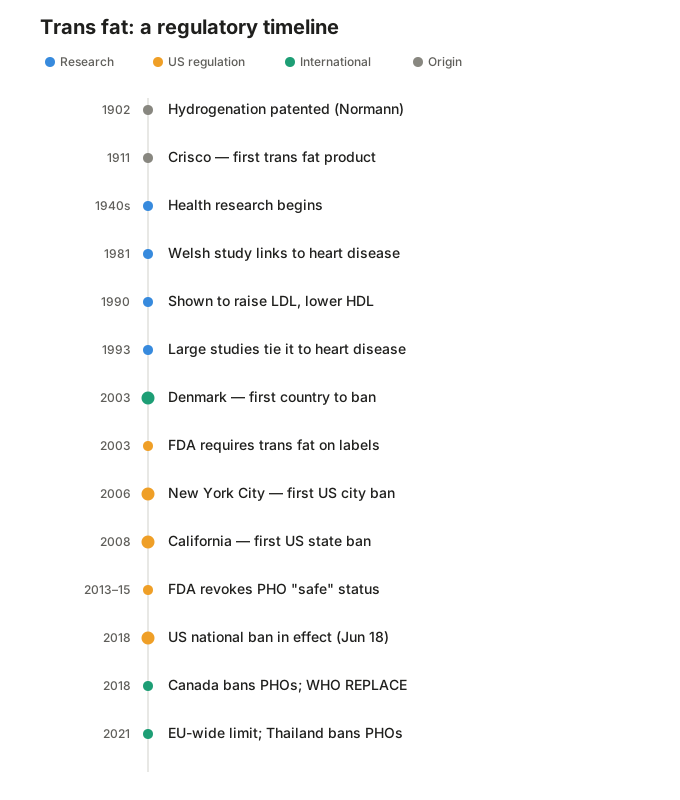
Research origin. Concern over the health impacts of trans fats first emerged in the 1940s, and by the late 1950s scientists had demonstrated a link between saturated fat intake and heart disease — though that early link was contested. The modern case sharpened in 1981, when a group of Welsh researchers speculated that trans fats from partially hydrogenated oils might be linked with heart disease. Then in 1990, Korver and Katan's study showed that trans fats lower HDL and raise LDL cholesterol, and in the early 1990s, the Nurses' Health Study found women with the highest trans fat intake had a 35% higher risk of coronary heart disease than those with the lowest.
First country ban. Denmark pioneered the banning of industrially produced trans fats in 2003, becoming the first country to do so. Executive order 160 took effect March 31, 2003, forbidding the sale of foods with a trans fat content above 2 percent of total fat or oil (naturally occurring trans fat in meat and dairy was exempt). It's sometimes dated to 2004 because that's when it took full force. The payoff was measurable: in the three years after the policy, CVD mortality fell by about 14.2 deaths per 100,000 people per year relative to a synthetic control group.
US cities and states. The first US move was actually voluntary — in 2004 the 18 restaurants in Tiburon, California voluntarily stopped using trans fat cooking oils, making it the first American town to go trans-fat-free. The first regulatory city ban came next: New York City became the first US city to ban trans fats in restaurants in December 2006, capping foods at 0.5 grams per serving. It phased in two stages — frying oils and spreads by July 1, 2007, and all foods by July 1, 2008. Philadelphia followed on February 8, 2007, with Seattle, Baltimore, and Montgomery County (MD) among others. Then California became the first US state to pass a restaurant trans fat ban, in 2008 — signed by Governor Schwarzenegger, taking effect for frying and spreads in 2010 and extending to baked goods in 2011.
US national ban. The FDA moved slowly. On July 11, 2003 it required manufacturers to list trans fat on the Nutrition Facts panel (compliance by January 2006). The actual ban came through revoking "safe" status: in November 2013 the FDA preliminarily determined that partially hydrogenated oils were no longer "generally recognized as safe" (GRAS); it finalized that in June 2015 and gave companies until June 18, 2018 to eliminate artificial trans fats.
Bans elsewhere. Switzerland followed Denmark starting in April 2008. Canada banned partially hydrogenated oils effective September 15, 2018, and Thailand's total PHO ban took effect June 1, 2021. The WHO launched its REPLACE initiative in 2018 to drive global elimination; by the end of 2019, 28 countries had implemented mandatory trans fat limits or PHO bans, with another 24 enacting limits to follow. The EU adopted a union-wide cap of 2 grams of industrial trans fat per 100 grams of fat, applicable from April 2021.