
Tinnitus 7X less likely if more than 30 ng of Vitamin D
Levels of 25-hydroxyvitamin D3 in individuals with primary subjective tinnitus and their associations with tinnitus occurrence and severity
Front. Neurol., 11 January 2026 https://doi.org/10.3389/fneur.2025.1751366
Hungary
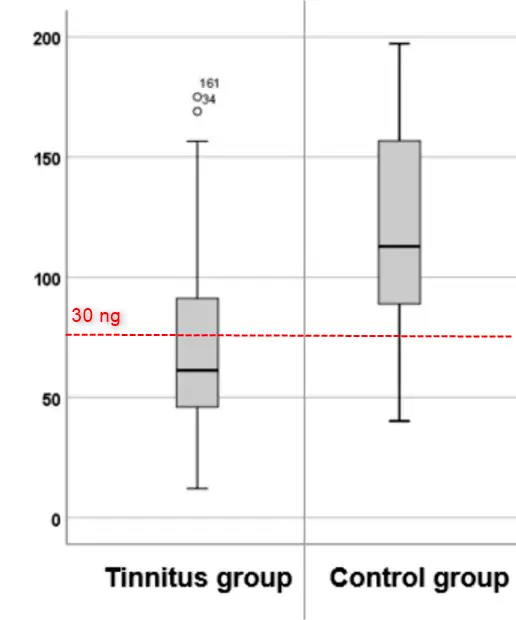
Objective: This study aimed to analyze vitamin D3 levels in both a tinnitus group and a control group.Materials and methods: A total of 350 patients with primary subjective tinnitus and 347 participants serving as a control group were examined. All patients underwent an otorhinolaryngological examination, audiological testing, and laboratory testing, including measurements of 25-hydroxyvitamin D3 levels.
Results: The prevalence of low 25-hydroxyvitamin D3 levels was significantly (p < 0.00001) higher in the tinnitus group (53.2%) compared to the control group (31.7%). Furthermore, when comparing the specific levels of 25-hydroxyvitamin D3 between the tinnitus and control groups, a statistically significant difference was observed (p < 0.00001), with lower levels found in the tinnitus group. Additionally, according to a logistic regression model, lower levels of 25-hydroxyvitamin D3 significantly predicted the occurrence of tinnitus (p = 0.000; OR: 0.132, 95% CI = 0.066–0.264). Additionally, it was found to be associated with moderately severe and severe tinnitus (p = 0.021; OR: 1.800, 95% CI = 0.806–4.022) and the development of chronic tinnitus (p = 0.001; OR: 0.717, 95% CI = 0.384–1.340). Moreover, ROC analysis indicated that lower levels of 25-hydroxyvitamin D3 are significant predictors of tinnitus (p = 0.000, 95% CI = 0.702–0.815), showing a sensitivity of 75.8%.
Conclusion: The notably lower levels of 25-hydroxyvitamin D3 suggest its potential role in the development of tinnitus. Additionally, proper supplementation of vitamin D3 could lead to new therapeutic approaches for managing tinnitus.
Related in VitaminDWiki
- Tinnitus is treated by Magnesium and perhaps Zinc or Vitamin D
- Many ear problems are strongly associated with low vitamin D – meta-analysis