
Tender skull, tender muscles, sensitized brain – how low vitamin D may help headaches become chronic
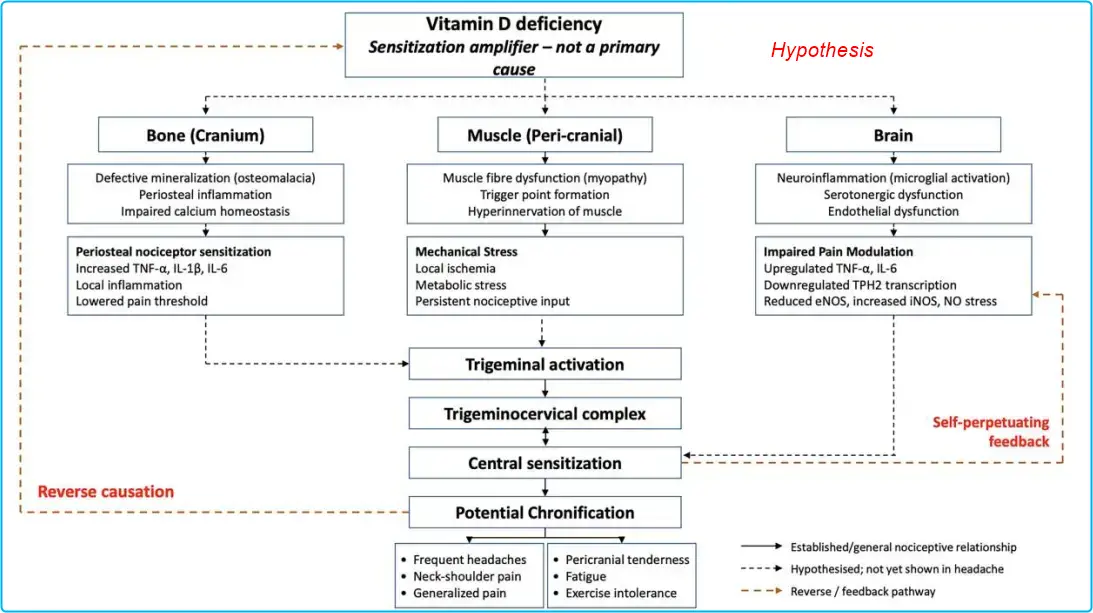
The bone–muscle–brain axis: Vitamin D deficiency as a sensitization amplifier in headache chronification
Cephalalgia Reports (SAGE), Nov 2026, https://doi.org/10.1177/25158163261509286
Sanjay Prakash, Manju Yadav
Summary by Claude Opus 5.5 - November 2026
Takeaway: Two Indian neurologists who have studied vitamin D and headache since 2009 propose that low vitamin D does not directly cause migraine or tension-type headache. Instead it "acts as a sensitization amplifier rather than a primary cause of headache," lowering pain thresholds in three places at once so that occasional headaches more easily become chronic.
Study type: Peer-reviewed viewpoint (hypothesis paper). No new patients or data, and not a systematic review.
The three proposed domains
- Bone – long-standing deficiency causes osteomalacia (poorly mineralized, tender bone). The authors suggest the skull may be affected too, irritating its richly innervated outer lining ("osteomalacic cephalalgia"), an idea from their 2009 patients whose headaches improved with vitamin D.
- Muscle – low vitamin D impairs muscle energy and calcium handling, overlapping with the biology of trigger points in neck and scalp muscles. Deficient rats developed deep-muscle hypersensitivity before any muscle wasting.
- Brain – vitamin D receptors sit in headache-related regions (hypothalamus, thalamus, periaqueductal gray); deficiency may increase neuroinflammation and weaken the brain's pain-dampening pathways.
Pain input from bone and muscle and a sensitized brain may then feed each other.
Supporting human data come mainly from the authors' own clinic. In their 2026 study of 150 people (50 chronic migraine, 50 episodic, 50 controls), chronic migraine had 3.6× the odds of deficiency (<30 ng/mL), and lower vitamin D went with more muscle tenderness Prakash 2026. An Italian clinic also found deficiency more common in chronic migraine Rebecchi 2021.
What this does NOT show
- It is a hypothesis – none of the three pathways has been proven in headache patients.
- Most bone and muscle evidence comes from one research group, and supplementation evidence is largely uncontrolled.
- Tenderness is non-specific; reverse causation and confounding (fibromyalgia, depression, poor sleep, obesity, less activity) remain possible.
- No dose, form, or target 25(OH)D level was tested; the authors say the model alone does not justify routine testing or supplementation for headache.
Sources:
Related in VitaminDWiki
- Headache category (includes Prakash 2013 hypothesis and 2016 case reports)
- Vitamin D and Migraine
- Headaches vary with latitude and season and perhaps vitamin D as well
- Migraine headaches cut in half by 4,000 IU of vitamin D – RCT
- Migraine headaches reduced with 50,000 IU vitamin D weekly – RCT
- Overview Pain and Vitamin D