
Skin can create and activate vitamin D – kidney not needed
Targeting the vitamin D endocrine system (VDES) for the management of inflammatory and malignant skin diseases: An historical view and outlook.
Rev Endocr Metab Disord. 2016 Jul 22. [Epub ahead of print]
Reichrath J1, Zouboulis CC2, Vogt T3, Holick MF4.
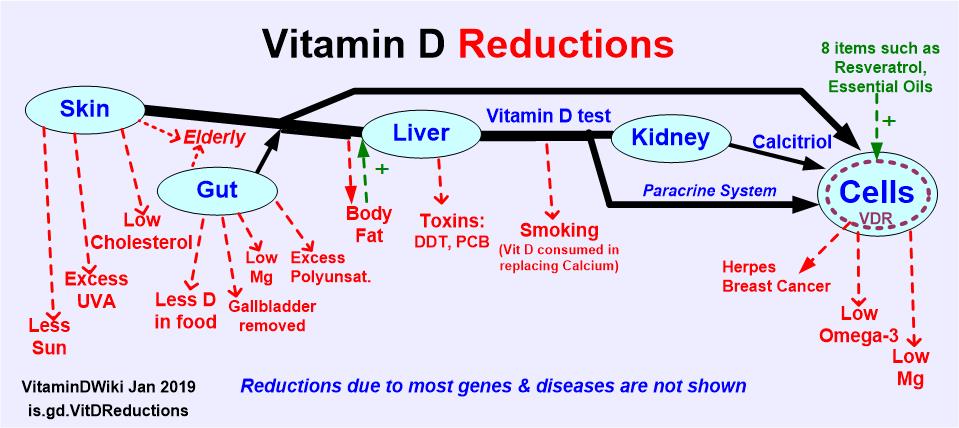 click on image for details
Vitamin D represents one of the major driving factors for the development of life on earth and for human evolution. While up to 10-20 % of the human organism's requirements in vitamin D can be obtained by the diet (under most living conditions in the USA and Europe), approximately 90 % of all needed vitamin D has to be photosynthesized in the skin through the action of the sun (ultraviolet-B (UV-B)).
The skin represents a key organ of the human body's vitamin D endocrine system (VDES), being both
the site of vitamin D synthesis and a
target tissue for biologically active vitamin D metabolites.
It was shown that human keratinocytes possess the enzymatic machinery (CYP27B1) for the synthesis of the biologically most active natural vitamin D metabolite 1,25-dihydroxyvitamin D3 (1,25(OH)2D3), representing an autonomous vitamin D3 pathway.
Cutaneous production of 1,25(OH)2D3 may exert intracrine, autocrine, and paracrine effects on keratinocytes and on neighboring cells. Many skin cells (including keratinocytes, sebocytes, fibroblasts, melanocytes, and skin immune cells) express the vitamin D receptor (VDR), an absolute pre-requisite for the mediation of genomic effects of 1,25(OH)2D3 and analogs. VDR belongs to the superfamily of trans-acting transcriptional regulatory factors, which includes the steroid and thyroid hormone receptors as well as the retinoid X receptors (RXR) and retinoic acid receptors (RAR). Numerous studies, including cDNA microarray analyses of messenger RNAs (mRNAs), indicate that as many as 500-1000 genes may be regulated by VDR ligands that control various cellular functions including growth, differentiation, and apoptosis.
The observation that 1,25(OH)2D3 is extremely effective in inducing the terminal differentiation and in inhibiting the proliferation of cultured human keratinocytes has resulted in the use of vitamin D analogs for the treatment of psoriasis. This review gives an historical view and summarizes our present knowledge about the relevance of the VDES for the management of inflammatory and malignant skin diseases.
KEYWORDS::Melanoma; Psoriasis; Skin; Skin cancer; Skin diseases; Vitamin D; Vitamin D endocrine system; Vitamin D receptor
PMID: 27447175
Publisher wants 40 dollars for the PDF
1.
Mason RS, Reichrath J. Sunlight vitamin D and skin cancer. Anti Cancer Agents Med Chem. 2013;13:83–97. doi:10.?2174/?1871520138044872?72.CrossRef
2.
Holick MF. Vitamin D deficiency. N Engl J Med. 2007;357:266–81. doi:10.?1056/?NEJMra070553.CrossRefPubMed
3.
Reichrath J. Vitamin D and the skin: an ancient friend, revisited. Exp Dermatol. 2007;16:618–25.CrossRefPubMed
4.
Saternus R, Pilz S, Gräber S, Kleber M, März W, Vogt T, et al. A closer look at evolution: variants (SNPs) of genes involved in skin pigmentation, including EXOC2, TYR, TYRP1, and DCT, are associated with 25(OH)D serum concentration. Endocrinology. 2015;156:39–47.CrossRefPubMed
5.
Rossberg W, Saternus R, Wagenpfeil S, Kleber M, März W, Vogt Th, et al. Skin pigmentation, cutaneous vitamin D synthesis and evolution: variants of genes (SNPs) involved in skin pigmentation are associated with 25(OH)D serum concentration. Anticancer Res. 2016.
6.
Matsumoto K, Azuma Y, Kiyoki M, Okumura H, Hashimoto K, Yoshikawa K. Involvement of endogenously produced 1,25-dihydroxyvitamin D-3 in the growth and differentiation of human keratinocytes. Biochim Biophys Acta. 1991;1092:311–8.CrossRefPubMed
7.
Prystowsky JH, Muzio PJ, Sevran S, Clemens TL. Effect of UVB phototherapy and oral calcitriol (1,25-dihydroxyvitamin D3) on vitamin D photosynthesis in patients with psoriasis. J Am Acad Dermatol. 1996;35:690–5.CrossRefPubMed
8.
Lehmann B, Genehr T, Knuschke P, Pietzsch J, Meurer M. UVB-induced conversion of 7-dehydrocholesterol to 1a,25-dihydroxyvitamin D3 in an in vitro human skin equivalent model. J Invest Dermatol. 2001;117:1179–85.CrossRefPubMed
9.
Lehmann B, Sauter W, Knuschke P, Dreßler S, Meurer M. Demonstration of UVB-induced synthesis of 1a,25-dihydroxyvitamin D3 (calcitriol) in human skin by microdialysis. Arch Dermatol Res. 2003;295:24–8.PubMed
10.
Vatieghem K, Dehaes P, Bouillon R, Segaert S. Cultured fibroblasts produce non-active vitamin D metabolites that can be activated by cultured keratinocytes. In: Abstracts Twelfth Workshop on Vitamin D, July 6-10, 2003, Maastricht, The Netherlands, page 27.
11.
Bittiner B, Bleehen SS, Mac NS. 1a-25-(OH)2 vitamin D3 increases intracellular calcium in human keratinocytes. Br J Dermatol. 1991;124:12230–5.CrossRef
12.
MacLaughlin JA, Cantley LC, Holick MF. 1,25(OH)2D3 increases calcium and phosphatidylinositol metabolism in differentiating cultured human keratinocytes. J Nutr Biochem. 1990;1:81–7.CrossRefPubMed
13.
Reichrath J, Reichrath S, Heyne K, Vogt T, Roemer K. Tumor suppression in skin and other tissues via cross-talk between vitamin D- and p53-signaling. Front Physiol. 2014;5:166. doi:10.?3389/?fphys.?2014.?00166.CrossRefPubMedPubMedCentral
14.
Haussler MR, Whitfield GK, Kaneko I, Haussler CA, Hsieh D, Hsieh JC, et al. Molecular mechanisms of vitamin D action. Calcif Tissue Int. 2013;92(2):77–98. doi:10.?1007/?s00223-012-9619-0.CrossRefPubMed
15.
Baker AR, Mc Donnell DP, Hughes M, Crisp TM, Mangelsdorf DJ, Haussler MR, et al. Cloning and expression of full-length cDNA encoding human vitamin D receptor. Proc Natl Acad Sci U S A. 1988;85:3294–8.CrossRefPubMedPubMedCentral
16.
Yu VC, Deisert C, Andersen B, Holloway JM, Devary OV, Näär AM, et al. RXRß: a coregulator that enhances binding of retinoic acid, thyroid hormone and vitamin D receptors to their cognate response elements. Cell. 1991;67:1251–66.CrossRefPubMed
17.
Heyne K, Heil TC, Bette B, Reichrath J, Roemer K. MDM2 binds and inhibits vitamin D receptor. Cell Cycle. 2015;14(13):2003–10. doi:10.?1080/?15384101.?2015.?1044176.CrossRefPubMedPubMedCentral
18.
Milde P, Hauser U, Simon R, Mall G, Ernst V, Haussler MR, et al. Expression of 1,25-dihydroxyvitamin D3 receptors in normal and psoriatic skin. J Invest Dermatol. 1991;97:230–9.CrossRefPubMed
19.
Reichrath J, Münssinger T, Kerber A, Rochette-Egly C, Chambon P, Bahmer FA, et al. In situ detection of retinoid-X receptor expression in normal and psoriatic human skin. Br J Dermatol. 1995;133:168–75.CrossRefPubMed
20.
Smith EL, Walworth NC, Holick MF. Effect of 1a-25-dihydroxyvitamin D3 on the morphologic and biochemical differentiation of cultured human epidermal keratinocytes grown under serum-free conditions. J Invest Dermatol. 1986;86:709–14.CrossRefPubMed
21.
Hosomi J, Hosoi J, Abe E, Suda T, Kuroki T. Regulation of terminal differentiation of cultured mouse epidermal cells by 1-alpha 25-dihydroxy-vitamin D3. Endocrinol. 1983;113:1950–7.CrossRef
22.
Gniadecki R, Serup J. Stimulation of epidermal proliferation in mice with 1 alpha, 25-dihydroxyvitamin D3 and receptor-active 20-EPI analogues of 1 alpha, 25-dihydroxyvitamin D3. Biochem Pharmacol. 1995;49:621–4.CrossRefPubMed
23.
Rigby WFC. The immunobiology of vitamin D. Immunol Today. 1988;9:54–8.CrossRefPubMed
24.
Texereau M, Viac J. Vitamin D, immune system and skin. Eur J Dermatol. 1992;2:258–64.
25.
Gombard HF, Borregaard N, Koeffler HP. Human cathelicidin antimicrobial peptide (CAMP) gene is a direct target of the vitamin D receptor and is strongly up-regulated in myeloid cells by 1,25-dihydroxyvitamin D3. FASEB J. 2005;19(9):1067–77.CrossRef
26.
Wang T-T, Nestel FP, Bourdeau V, Nagai Y, Wang Q, Liao J, et al. Cutting edge: 1,25-dihydroxyvitamin D3 is a direct inducer of antimicrobial peptide gene expression. J Immunol. 2004;173(5):2909–12.CrossRefPubMed
27.
Liu PT, Stenger S, Li H, Wenzel L, Tan BH, Krutzik SR, et al. Toll-like receptor triggering of a vitamin D-mediated human antimicrobial response. Science. 2006;311(5768):1770–3.CrossRefPubMed
28.
Ranson M, Posen S, Mason RS. Human melanocytes as a target tissue for hormones: in vitro studies with 1a,25-dihydroxyvitamin D3, alpha-melanocyte stimulating hormone, and beta-estradiol. J Invest Dermatol. 1988;91:593–8.CrossRefPubMed
29.
Krämer C, Seltmann H, Seifert M, Tilgen W, Zouboulis CC, Reichrath J. Characterization of the vitamin D endocrine system in human sebocytes in vitro. J Steroid Biochem Mol Biol. 2009;113(1-2):9–16.CrossRefPubMed
30.
MacLaughlin JA, Gange W, Taylor D, Smith E, Holick MF. Cultured psoriatic fibroblasts from involved and uninvolved sites have partial but not absolute resistance to the proliferation-inhibition activity of 1,25-dihydroxyvitamin D3. Proc Natl Acad Sci U S A. 1985;82:5409–12.CrossRefPubMedPubMedCentral
31.
Morimoto S, Kumahara Y. A patient with psoriasis cured by 1a-hydroxyvitamin D3. Med J Osaka Univ. 1985;35:3–4. 51-4.
32.
Morimoto S, Yochikawa K, Kozuka T, Kitano Y, Imawaka S, Fukuo K, et al. An open study of vitamin D3 treatment in psoriasis vulgaris. Br J Dermatol. 1986;115:421–9.CrossRefPubMed
33.
Holick MF, Chen ML, Kong XF, Sanan DK. Clinical uses for calciotropic hormones 1,25-dihydroxyvitamin D3 and parathyroid hormone related peptide in dermatology: a new perspective. J Invest Dermatol (Symp Proc). 1996;1:1–9.
34.
Perez A, Chen TC, Turner A, Raab R, Bhawan J, Poche P, et al. Efficacy and safety of topical calcitriol (1,25-dihydroxyvitamin D3) for the treatment of psoriasis. Br J Dermatol. 1996;134:238–46.CrossRefPubMed
35.
Kragballe K, Beck HI, Sogaard H. Improvement of psoriasis by topical vitamin D3 analogue (MC 903) in a double-blind study. Br J Dermatol. 1988;119:223–30.CrossRefPubMed
36.
van de Kerkhof PCM, van Bokhoven M, Zultak M, Czarnetzki BM. A double-blind study of topical 1a-25-dihydroxyvitamin D3 in psoriasis. Br J Dermatol. 1989;120:661–4.CrossRefPubMed
37.
Barker JN, Ashton RE, Marks R, Harris RI, Berth-Jones J. Topical maxacalcitol for the treatment of psoriasis vulgaris: a placebo-controlled, double-blind, dose-finding study with active comparator. Br J Dermatol. 1999;141(2):274–8.CrossRefPubMed
38.
Durakovic C, Malabanan A, Holick MF. Rationale for use and clinical responsiveness of hexafluoro-1,25-dihydroxyvitamin D3 for the treatment of plaque psoriasis: a pilot study. Br J Dermatol. 2001;144(3):500–6.CrossRefPubMed
39.
Miyachi Y, Ohkawara A, Ohkido M, Harada S, Tamaki K, Nakagawa H, et al. Long-term safety and efficacy of high-concentration (20 microg/g) tacalcitol ointment in psoriasis vulgaris. Eur J Dermatol. 2002;12(5):463–8.PubMed
40.
van de Kerkhof PC, Berth-Jones J, Griffiths CE, Harrison PV, Honigsmann H, Marks R, et al. Long-term efficacy and safety of tacalcitol ointment in patients with chronic plaque psoriasis. Br J Dermatol. 2002;146(3):414–22.CrossRefPubMed
41.
Kragballe K, Gjertsen BT, de Hoop D, Karlsmark T, van de Kerhof PCM, Larko O, et al. Double-blind right/left comparison of calcipotriol and betametasone valerate in treatment of psoriasis vulgaris. Lancet. 1991;337:193–6.CrossRefPubMed
42.
Binderup L, Latini S, Binderup E, Bretting C, Calverley M, Hansen K. 20-epi-vitamin D3 analogues: a novel class of potent regulators of cell growth and immune response. Biochem Pharmacol. 1991;42:1569–75.CrossRefPubMed
43.
Queille-Roussel C, Duteil L, Parneix-Spake A, Arsonnaud S, Rizova E. The safety of calcitriol 3 microg/g ointment. Evaluation of cutaneous contact sensitization, cumulative irritancy, photoallergic contact sensitization and phototoxicity. Eur J Dermatol. 2001;11(3):219–24.PubMed
44.
Perez A, Raab R, Chen TC, Turner A, Holick MF. Safety and efficacy of oral calcitriol (1,25-dihydroxyvitamin D3) for the treatment of psoriasis. Br J Dermatol. 1996;134:1070–8.CrossRefPubMed
45.
Reichrath J, Müller SM, Kerber A, Baum HP, Bahmer FA. Biologic effects of topical calcipotriol (MC 903) treatment in psoriatic skin. J Am Acad Dermatol. 1997;36:19–28.CrossRefPubMed
46.
Chen ML, Perez A, Sanan DK, Heinrich G, Chen TC, Holick MF. Induction of vitamin D receptor mRNA expression in psoriatic plaques correlates with clinical response to 1,25-dihydroxyvitamin D3. J Invest Dermatol. 1996;106:637–41.CrossRefPubMed
47.
Missero C, Calautti E, Eckner R, Chin J, Tsai LH, Livingston DM, et al. Involvement of the cell-cycle inhibitor Cip1/WAF1 and the E1A-associaated p300 protein in terminal differentiation. Proc Natl Acad Sci U S A. 1995;92:5451–5.CrossRefPubMedPubMedCentral
48.
Dayangac-Erden D, Karaduman A, Erdem-Yurter H. Polymorphisms of vitamin D receptor gene in Turkish familial psoriasis patients. Arch Dermatol Res. 2007;299(10):487–91.CrossRefPubMed
49.
Okita H, Ohtsuka T, Yamakage A, Yamazaki S. Polymorphism of the vitamin D(3) receptor in patients with psoriasis. Arch Dermatol Res. 2002;294(4):159–62.CrossRefPubMed
50.
Park BS, Park JS, Lee DY, Youn JI, Kim IG. Vitamin D receptor polymorphism is associated with psoriasis. J Investig Dermatol. 1999;112(1):113–6.CrossRefPubMed
51.
Saeki H, Asano N, Tsunemi Y, Takekoshi T, Kishimoto M, Mitsui H, et al. Polymorphisms of vitamin D receptor gene in Japanese patients with psoriasis vulgaris. J Dermatol Sci. 2002;30(2):167–71.CrossRefPubMed
52.
Lee DY, Park BS, Choi KH, Jeon JH, Cho KH, Song KY, et al. Vitamin D receptor genotypes are not associated with clinical response to calcipotriol in Korean psoriasis patients. Arch Dermatol Res. 2002;294(1-2):1–5.CrossRefPubMed
53.
Kontula K, Välimäki S, Kainulainen K, Viitanen AM, Keski-Oja J. Vitamin D receptor polymorphism and treatment of psoriasis with calcipotriol. Br J Dermatol. 1997;136:147–8.CrossRef
54.
Mee JB, Cork MJ. Vitamin D receptor polymorphism and calcipotriol response in patients with psoriasis. J Invest Dermatol. 1998;110:301–2.CrossRefPubMed
55.
Colin EM, Weel AEAM, Uitterlinden AG, Buurman CJ, Birkenhäger JC, Pols HAP, et al. Consequences of vitamin D receptor gene polymorphisms for growth inhibition of cultured human peripheral blood mononuclear cells by 1,25-dihydroxyvitamin D3. Clin Endocrinol. 2000;52:211–6.CrossRef
56.
Staberg B, Oxholm A, Klemp P, Christiansen C. Abnormal vitamin D metabolism in patients with psoriasis. Acta Derm Venereol. 1987;67(1):65–8.PubMed
57.
Stewart AF, Battaglini-Sabetta J, Millstone L. Hypocalcemia-induced pustular psoriasis of von Zumbusch. New experience with an old syndrome. Ann Intern Med. 1984;100(5):677–80.CrossRefPubMed
58.
Stone OJ. Chloroquine, ground substance, aggravation of psoriasis. Int J Dermatol. 1985;24(8):539.CrossRefPubMed
59.
Lucker GP, van de Kerkhof PC, van Dijk MR, Steijlen PM. Effect of topical calcipotriol on congenital ichthyosis. Br J Dermatol. 1994;131:546–50.CrossRefPubMed
60.
Okano M. Assessment of the clinical effect of topical tacalcitol on ichthyoses with retentive hyperkeratosis. Dermatology. 2001;202(2):116–8.CrossRefPubMed
61.
Humbert P, Dupond JL, Agache P, Laurent R, Rochefort A, Drobacheff C, et al. Treatment of scleroderma with oral 1,25-dihydroxyvitamin D3: evaluation of skin involvement using non-invasive techniques. Results of an open prospective trial. Acta Derm Venereol (Stockh). 1993;73:449–51.
62.
Garnier G. Vitamin D2 in treatment of acne conglobata. Arch Belg Dermatol Syphiligr. 1964;20:105–8.PubMed
63.
Cerri B. Attempted therapy for lupus vulgaris and juvenile acne with provitamins of the D group. Minerva Dermatol. 1952;27(3):53–7.PubMed
64.
Maynard MT. Vitamin D in acne: a comparison with X-ray treatment. Cal West Med. 1938;49(2):127–32.PubMedPubMedCentral
65.
Agak GW, Qin M, Nobe J, Kim MH, Krutzik SR, Tristan GR, et al. Propionibacterium acnes induces an IL-17 response in acne vulgaris that is regulated by vitamin A and vitamin D. J Invest Dermatol. 2014;134(2):366–73. doi:10.?1038/?jid.?2013.?334.CrossRefPubMed
66.
Hayashi N, Watanabe H, Yasukawa H, Uratsuji H, Kanazawa H, Ishimaru M, et al. Comedolytic effect of topically applied active vitamin D3 analogue on pseudocomedones in the rhino mouse. Br J Dermatol. 2006;155(5):895–901.CrossRefPubMed
67.
Schauber J. Antimicrobial peptides, vitamin D3 and more. How rosacea may develop. Hautarzt. 2011;62(11):815–9. doi:10.?1007/?s00105-011-2142-9.CrossRefPubMed
68.
Heilborn JD, Weber G, Grönberg A, Dieterich. Topical treatment with the vitamin D analogue calcipotriol enhances the upregulation of the antimicrobial protein hCAP18/LL-37 during wounding in human skin in vivo. Exp Dermatol. 2009.
69.
Reichrath J, Holick MF. Clinical utility of 1,25-dihydroxyvitamin D3 and its analogs for the treatment of psoriasis and other skin diseases. In: Holick MF, editor. Vitamin D. Physiology, molecular biology and clinical applications. New Jersey: Humana Press Totowa; 1999. p. 357–74.
70.
Carrozzo AM, Gatti S, Ferranti G, Primavera G, Vidolin AP, Nini G. Calcipotriol treatment of confluent and reticulated papillomatosis (Gougerot-Carteau syndrome). JEADV. 2000;14:131–3.PubMed
71.
Bikle DD. The vitamin D receptor: a tumor suppressor in skin. Discov Med. 2011;11(56):7–17.PubMedPubMedCentral
72.
Reichrath J, Kamradt J, Zhu XH. Kong Xf, Tilgen W, Holick MF: Analysis of 1,25-dihydroxyvitamin D3 receptors in basal cell carcinomas. Am J Pathol. 1999;155(2):583–9.CrossRefPubMedPubMedCentral
73.
Reichrath J, Rafi L, Rech M, Mitschele T, Meineke V, Gärtner BC, et al. Analysis of the vitamin D system in cutaneous squamous cell carcinomas (SCC). J Cutan Pathol. 2004;31(3):224–31.CrossRefPubMed
74.
Mitschele T, Diesel B, Friedrich M, Meineke V, Maas RM, Gärtner BC, et al. Analysis of the vitamin D system in basal cell carcinomas (BCCs). Lab Investig. 2004;84(6):693–702.CrossRefPubMed
75.
Uhmann A, Niemann H, Lammering B, Henkel C, Heß I, Nitzki F, et al. Antitumoral effects of calcitriol in basal cell carcinomas involve inhibition of Hedgehog (Hh) signaling and induction of vitamin D receptor signaling and differentiation. Mol Cancer Ther. 2011;10(11):2179–88.CrossRefPubMed
76.
Biijlsma MF, Spek CA, Zivkovic D, van de Water S, Rezaee F, Peppelenbosch MP. Repression of smoothened by patched dependent (pro)vitamin D3 secretion. PLoS Biol. 2006;4:e232.CrossRef
77.
Köstner K, Denzer N, Müller CSL, Klein R, Tilgen W, Reichrath J. The relevance of vitamin D receptor (VDR) gene polymorphisms for cancer: a meta-analysis of the literature. Anticancer Res. 2009;29:3511–36.PubMed
78.
Denzer N, Vogt T, Reichrath J. Vitamin D receptor (VDR) polymorphisms and skin cancer: a systematic review. Dermatoendocrinol. 2011;3(3):205–10.CrossRefPubMedPubMedCentral
79.
Köstner K, Denzer N, Koreng M, Reichrath S, Gräber S, Klein R, et al. Association of genetic variants of the vitamin D receptor (VDR) with cutaneous squamous cell carcinomas (SCC) and basal cell carcinomas (BCC): a pilot study in a German population. Anticancer Res. 2012;32(1):327–33.PubMed
80.
Ramachandran S, Fryer AA, Lovatt TJ, Smith AG, Lear JT, Jones PW, et al. Combined effects of gender, skin type and polymorphic genes on clinical phenotype: use of rate of increase in numbers of basal cell carcinomas as a model system. Cancer Lett. 2003;189(2):175–81.CrossRefPubMed
81.
Han J, Colditz GA, Hunter DJ. Polymorphisms in the MTHFR and VDR genes and skin cancer risk. Carcinogenesis. 2007;28(2):390–7.CrossRefPubMed
82.
Osborne JE, Hutchinson PE. Vitamin D and systemic cancer: is this relevant to malignant melanoma? Br J Dermatol. 2002;147(2):197–213.CrossRefPubMed
83.
Reichrath J, Rech M, Moeini M, Meese E, Tilgen W, Seifert M. In vitro comparison of the vitamin D endocrine system in 1,25(OH)2D3-responsive and -resistant melanoma cells. Cancer Biol Ther. 2007;6(1):48–55.CrossRefPubMed
84.
Essa S, Reichrath S, Mahlknecht U, Montenarh M, Vogt T, Reichrath J. Signature of VDR miRNAs and epigenetic modulation of vitamin D signaling in melanoma cell lines. Anticancer Res. 2012;32(1):383–9.PubMed
85.
Hutchinson PE, Osborne JE, Lear JT, Smith AG, Bowers PW, Morris PN, et al. Vitamin D receptor polymorphisms are associated with altered prognosis in patients. 2000.
86.
Halsall JA, Osborne JE, Potter L, Pringle JH, Hutchinson PE. A novel polymorphism in the 1A promoter region of the vitamin D receptor is associated with altered susceptibility and prognosis in malignant melanoma. Br J Cancer. 2004;91(4):765–70.PubMedPubMedCentral
87.
Mandelcorn-Monson R, Marrett L, Kricker A, Armstrong BK, Orlow I, Goumas C, et al. Sun exposure, vitamin D receptor polymorphisms FokI and BsmI and risk of multiple primary melanoma. Cancer Epidemiol. 2011;35(6):e105–10.CrossRefPubMedPubMedCentral
88.
Mocellin S, Nitti D. Vitamin D receptor polymorphisms and the risk of cutaneous melanoma: a systematic review and meta-analysis. Cancer. 2008;113(9):2398–407.CrossRefPubMed
89.
Newton-Bishop JA, Beswick S, Randerson-Moor J, Chang YM, Affleck P, Elliott F, et al. Serum 25-hydroxyvitamin D3 levels are associated with Breslow thickness at presentation and survival from melanoma. J Clin Oncol. 2009;27(32):5439–44.CrossRefPubMedPubMedCentral
90.
Nürnberg B, Gräber S, Gärtner B, Geisel J, Pföhler C, Schadendorf D, et al. Reduced serum 25-hydroxyvitamin D levels in stage IV melanoma patients. Anticancer Res. 2009;29(9):3669–74.PubMed
91.
Bade B, Zdebik A, Wagenpfeil S, Gräber S, Geisel J, Vogt T, et al. Low serum 25-hydroxyvitamin d concentrations are associated with increased risk for melanoma and unfavourable prognosis. PLoS One. 2014;9(12):e112863. doi:10.?1371/?journal.?pone.?0112863.CrossRefPubMedPubMedCentral
92.
Fang S, Sui D, Wang Y, Liu H, Chiang YJ, Ross MI, et al. Association of vitamin D levels with outcome in patients with melanoma after adjustment for C-reactive protein. J Clin Oncol. 2016.
93.
Tang JY, Fu T, Leblanc E, Manson JE, Feldman D, Linos E, et al. Calcium plus vitamin D supplementation and the risk of nonmelanoma and melanoma skin cancer: post hoc analyses of the women’s health initiative randomized controlled trial. J Clin Oncol. 2011;29(22):3078–84.CrossRefPubMedPubMedCentral