
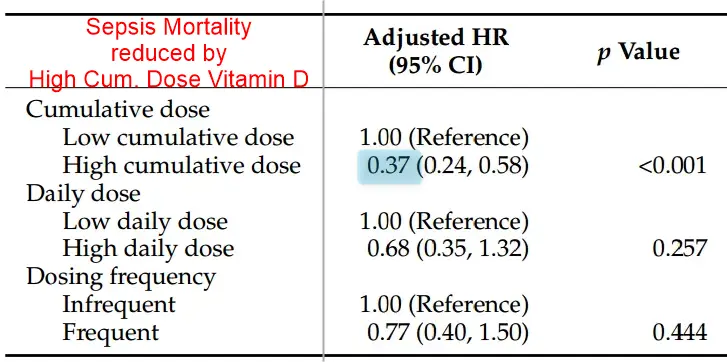
Sepsis Mortality reduced 60% by Large Total Dose Vitamin D
Impact of Vitamin D3 Supplementation on 28-Day ICU Mortality in Sepsis Patients: A Retrospective Study with Propensity Score Matching - April 2026
Pathogens 2026, 15(4), 433; https://doi.org/10.3390/pathogens15040433
Reduced levels of vitamin D are associated with increased incidence and mortality of sepsis. Nonetheless, the effectiveness of vitamin D supplementation in improving sepsis patients’ outcomes continues to be debated. In this research, which was conducted as a retrospective cohort analysis, data obtained from the Medical Information Mart for Intensive Care IV (MIMIC-IV 3.0) were used. The focus of the study was on vitamin D3 administration to sepsis patients while in the ICU. The primary outcome measurement was 28-day ICU mortality, with secondary outcomes of mechanical ventilation duration, percentage of patients receiving mechanical ventilation, and ICU stay length. The Kaplan–Meier curve analysis, Cox regression analysis, and subgroup analyses were performed to explore the link between vitamin D3 supplementation and sepsis prognosis. A 1:1 propensity score matching (PSM) approach was used to strengthen the reliability of the results. Before matching, the cohort comprised 28,524 patients, which was reduced to 4,856 after PSM. The analysis revealed that vitamin D3 supplementation was associated with a lower 28-day ICU mortality rate (HR = 0.71, 95% CI: 0.64–0.78, p < 0.001). Kaplan–Meier curve analysis revealed significantly greater survival probabilities in the group receiving vitamin D3 than in the group not receiving vitamin D3 (p < 0.001).
Subgroup analysis showed that total cumulative exposure to vitamin D3 was more strongly associated with 28-day ICU mortality (p < 0.001), whereas daily dose and dosing frequency showed no significant association.
The results after PSM and subgroup analysis were consistent with those of the original cohort study, further confirming the robustness of the results. Overall, vitamin D3 supplementation is associated with lower 28-day ICU mortality and better outcomes in patients with sepsis. However, given the retrospective observational design, large-scale prospective randomized controlled trials are warranted to validate these observational associations and establish causal effects.