
Salmon raised on farms have 10X more Vitamin D if sunlight
Field Evidence of Endogenous Vitamin D Synthesis in Atlantic Salmon Induced by Natural Sunlight
Aquac Nutr. 2025 Dec 20:2025:3823472. doi: 10.1155/anu/3823472
Christina Aspaas Husebø 1, Kjetil Berge 1, Frederike Keitel-Gröner 1, Eirik Hoel 1, Johan Rennemo 1, Margunn Sandstad 1, Kristine Marie Bjerkestrand 1, Lukas Lorentzen 1, Eirik Welde 2, Thea Morken 3, Ingunn Stubhaug 3, Julia Mullins 3, Håvard Bjørgen 4, Thea Bossum 5 6, Cato Brede 5 6 7, David Lausten Knudsen 3 6
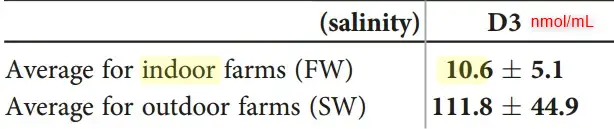
Fish are believed not to synthesize vitamin D through UV exposure but to meet their requirements from dietary sources. The high vitamin D levels found in many fish species are thought to originate from UV-induced synthesis in plankton, with vitamin D subsequently accumulating through the aquatic food chain. Atlantic salmon is a rich dietary source of vitamin D, but limited data exist on circulating vitamin D levels. To address this, plasma levels of the three main vitamin D metabolites were measured in Atlantic salmon from Norwegian fish farms using mass spectrometry. Here, we show that salmon reared in open sea pens have significantly higher vitamin D levels than those raised indoors. Monitoring an outdoor farm over 18 months revealed a distinct seasonal pattern between vitamin D levels and day length. In a follow-up experiment, indoor-raised fish were divided into two groups: one remained indoors, while the other was transferred outdoors for 52 days. Both groups received the same commercial feed, yet the outdoor group exhibited a fivefold increase in whole-body vitamin D content. These surprising findings provide field evidence of endogenous vitamin D synthesis in fish induced by natural sunlight. This discovery could have important implications for aquaculture, emphasizing the risk of suboptimal vitamin D levels in farmed fish when sunlight exposure is limited.
Icelantic salmon - primarily farmed outdoors - Perplexity PDF