
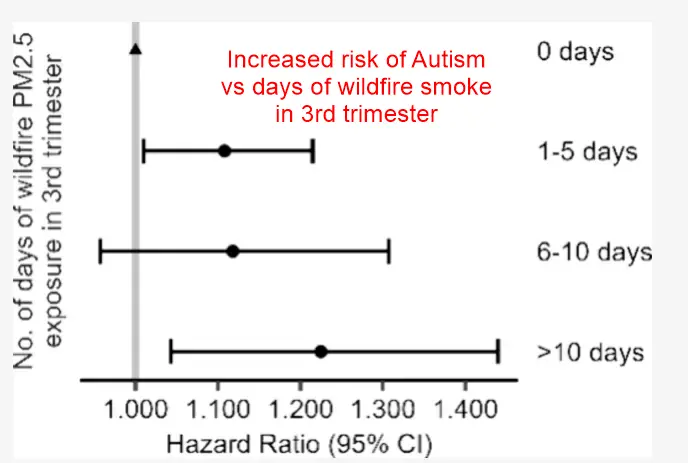
Risk of autism increased 1.2 X if wildfire smoke in 3rd trimester
Prenatal Exposure to Wildfire and Autism in Children
Environmental Science & Technology Jan 2026 https://doi.org/10.1021/acs.est.5c08256
David G. LuglioXin YuJane C. LinTing ChowMayra P. MartinezZhanghua ChenSandrah P. EckelJoel SchwartzFrederick W. LurmannNathan R. PavlovicRob McConnellAnny H. XiangMd Mostafijur Rahman
Chronic health effects of wildfire PM2.5 on neurodevelopmental outcomes are largely unknown. Therefore, the effects of wildfire PM2.5 on autism were assessed in a southern California-based pregnancy cohort using Cox proportional hazard models. Exposure was estimated from 2006 to 2014 at maternal addresses across pregnancy and individual trimesters using three metrics: (1) mean wildfire PM2.5 concentration, (2) number of days of smoke exposure, and (3) number of waves of smoke exposure. Analysis was restricted to days over specific PM2.5 concentration thresholds (3 and 5 μg/m3). Nonmovers during pregnancy (75% of cohort) were assessed in sensitivity analyses. There were 3356 autism diagnoses by age 5. Autism risk was associated with increased number of wildfire-exposed days during the third trimester and was strongest for nonmovers.
Nonmover hazard ratios (HR) with exposure to 1–5, 6–10, and >10 wildfire days in the third trimester (compared to none) were 1.108 (95% CI: 1.010,1.215), 1.118 (0.957,1.307), and 1.225 (1.043,1.440), respectively. HR per wildfire wave increase (>3 μg/m3 for 2 consecutive days) during the third trimester were 1.073 (1.009,1.140) and 1.267 (1.054,1.205) for the entire cohort and nonmovers, respectively. There was no association with the mean wildfire PM2.5 concentration alone. Prenatal exposure to wildfire smoke may increase risk of autism among children.