
Plant Nitrates decrease mortality, other Nitrates increase mortality (Nitric Oxide)
Source-specific nitrate intake and all-cause mortality in the Danish Diet, Cancer, and Health Study
European Journal of Epidemiology https://doi.org/10.1007/s10654-024-01133-5
Nicola P. Bondonno, Pratik Pokharel, Catherine P. Bondonno, Dorit W. Erichsen, Liezhou Zhong, Jörg Schullehner, Kirsten Frederiksen, Cecilie Kyrø, Peter Fjeldstad Hendriksen, Jonathan M. Hodgson, Frederik Dalgaard, Lauren C. Blekkenhorst, Ole Raaschou-Nielsen, Torben Sigsgaard, Christina C. Dahm, Anne Tjønneland & Anja Olsen
Introduction
Nitrate and nitrite are naturally occurring in both plant- and animal-sourced foods, are used as additives in the processing of meat, and are found in water. There is growing evidence that they exhibit a spectrum of health effects, depending on the dietary source. The aim of the study was to examine source-dependent associations between dietary intakes of nitrate/nitrite and both all-cause and cause-specific mortality.
Methods
In 52,247 participants of the Danish Diet, Cancer and Health Study, associations between source-dependent nitrate and nitrite intakes––calculated using comprehensive food composition and national drinking water quality monitoring databases––and all-cause, cardiovascular disease (CVD)-related, and cancer-related mortality over 27 years were examined using restricted cubic splines within Cox proportional hazards models adjusting for demographic, lifestyle, and dietary confounders. Analyses were stratified by factors hypothesised to influence the formation of carcinogenic N-nitroso compounds (namely, smoking and dietary intakes of vitamin C, vitamin E, folate, and polyphenols).
Results
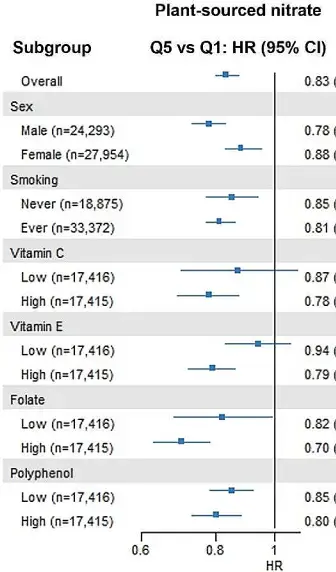
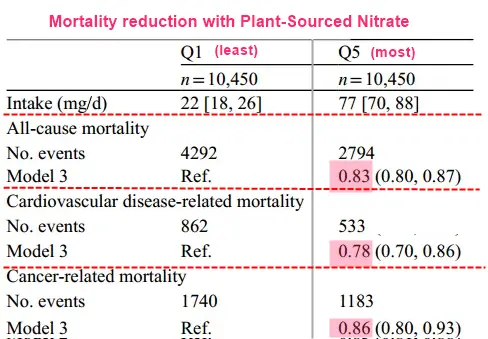
Plant-sourced nitrate intake was inversely associated with all-cause mortality [HRQ5vsQ1: 0.83 (0.80, 0.87)] while higher risks of all-cause mortality were seen for higher intakes of naturally occurring animal-sourced nitrate [1.09 (1.04, 1.14)], additive permitted meat-sourced nitrate [1.19 (1.14, 1.25)], and tap water-sourced nitrate [1.19 (1.14, 1.25)]. Similar source-dependent associations were seen for nitrite and for CVD-related and cancer-related mortality except that naturally occurring animal-sourced nitrate and tap water-sourced nitrate were not associated with cancer-related mortality and additive permitted meat-sourced nitrate was not associated with CVD-related mortality. No clear patterns emerged in stratified analyses.
Conclusion
Nitrate/nitrite from plant sources are inversely associated while those from naturally occurring animal-sources, additive-permitted meat sources, and tap water-sources are positively associated with mortality.
📄 Download the PDF from VitaminDWiki
Other studies on the web agree
Dietary Nitrate from Plant Foods: A Conditionally Essential Nutrient for Cardiovascular Health - Jan 2024, 100158 FREE PDF
Higher plant-derived nitrate intake is associated with lower odds of frailty in a cross-sectional study of community-dwelling older women - May 2024 FREE PDF
Leafy Vegetable Nitrite and Nitrate Content: Potential Health Effects - April 2023 FREE PDF
Plant but not animal sourced nitrate intake is associated with lower dementia related mortality in the Australian Diabetes, Obesity, and Lifestyle Study -2024 https://doi.org/10.3389/fnut.2024.1327042
Why are plant nitrates so much healthier than animal nitrates? (asked Perplexity AI Aug 2024)
Plant nitrates are considered healthier than animal nitrates due to several key differences in how they are processed and their effects on the body.
Source and Breakdown
Plant Nitrates : Found naturally in vegetables such as leafy greens, beets, and root vegetables. When consumed, these nitrates are converted into nitric oxide in the body, which has beneficial effects such as improving blood flow, lowering blood pressure, and supporting cardiovascular health. This conversion is facilitated by the presence of antioxidants like vitamin C in vegetables, which help prevent the formation of harmful nitrosamines.
Animal Nitrates : Often found in processed meats where nitrates are added as preservatives. These added nitrates can break down into nitrosamines, especially when exposed to high heat during cooking. Nitrosamines are carcinogenic and have been linked to an increased risk of cancers, particularly those of the digestive system.
Health Implications
Cardiovascular Health : Plant-based nitrates contribute to the production of nitric oxide, which helps in maintaining cardiovascular health by improving blood circulation and lowering blood pressure.
Cancer Risk : The antioxidants in vegetables help inhibit the formation of nitrosamines, reducing cancer risk. Conversely, nitrates from processed meats can form nitrosamines, increasing the risk of cancers such as colorectal, stomach, and esophageal cancer.
Mortality Rates : Research indicates that higher intakes of plant-sourced nitrates are associated with a lower risk of all-cause, cardiovascular disease-related, and cancer-related mortality. In contrast, higher intakes of nitrates from animal sources and processed meats are linked to increased mortality risks.
Mechanisms of Action
Nitric Oxide Pathway : Plant nitrates are more likely to be converted into nitric oxide due to the presence of antioxidants in vegetables. Nitric oxide has various health benefits, including vasodilation, which improves blood flow and reduces blood pressure.
Nitrosamine Formation : Animal nitrates, especially from processed meats, are more prone to converting into nitrosamines, particularly under high temperatures during cooking. Nitrosamines are known carcinogens and contribute to higher cancer risks.
In summary, plant nitrates are healthier due to their conversion into beneficial nitric oxide and the presence of antioxidants that prevent harmful nitrosamine formation. Animal nitrates, particularly from processed meats, pose health risks due to their potential to form carcinogenic nitrosamines.
VitaminDWiki - Nitric oxide (from sun, Mg, Vit D, etc) reduces some health problems - many studies.
Dr. Greger had 26 videos on Nitric Oxide as of Aug 2024
The Best Mouthwash for Halitosis (Bad Breath)
Best Brain Foods: Greens and Beets Put to the Test
Best Brain Foods: Berries and Nuts Put to the Test
Saffron for Erectile Dysfunction
Lowering Our Sodium-to-Potassium Ratio to Reduce Stroke Risk
Sodium and Arterial Function: A-Salting Our Endothelium
The Best Way to Get Vitamin D: Sun, Supplements, or Salons?
Vinegar and Artery Function
Fennel Seeds to Improve Athletic Performance
Antibacterial Toothpaste: Harmful, Helpful, or Harmless?
Whole Beets vs. Juice for Improving Athletic Performance
What is the latest science on the performance-enhancing qualities of nitrate-rich vegetables?
Hibiscus Tea vs. Plant-Based Diets for Hypertension
Appropriating Plant Defenses
Pistachio Nuts for Erectile Dysfunction
Biblical Daniel Fast Put to the Test
Watermelon as Treatment for Erectile Dysfunction
So Should We Drink Beet Juice, or Not?
Are Nitrates Pollutants or Nutrients?
Is Bacon Good or Is Spinach Bad? (nope)
Hearts Shouldn’t Skip a Beet
Don’t Use Antiseptic Mouthwash (blocks nitrates in vegitables)
Priming the Proton Pump
The Power of NO