
Spinal surgery + 3 years: 4X increased risk of adjacent vertabrae problem if <30 ng of Vitamin D
Vitamin D Insufficiency Increases Adjacent Segment Disease Risk Within 3 Years of Lumbar Interbody Fusion
Operative Neurosurgery May 2026. | DOI: 10.1227/ons.0000000000002038 PDF behind paywall
Wilkinson, Brandon M. MD1; Polavarapu, Hanish MD1; Bashir, Raahim MD2; Collard de Beaufort, Jonathan BS1; Hazama, Ali MD1
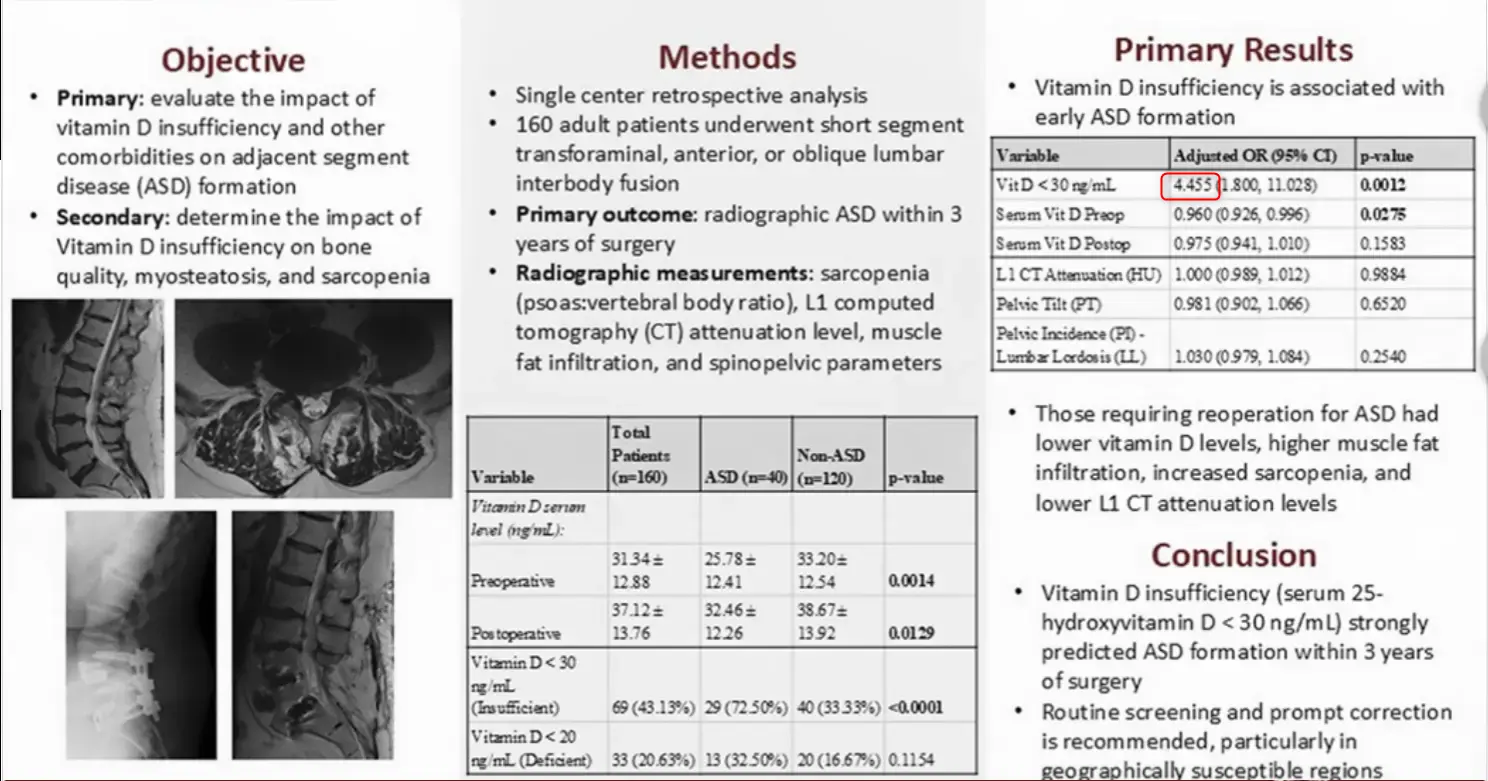
BACKGROUND AND OBJECTIVES: Information regarding modifiable nonsurgical factors related to adjacent segment disease (ASD) development after lumbar spine fusion is lacking. Vitamin D plays a key role in muscle maintenance and soft tissue integrity. Insufficiency can lead to sarcopenia and myosteatosis, which have recently been shown to increase ASD risk. We sought to evaluate the impact of vitamin D insufficiency and numerous medical comorbidities on ASD formation.
METHODS: Retrospective data were collected from 160 patients undergoing lumbar interbody fusion from 2012 to 2022. The primary outcome was ASD development within 3 years of surgery. Adult patients older than 18 years who underwent elective short-segment anterior, oblique, or transforaminal lumbar interbody fusion were included. Patients who had prior fusions, thoracolumbar deformity corrections, or ongoing oncological processes were excluded. Demographic, surgical, radiographic, and medical comorbidity data including vitamin D serum levels were recorded for all patients. Odds ratios were calculated with logistic regression analysis.
RESULTS: In 160 patients undergoing lumbar interbody fusion, 40 (25%) developed ASD within 3 years. Older age (P = .0013) and female gender (P = .0073) were associated with increased ASD risk, whereas body mass index was not. Of all comorbidities analyzed, vitamin D insufficiency was the only significant predictor of ASD development (P = .0012). ASD patients had significantly lower preoperative and postoperative serum vitamin D levels vs non-ASD patients (25.78 ± 12.41 vs 33.20 ± 12.54 ng/mL, P = .0014; 32.46 ± 12.26 vs 38.67 ± 13.92 ng/mL, P = .0129, respectively). Prior lumbar surgery was a significant risk factor, as was extent of surgery on univariate but not multivariate analysis.
CONCLUSION: Vitamin D insufficiency strongly predicted ASD development within 3 years of lumbar interbody fusion in our patient population. We recommend routine screening and prompt correction in insufficient patients properatively and postoperatively, particularly in geographically susceptible regions.
Related in VitaminDWiki
- Pain after spinal cord injury 4.8 X more likely if low Vitamin D
- Spinal fusion and Vitamin D - several studies
- Spinal Fusion complications 2.2 X more likely if low Vitamin D
- Surgery outcome worse if low vitamin D (lumbar spine surgery this time)
- Lumbar degenerative disc diseases might be fought by Vitamin D Receptor activation– many studies