Ibuprofen increases many health problems
Increased risk that acute pain will become chronic if ibuprofin (anti-inflamatory) Sept 2026
- " Back pain patients treated with NSAIDs appear to have a 76 percent increased risk of developing chronic back pain. "
- After cardiac surgery, high-risk patients were routinely given beta-blocker drugs to block adrenaline-type hormones— that is, until this practice was actually put to the test, and they were found to result in more deaths than placebo."
Compare Ibuprofin/NSAID with Vitamin D - Sept 2026
Vitamin D is not as a same-day painkiller. But vitamin D acts on the same prostaglandin pathway that ibuprofen targets, at more points, and it does other things as well. The main difference is timing: ibuprofen works within the hour, while vitamin D works over days to weeks.
Same target, different lever. Ibuprofen blocks the COX enzymes directly. Prostaglandin output drops fast, then rebounds as the drug clears. Calcitriol works through gene expression at three points on the pathway: it suppresses COX-2 expression, up-regulates 15-PGDH (the enzyme that inactivates prostaglandins), and down-regulates the prostaglandin receptors needed for signaling [Krishnan 2010]. That work was done in prostate cells, and the same group found calcitriol and NSAIDs together gave synergistic growth inhibition. Vitamin D also lowers pro-inflammatory cytokine release and dampens T-cell responses [Helde-Frankling 2017].
The cleanest head-to-head: menstrual cramps. This is textbook prostaglandin pain, where NSAIDs are first-line. In Lasco's RCT, women in the lowest quartile of 25(OH)D got a single 300,000 IU dose five days before their expected period. Cramping was lower, and none of them used NSAIDs over two months, versus 40% of the untreated group [Lasco 2012]. A meta-analysis of 11 RCTs with 687 participants found a pooled pain reduction of about 1.6 points, with benefit in primary but not secondary dysmenorrhea [Dysmenorrhea meta 2024].
Other pain conditions. Across 19 RCTs of chronic pain, vitamin D gave a significantly greater drop in pain score than placebo (mean difference −0.57) [Wu 2016 meta]. Fibromyalgia showed an SMD of −0.85 on NRS/VAS [Fibromyalgia meta 2025], and painful diabetic neuropathy showed a short-term SMD of −0.85 [Neuropathy meta 2025].
Where it failed. In D-Health, 60,000 IU/month had negligible effect on bodily pain, but 76% of participants were predicted to be above 50 nmol/L at baseline [D-Health pain 2023]. A chronic low back pain meta-analysis was also null regardless of baseline level [CLBP meta 2024]. The overall pattern is that people who start deficient are the ones who benefit: below 30 nmol/L most likely helps, above 50 nmol/L probably adds little.
The "more." Ibuprofen has a cost that vitamin D doesn't. The FDA's 2015 label strengthening put the added heart attack and stroke risk at roughly 10% to 50% or more depending on drug and dose, starting as early as the first weeks [FDA 2015 via AHA]. That comes on top of GI bleeding and kidney risk. Low vitamin D is also linked to worse pain after surgery: in one observational study, low preoperative levels went with higher pain scores and more opioid use after laparoscopic cholecystectomy [Lap chole 2023].
| Feature | Ibuprofen | Vitamin D |
|---|---|---|
| Prostaglandin action | Blocks COX enzyme activity | Lowers COX-2, raises 15-PGDH, lowers PG receptors |
| Other anti-inflammatory action | Minimal | Lowers cytokines; modulates T cells |
| Onset | 30–60 min | Days (bolus) to weeks (daily) |
| Duration | 4–8 h per dose | Weeks to months |
| Best pain evidence | Acute pain; dysmenorrhea; arthritis | Dysmenorrhea; fibromyalgia; diabetic neuropathy |
| Who benefits | Nearly everyone | Mainly those starting low |
| Main risks | GI bleeding; kidney; heart attack/stroke | Hypercalcemia only with excess |
| Combine? | Yes | Yes; synergy in cell studies |
| US annual deaths | 500 | 0 |
What Ibuprofen Quietly Takes From the Body — and What the Garden Offers Instead - 2026
- "Ibuprofen works by blocking the COX enzymes (cyclooxygenase-1 and -2). This is presented as elegant: shut down the inflammatory cascade, and pain quiets. But COX-1 is not a “pain enzyme.” It is a housekeeping enzyme — it maintains the protective mucus lining of your stomach, regulates blood flow to your kidneys, and governs the platelet behavior that keeps your cardiovascular system in balance. To block it for pain is to switch off a dozen quiet, vital functions in order to silence one loud one. This is the xenobiotic’s signature move: it cannot be specific, because the body never built a specific lock for this foreign key. GreenMedInfo, “Newly-Identified Side Effects of Ibuprofen and 20 More Reasons to Be Cautious”). "
- "NSAIDs as a class are responsible for an estimated over one million hospitalizations and up to 165,000 deaths every year worldwide"
- "Acetaminophen (Tylenol/paracetamol) is the leading cause of acute liver failure in the Western world"
Ibuprofen Can Stop Your Heart (31% Increase In Cardiac Arrest Risk GreenMedInfo
Reporting on
Non-steroidal anti-inflammatory drug use is associated with increased risk of out-of-hospital cardiac arrest: a nationwide case–time–control study
Download the PDF from VitaminDWiki
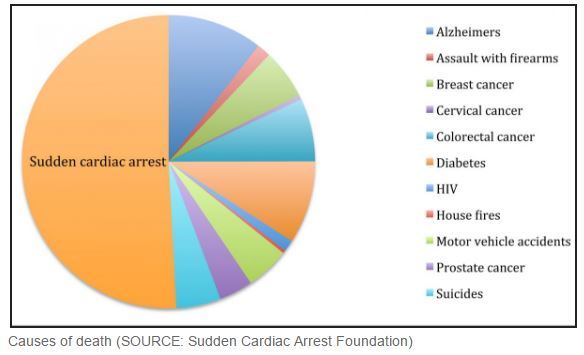
Sudden Cardiac Arrest: A Healthcare Crisis
“Sudden cardiac arrest (SCA) is a leading cause of death among adults over the age of 40 in the United States and other countries. In the U.S”
. . “and nine out of 10 victims die.”
SCA deaths are roughly equivalent to the number who die from Alzheimers disease, assault with firearms, breast cancer, cervical cancer, colorectal cancer, diabetes, HIV, house fires, motor vehicle accidents, prostate cancer and suicides combined
- The age-adjusted incidence of out-of-hospital cardiac arrest per 10,000 adults is
- 10.1 among blacks,
- 6.5 among Hispanics, and
- 5.8 among whites.
- Note by VitaminDWiki: Darker skin (lower vitamin D) associated with more SCA