
Obesity also increases the risk of mental health problems (probably Vitamin D)
Obesity as pleiotropic risk state for metabolic and mental health throughout life
Translational Psychiatry volume 13, Article number: 175 (2023)Michael Leutner, Elma Dervic, Luise Bellach, Peter Klimek, Stefan Thurner & Alexander Kautzky
Obesity, a highly prevalent disorder and central diagnosis of the metabolic syndrome, is linked to mental health by clinical observations and biological pathways. Patients with a diagnosis of obesity may show long-lasting increases in risk for receiving psychiatric co-diagnoses. Austrian national registry data of inpatient services from 1997 to 2014 were analyzed to detect associations between a hospital diagnosis of obesity (ICD-10: E66) and disorders grouped by level-3 ICD-10 codes. Data were stratified by age decades and associations between each pair of diagnoses were computed with the Cochran-Mantel-Haenszel method, providing odds ratios (OR) and p values corrected for multiple testing. Further, directions of the associations were assessed by calculating time-order-ratios. Receiving a diagnosis of obesity significantly increased the odds for a large spectrum of psychiatric disorders across all age groups, including depression, psychosis-spectrum, anxiety, eating and personality disorders (all pcorr < 0.01, all OR > 1.5). For all co-diagnoses except for psychosis-spectrum, obesity was significantly more often the diagnosis received first. Further, significant sex differences were found for most disorders, with women showing increased risk for all disorders except schizophrenia and nicotine addiction. In addition to the well-recognized role in promoting disorders related to the metabolic syndrome and severe cardiometabolic sequalae, obesity commonly precedes severe mental health disorders. Risk is most pronounced in young age groups and particularly increased in female patients. Consequently, thorough screening for mental health problems in patients with obesity is urgently called for to allow prevention and facilitate adequate treatment.
Obesity concurrent health problems
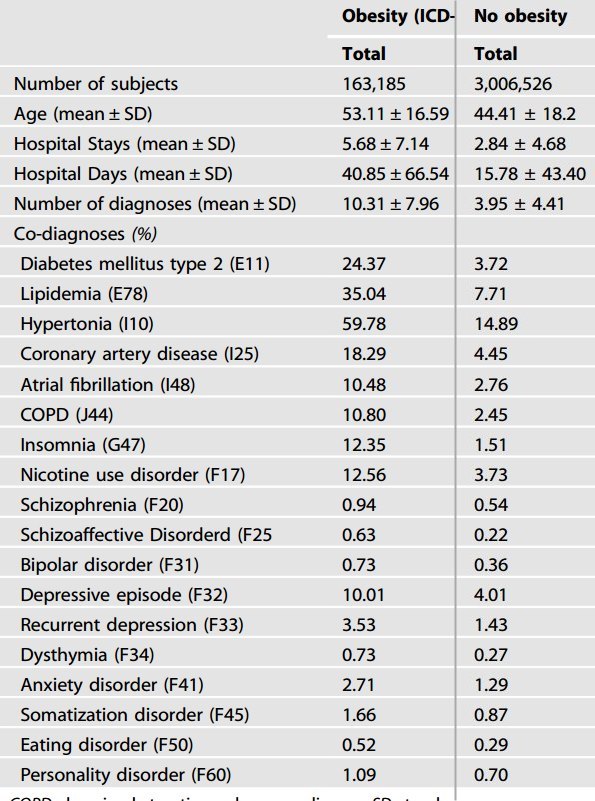
Note: Virtually all of the above are associated with low vitamin D
Suspect that many would decrease if Obese persons were to take enough Vitamin D
📄 Download the PDF from VitaminDWiki
Trial site news review of the study
Obesity Significantly Increases Risk of Developing Mental Health Disorders Across All Age Groups
"Researchers analyzed a population-wide national registry of inpatient hospitalizations in Austria from 1997 to 2014 "
"Receiving a diagnosis of obesity significantly increased the odds for a large spectrum of psychiatric disorders across all age groups, including depression, psychosis-spectrum, anxiety, eating and personality disorders. For all co-diagnoses except for psychosis-spectrum, obesity was significantly more often the diagnosis received first. Further, significant sex differences were found for most disorders, with women showing increased risk for all disorders except schizophrenia and nicotine addiction."
VitaminDWiki – Overview Obesity and Vitamin D contains
{include}
{include}
VitaminDWiki – Obesity is associated with low Vitamin D (and treated by D as well) – Aug 2019 has:
{include}