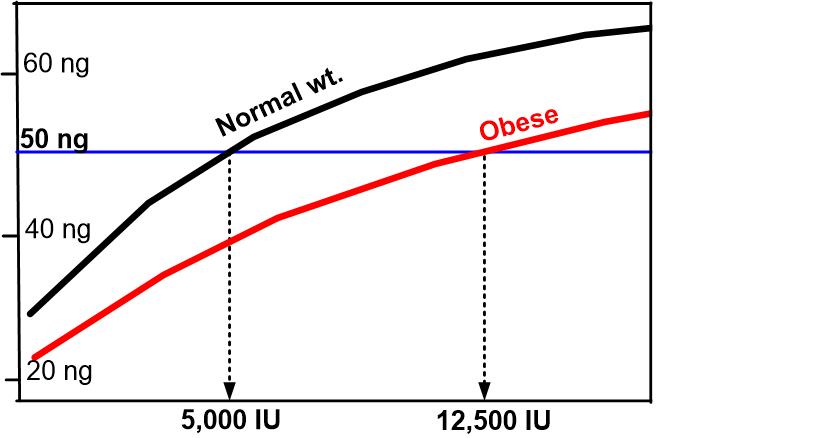
None of the metabolic syndrome studies reviewed gave more vitamin D to the obese participants
Effect of vitamin D supplementation on metabolic syndrome parameters in adults: a systematic review of randomized controlled trials exploring the role of baseline vitamin D status and supplementation dose
Front Nutr. 2026 Oct 27:13:1974621. doi: 10.3389/fnut.2026.1974621
Hind Alzarooni 1, Falak Zeb 2 3, Dimitrios Papandreou 1
None of the studies adjusted vitamin D dose for weight or obesity
Claude AI - Research mode
None of the eight included trials, and neither the Alzarooni review nor the meta-analyses it cites, chose doses by body weight or BMI or tested whether obesity blunted the 25(OH)D response. That held even though the trials that report BMI enrolled overweight-to-obese adults (mean BMI about 29–33 kg/m²). The few times obesity comes up, it is treated as a confounder or a reason for low vitamin D status, not as a reason to raise the dose.
TL;DR
- Nobody adjusted for weight. All 8 trials used one fixed dose for everyone, from 1,000 to about 7,100 IU/day. No trial reported an analysis by BMI subgroup, and none I could check said obese participants need 2–3× more. The trials that report BMI were overweight-to-obese at baseline: Mahmood 29.1, Ferreira about 29.4, Makariou 32, Salekzamani 33.2 kg/m².
- Your premise needs one correction. Only one cohort got 50,000 IU/week: Salekzamani 2016/2017, the same 71–80 people. Mahmood gave 60,000 IU/week then monthly (about 4,300 IU/day averaged). Hussain gave two 200,000 IU boluses (about 7,100 IU/day over 8 weeks) and never measured 25(OH)D afterwards. The other four trials used 1,000–2,000 IU/day, which is far below obesity-adjusted needs.
- The irony is real. The review cites Holick et al. 2011 only for deficiency cut-offs. That same guideline says "Obese adults need at least two to three times more vitamin D." It suggests 6,000–10,000 IU/day to treat deficiency in obese patients. The 2024 Endocrine Society guideline dropped that obesity-specific advice, citing insufficient evidence.
Key Findings
1. Fixed dosing everywhere. Every trial gave a flat dose. None scaled it by kg, BMI or obesity class. Where a reason for the dose is visible, it is convenience or local custom, not body size. Hussain based its sample size on Farag, and Farag simply gave 2,000 IU/day.[1][2]
2. Achieved levels were modest despite large daily equivalents. - Salekzamani's 7,143 IU/day falls inside the 2011 Endocrine Society's obese-treatment range, yet it raised 25(OH)D only from 16.5 to 78.4 nmol/L (about 6.6 to 31.4 ng/mL).[3][4][5] - Mahmood's about 4,300 IU/day reached only 26.1 ng/mL.[3][6] - Ferreira's 1,000 IU/day reached about 27.5 ng/mL.[7] - Makariou's 2,000 IU/day reached a median of 30.6 ng/mL.[8]
None of these approach the 100–150 nmol/L that AlAnouti et al. (with Papandreou as co-author) said was needed for cardiovascular protection.[9] That pattern fits a blunted response in heavy participants, but no trial tested it.
3. Obesity awareness was at most incidental. Farag's background notes that low vitamin D is inversely related to BMI.[1] Hussain, discussing its null results, suggests patients may have failed to reach adequate levels.[2] Neither links this to body size or dose. I found no trial that mentions volumetric dilution, adipose sequestration or weight-based dosing. Full texts of Salekzamani, Ferreira, Makariou (beyond the abstract), Mahmood and Taghizadeh were not accessible, so this point is weaker for those five.
4. The review's "about 2,000 IU/day is enough" claim rests on an analysis that ignored body weight. Zhuang et al. 2023 recommends 60,000 IU monthly (about 2,000 IU/day) to reach >75 nmol/L.[10][11] Its data extraction, subgroup analyses and meta-regression covered age, sex, disease status, latitude, assay and baseline 25(OH)D, but not BMI or body weight.[12] Applying a target derived without considering weight to a MetS population that is mostly obese is a methodological gap.
Details: Trial-by-Trial Summary
| Trial | Dose (daily equivalent) | Baseline BMI | Dose adjusted for weight? | Achieved 25(OH)D | Obesity/dose need acknowledged? |
|---|---|---|---|---|---|
| Ferreira 2020 (Brazil) | 1,000 IU/day (≈14 IU/kg/day at ~72 kg, illustrative) | ≈29.4 kg/m² (secondary source) | No, fixed | 15.0 → 27.5 ng/mL (same-cohort report); +45.4%[13] | Not verified; full text paywalled |
| Salekzamani 2016 (Iran) | 50,000 IU/week = 7,143 IU/day (≈79 IU/kg/day at ~90 kg, illustrative) | 33.17 ± 4.83 kg/m² (VD arm) | No, fixed | 16.5 → 78.4 nmol/L (≈31 ng/mL)[4][14] | Not verified; full text inaccessible |
| Salekzamani 2017 (Iran, same cohort) | Same as 2016 | Same cohort | No, fixed | Same cohort[10] | Not verified |
| Makariou 2017 (Greece) | 2,000 IU/day (≈23 IU/kg/day at ~88 kg, illustrative) | 32 ± 5.0 kg/m² (VD arm) | No, fixed | Median 16.0 → 30.6 ng/mL | No (abstract); Discussion not accessible[8] |
| Farag 2018 (Iraq) | 2,000 IU/day | Not reported in accessible text | No, fixed | 26.7 → 57.9 (units ambiguous in secondary source) | Partial: notes inverse vitamin D–BMI link (Background); no dose implication[1] |
| Mahmood 2016 (India) | 60,000 IU/week ×8 wk then monthly ×4 mo ≈ 4,286 IU/day (≈57 IU/kg/day at ~75 kg, illustrative) | 29.1 ± 4.06 kg/m² | No, fixed | 15.4 → 26.1 ng/mL (target 30 not reached)[3][10] | Not verified; full text paywalled |
| Taghizadeh 2021 (Iran) | 1,500 IU/day in fortified yogurt | Not reported in accessible text | No, fixed | Increased; values not accessible[10][15] | Not verified |
| Hussain 2026 (Pakistan) | 200,000 IU at wk 0 and 4 ≈ 7,143 IU/day over 8 wk | Measured but not in extracted text | No, fixed | Not measured at endpoint | No; blames possible inadequate levels, not obesity (Discussion) |
| Aquino 2023 (excluded) | 50,000 IU/week ×8 wk then 7,000 IU/week ×12 wk ≈ 3,457 IU/day | Not checked | No, fixed | Increased; values not checked | Partial: says MetS disorders impair bioavailability (Introduction)[16] |
| El Bilbeisi 2021 (excluded) | Not examined | Not examined | Not examined | Not examined | Not examined |
Notes on the table:
- Daily equivalents are total dose divided by days of intervention.
- IU/kg figures are illustrative estimates only. No accessible source gave mean body weight, so I assumed weights consistent with each reported BMI. For comparison, Drincic/Heaney's dilution model implies roughly 70–80 IU/kg/day to reach 75–100 nmol/L.[17] Only Salekzamani approaches that, and it achieved only about 31 ng/mL.
- Farag's 25(OH)D values are labelled ng/mL in Qi et al. A 31-unit rise from 2,000 IU/day is far more plausible in nmol/L, so treat the units as unresolved.
- Hussain's design included a subgroup by baseline vitamin D status, not by BMI, and the authors state they "did not check for serum vitamin D levels at the end."[2]
How the Review and Cited Meta-Analyses Handled Obesity
Alzarooni 2026. - It lists obesity severity only as a source of heterogeneity. - It promised to extract BMI but did not report it.[10] - It stratified dose at a fixed <4,000 vs ≥4,000 IU/day cut-off with no adjustment for body weight.
That cut-off groups Salekzamani (obese, 7,143 IU/day) with lean-population high-dose trials. It also calls 2,000 IU/day in 32-BMI patients "low dose" without asking whether it was adequate for their size.
Ge et al. 2025 (obesity-associated MetS). - It extracted BMI and ran outcome subgroups by BMI category. For example, total cholesterol rose significantly in the BMI >30 subgroup.[18] - Despite focusing on obese patients, it did not scale dose to body size or analyse achieved 25(OH)D by BMI. Doses were pooled as given (400–20,000 IU/day).[18]
Qi et al. 2022. - It split doses at >3,000 vs ≤3,000 IU/day.[5] - Its Discussion says obese people may have low 25(OH)D because adipose tissue impedes vitamin D absorption and use. It treats this as evidence the vitamin D–MetS link may be "confused with obesity, not causation", not as a reason dosing was inadequate.[5] - It notes the endline levels were below 100–150 nmol/L.[5]
AlAnouti et al. 2020 (Papandreou co-author). - Its Discussion states: "Obesity reduces the detectable serum levels of 25-hydroxyvitamin D through the sequestration of vitamin D in body fat tissue."[9] - It again frames this as confounding, and attributes null results to dose, duration and bolus dosing rather than body size.[9]
The senior author of the 2026 review has therefore already signed off on the sequestration mechanism, yet the 2026 review does not apply it to dose adequacy.
Aquino et al. 2023 (Heliyon, GRADE). It acknowledges an inverse association between adiposity and vitamin D levels. It grades evidence on triglycerides and waist circumference as low certainty, with no dose-per-body-size analysis.[19][20]
Zhuang et al. 2023. As noted above, BMI and weight were not modelled at all.
Context: The Evidence That Obese People Need More
- Endocrine Society 2011 (Holick et al.).
- It recommends that obese adults "be given at least two to three times more vitamin D".[21]
- It suggests 6,000–10,000 IU/day to treat deficiency, then 3,000–6,000 IU/day for maintenance.[22]
- It attributes this to body fat sequestering the fat-soluble vitamin.[23]
- Ekwaru et al. 2014 note that "the Endocrine Society also acknowledges that there are no good studies that clearly justify this."
- Ekwaru et al. 2014 (PLoS One, 22,214 recordings from 17,614 healthy Canadian adult volunteers). "We recommend vitamin D supplementation be 2 to 3 times higher for obese subjects and 1.5 times higher for overweight subjects relative to normal weight subjects."[24] To average 100 nmol/L, they estimate 2,080, 3,065 and 5,473 IU/day for normal-weight, overweight and obese adults respectively.
- Wortsman et al. 2000 (AJCN). Obese subjects showed decreased bioavailability of vitamin D from skin and diet, attributed to deposition in body fat.[25]
- Drincic et al. 2012 (Obesity). In a cross-sectional study of 686 unsupplemented adults, a volumetric dilution model "fully explains" the low vitamin D status of obesity. The authors conclude that "Vitamin D replacement therapy needs to be adjusted for body size," and state that a daily input of 70–80 IU/kg body weight will produce 25(OH)D of 30–40 ng/mL (75–100 nmol/L).
- Tobias et al. 2023 (JAMA Netw Open, VITAL, n = 16,515). "Supplementation increased vitamin D levels less over 2 years at higher body mass index."[26] At 1 year on the same 2,000 IU/day, mean 25(OH)D was 38.6 ng/mL in obese participants vs 45.9 ng/mL in normal-weight participants. The authors call this hypothesis-generating evidence that adiposity blunts the response. It may also explain why VITAL's cancer and autoimmune benefits appeared only at BMI <25.[27]
Endocrine Society 2024 (Demay et al.).
- It found insufficient evidence to recommend empiric supplementation in obesity.[28]
- Its Recommendation 14 reads: "In adults with obesity, we suggest against routine screening for 25(OH)D levels," with very low certainty evidence (2 | ⊕OOO).
- It states that "the Endocrine Society no longer endorses specific 25(OH)D levels to define vitamin D sufficiency, insufficiency, and deficiency," which includes the 30 ng/mL target.
- It prefers daily over intermittent high doses in people aged 50 and over.[29]
It did not reaffirm the 2–3× rule. That weakens the guideline-based argument, though it does not undo the pharmacokinetic evidence above.
Caveats
- Full texts of Salekzamani, Ferreira, Mahmood and Taghizadeh were paywalled or blocked. Their BMI and 25(OH)D values come from secondary meta-analysis tables: Qi 2022, PeerJ, and Pérez-López 2020 for Ferreira's same-cohort data. A brief obesity comment buried in those Discussions cannot be ruled out.
- IU/kg values are estimates based on assumed weights.
- Farag's 25(OH)D units are ambiguous in the secondary source.
- The 2024 Endocrine Society guideline weakens reliance on the 2011 2–3× recommendation as current guidance.
Sources:
- Alzarooni 2026 review
- Holick 2011 guideline
- Ekwaru 2014
- Drincic 2012
- Tobias 2023 VITAL
- Demay 2024 guideline
- Makariou 2017
- Farag 2018
- Hussain 2026
- Mahmood 2016 abstract
- Taghizadeh 2021
- Ferreira data via Pérez-López 2020
- Salekzamani 2016
- Qi 2022 meta-analysis
- AlAnouti 2020
- Ge 2025
- Aquino 2023 GRADE review
- Zhuang 2023
- Aquino 2023 pilot
Sources
- Comparative effects of vitamin D and vitamin C supplementations with and without endurance physical activity on metabolic syndrome patients: a randomized controlled trial - Diabetology & Metabolic Syndrome
- https://lifenscience.org/index.php/life-and-science/article/download/849/530
- The impacts of vitamin D supplementation in adults with metabolic syndrome: A systematic review and meta-analysis of randomized controlled trials - PMC
- Effects of vitamin D supplementation on cardiometabolic parameters among patients with metabolic syndrome: A systematic review and GRADE evidence synthesis of randomized controlled trials - PMC
- Google Drive
- International Journal for Vitamin and Nutrition Research
- Vitamin D supplementation after the menopause - Faustino R. Pérez-López, Peter Chedraui, Stefan Pilz, 2020
- No effect of vitamin D supplementation on cardiovascular risk factors in subjects with metabolic syndrome: a pilot randomised study
- Effects of Vitamin D Supplementation on Lipid Profile in Adults with the Metabolic Syndrome: A Systematic Review and Meta-Analysis of Randomized Controlled Trials
- Frontiers
- www.frontiersin.org
- Frontiers | Efficacy of intermittent versus daily vitamin D supplementation on improving circulating 25(OH)D concentration: a Bayesian network meta-analysis of randomized controlled trials
- Google Scholar
- Frontiers
- The effects of consuming a low-fat yogurt fortified with nano encapsulated vitamin D on serum pro-oxidant-antioxidant balance (PAB) in adults with metabolic syndrome; a randomized control trial - ScienceDirect
- Vitamin D3 supplementation had no benefits in patients with metabolic syndrome and vitamin D deficiency: A pilot study - ScienceDirect
- Vitamin D and Obesity
- Effect of vitamin D supplementation on body composition, lipid profile, and glycemic indices in patients with obesity-associated metabolic syndrome: a systematic review and meta-analysis - Diabetology & Metabolic Syndrome
- (PDF) Effects of vitamin D supplementation on cardiometabolic parameters among patients with metabolic syndrome: A systematic review and GRADE evidence synthesis of randomized controlled trials
- Effects of vitamin D supplementation on cardiometabolic parameters among patients with metabolic syndrome: A systematic review and GRADE evidence synthesis of randomized controlled trials - ScienceDirect
- Guideline Summary NGC-8727 Guideline Title
- Deriving D3 supplemental ratios of bodyweight from Ekwaru et al. 2014
- Evaluation, Treatment, and Prevention of Vitamin D ...
- The Importance of Body Weight for the Dose Response Relationship of Oral Vitamin D Supplementation and Serum 25-Hydroxyvitamin D in Healthy Volunteers
- Vitamin D and Obesity: Current Evidence and Controversies - Current Obesity Reports
- Association of Body Weight With Response to Vitamin D Supplementation and Metabolism
- Association of Body Weight With Response to Vitamin D Supplementation and Metabolism - PMC
- Vitamin D for Disease Prevention: ES 2024 Guideline Summary
- ENDO 2024: Updated vitamin D guideline
Related in VitaminDWiki
- Vitamin D is linked to metabolic syndrome and obesity
- Obese need 2X to 3X more vitamin D
a few of the studies reviewed on this page gave an equivalent of 7,000 IU daily