
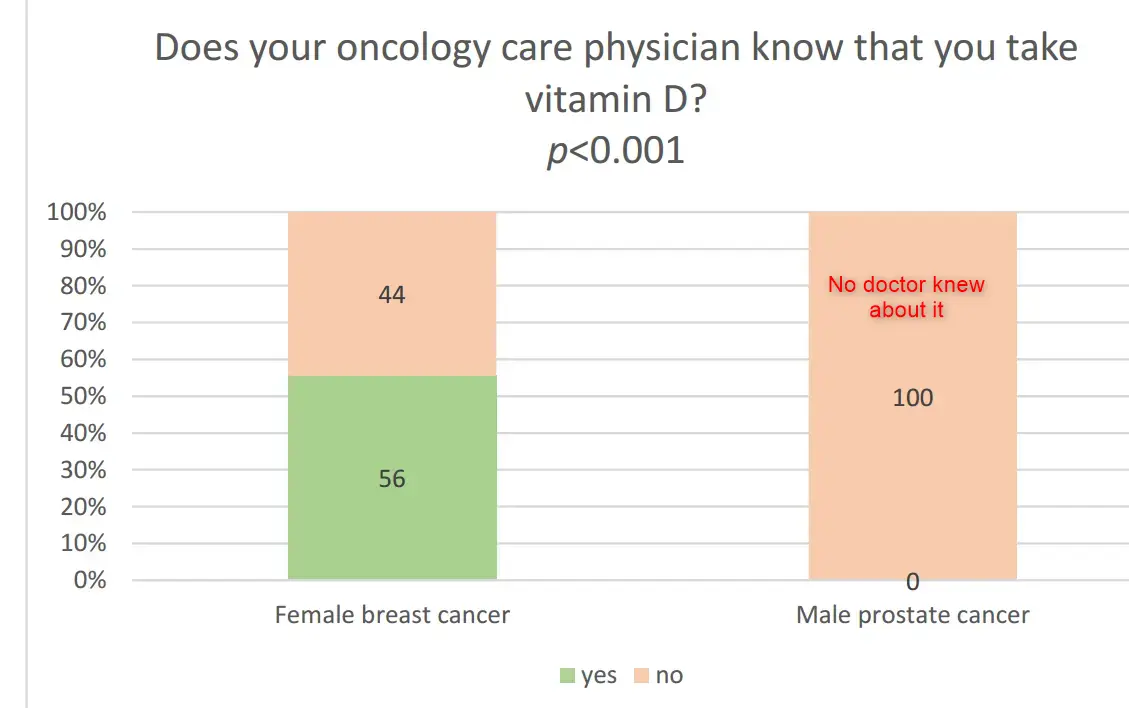
No Prostate Cancer Survivor told their doctor that they were taking Vitamin D
Vitamin D-Related Information Exposure, Attitudes, and Practices Among Prostate and Breast Cancer Survivors in Poland: Implications for Patient–Physician Communication
Nutrients 2026, 18(3), 427 2026; https://doi.org/10.3390/nu18030427
Poland
Introduction: The potential impact of vitamin D deficiency on cancer risk and oncological management remains under investigation. The study aimed to analyse vitamin D information exposure, attitudes, and practices, including the use of vitamin D and other supplements as well as serum 25-hydroxyvitamin D [(25(OH)D)] testing, among breast cancer and prostate cancer survivors in the context of patient–physician communication.
Material and methods: This cross-sectional survey included 145 breast and prostate cancer survivors (mean age 62.2 ± 9.9 years) who participated using an original, validated questionnaire.
Results: Between cancer diagnosis and survey completion, more than 52% of respondents reported vitamin D supplementation, and nearly 65% declared using supplements other than vitamin D in relation to their cancer. However, only 17.3% of respondents had been instructed by their physician to take vitamin D, and only 5.5% had been ordered by their physician to have their serum 25(OH)D levels tested. The majority of respondents (94%) perceived the need for physicians to routinely order vitamin D level tests for patients diagnosed with cancer. Only 39.5% of vitamin D users and 7.5% of other supplement users stated that their oncology care physicians knew about their supplement intake. The most common reason for patients not to inform their physician about taking vitamin D and/or other supplements was that the physician did not ask about this issue. Almost all aspects analysed showed greater health information exposure and better communication skills with physicians among women than among men.
Conclusions: It appears reasonable to improve physician–patient communication and broaden consideration of patients’ needs, which suggests a direction for further studies on the role of routine 25(OH)D testing in the standard care of patients with breast and prostate cancer.
Related in VitaminDWiki
- Do not expect a doctor to recommend a pill which will eliminate his job (vitamin D)
- Doctors are incentivised to prescribe medicines, not improve health
- Breast Cancer treatment – Vitamin D was the most-popular supplement
- Prostate Cancer Survivors are 2.3 X more likely to have high levels of Vitamin D – meta-analysis
- The use of Vitamin D to prevent prostate cancer doubled in a decade
- 7X increase in stage IV Prostate Cancer survival when vitamin D greater than 32 ng
- Better survival of many cancers if higher level of vitamin D