
Myotonic dystrophy (a rare genetic muscle problem) associated with low vitamin D
What Is Myotonic Dystrophy? - July 2026
MD runs in families - but not in genes (so far)
- "Families share diet. Water. Soil, where they grow food or where the food they buy is grown. Dental practice: the dentist the mother went to is likely the dentist the daughter went to, using the same materials in the same generation. Vaccination schedules calibrated to the era. Pharmaceutical exposure patterns. Cooking oils, cookware, household cleaning products, mattresses. Stress patterns, sleep patterns, cultural attitudes toward illness and pain. Electromagnetic environments: houses built in the same decade, wired the same way, situated near the same transmission infrastructure. Amandha Vollmer and other practitioners working in the older homeopathic and naturopathic traditions describe an additional layer called miasm: patterns of physiological response passed from mother to child that reflect the accumulated nutritional depletions, toxic exposures, and unresolved strains of the preceding generations.⁶ Whether the mechanism is best framed as material burden or as something subtler, the observation is the same. Families transmit terrain, and the terrain determines expression."
- "The clinical picture the framework calls myotonic dystrophy fits, in almost every specific, the picture that decades of clinical and biochemical work have documented under other names: magnesium depletion, heavy metal toxicity, generational nutritional collapse, and the compounding factors of the industrial environment. The overlap is not partial. It is precise."
In 2013: 44 DM patients found 88% below 30 ng/mL and 40% below 10 ng/mL.
Many conversations with Claude AI on MD and Vitamin D - July 2026
Cutaneous features of myotonic dystrophy types 1 and 2: Implication of premature aging and vitamin D homeostasis - Italy 2016
Neuromuscular Disorders, online 16 Nov 2016, http://dx.doi.org/10.1016/j.nmd.2016.11.004
Elena Campione, MD, PhDa, Annalisa Botta, PhDb, Monia Di Prete, MDa, Emanuele Rastelli, MDc, Manuela Gibellini, MDc, d, Antonio Petrucci, MDe, Sergio Bernardini, MDd, Giuseppe Novelli, PhDb, Luca Bianchi, MDa, Augusto Orlandi, MDf, Roberto Massa, MDc, Chiara Terracciano, MD, PhDc, d, ,
Highlights
• DM1 and DM2 display a high frequency and a similar pattern of cutaneous alterations
• Nevi abnormalities and premature aging are the most common skin features in DM
• In DM1 patients, the number of nevi correlated with CTG expansion size
• Dysplastic nevi and xerosis inversely correlated with vitamin D levels in DM1
Skin changes have been described in myotonic dystrophy type 1 (DM1). However, whether and in which way skin is a target of specific disease alterations in DM1 and DM2 has not been yet clarified. This study aims to explore cutaneous features of DM1 and DM2 patients. Skin examination was performed in 60 DM1, 15 DM2, and 103 control, unselected patients by means of dermoscopy. It revealed quantitative and qualitative abnormalities of nevi and typical signs of premature aging in both DM1 and DM2 patients, with a significantly higher frequency of dysplastic nevi, alopecia, xerosis and seborrheic dermatitis.
Twenty-eight nevi were excised in DM patients and none showed histological features of melanoma, although 12 of them were diagnosed as dysplastic and the remaining 16 presented histological irregularity in melanin distribution. In DM1 patients, the number of nevi correlated with CTG expansion size, whereas the presence of dysplastic nevi and xerosis inversely correlated with vitamin D levels. DM1 and DM2 patients display a high frequency of skin abnormalities, the most common of which correlate with genotype severity and serum vitamin D levels. Skin examination is highly informative in these patients and reveals features suggestive of premature aging and impaired vitamin D homeostasis.
Vitamin D deficiency in myotonic dystrophy type 1 - Italy 2013
J Neurol. 2013 Sep;260(9):2330-4. doi: 10.1007/s00415-013-6984-1. Epub 2013 Jun 11.
Terracciano C1, Rastelli E, Morello M, Celi M, Bucci E, Antonini G, Porzio O, Tarantino U, Zenobi R, Massa R.
1Neuromuscular Center, Division of Neurology, Department of Systems Medicine, Tor Vergata University, Via Montpellier 1, 00133 Rome, Italy. chiara.terracciano@uniroma2.it
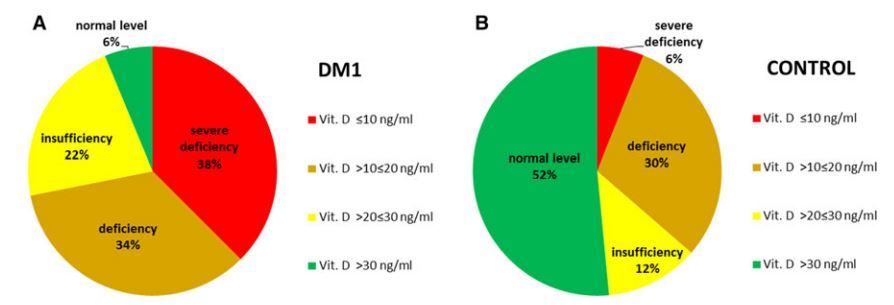
Myotonic dystrophy type 1 (DM1) is a multisystemic disorder affecting, among others, the endocrine system, with derangement of steroid hormones functions. Vitamin D is a steroid recognized for its role in calcium homeostasis. In addition, vitamin D influences muscle metabolism by genomic and non-genomic actions, including stimulation of the insulin-like-growth-factor 1 (IGF1), a major regulator of muscle trophism. To verify the presence of vitamin D deficit in DM1 and its possible consequences, serum 25-hydroxyvitamin D (25(OH)D), calcium, parathormone (PTH), and IGF1 levels were measured in 32 DM1 patients and in 32 age-matched controls. Bone mineral density (BMD) and proximal muscle strength were also measured by DXA and a handheld dynamometer, respectively.
In DM1 patients, 25(OH)D levels were reduced compared to controls, and a significant decrease of IGF1 was also found. 25(OH)D levels inversely correlated with CTG expansion size, while IGF1 levels and muscle strength directly correlated with levels of 25(OH)D lower than 20 and 10 ng/ml, respectively.
A significantly higher percentage of DM1 patients presented hyperparathyroidism as compared to controls.
Calcium levels and BMD were comparable between the two groups.
Oral administration of cholecalciferol in 11 DM1 patients with severe vitamin D deficiency induced a normal increase of circulating 25(OH)D, ruling out defects in intestinal absorption or hepatic hydroxylation.
DM1 patients show a reduction of circulating 25(OH)D, which correlates with genotype and may influence IGF1 levels and proximal muscle strength.
Oral supplementation with vitamin D should be considered in DM1 and might mitigate muscle weakness.
PMID: 23754696 DOI: 10.1007/s00415-013-6984-1
Download the PDF from VitaminDWiki (from ResearchGate)
Vitamin D, parathyroid hormone and muscle impairment in myotonic dystrophies - Italy 2013
J Neurol Sci. 2013 Jun 25. pii: S0022-510X(13)00268-2. doi: 10.1016/j.jns.2013.06.008.
Passeri E, Bugiardini E, Sansone VA, Valaperta R, Costa E, Ambrosi B, Meola G, Corbetta S.
Endocrinology and Diabetology Unit, Dept. of Biomedical Sciences for Health, University of Milan, Milan, Italy. Electronic address: elenapasseri83@libero.it.
Parathyroid function in Myotonic Dystrophy (DM) patients has been poorly investigated. Parathyroid and muscle parameters were assessed in 31 male DM1 (44±2years), 13 male DM2 (56±2years) and 32 healthy controls. Hyperparathyroidism was diagnosed in 18% of patients without differences between DM types. In all DM patients, hyperparathyroidism was associated with normocalcemia but one with hypercalcemia. DM patients presented significantly higher PTH and lower vitamin D (25OHD) compared with controls, also considering seasonality.
Severe vitamin D deficiency (25OHD<10ng/ml) was diagnosed in 40% and
hypovitaminosis D (25OHD<30ng/ml) occurred in 88% of DM patients.
About one-third of DM1 presented hypophosphatemia associated with elevated PTH levels.
Serum 25OHD levels negatively correlated with PTH and with body fat mass. Considering DM1 patients, serum PTH levels positively correlated with CTG triplet repeats. Furthermore, PTH levels negatively correlated with total modified Medical Research Council (MRC) and positively with Muscular Impairment Rating Scale (MIRS). By contrast, in DM2 patients muscle assessment did not show any correlation with parathyroid function.
In conclusion, we arrived at the following:
1) severe vitamin D deficiency is common in DM patients and it is associated with secondary hyperparathyroidism;
2) primary hyperparathyroidism, though rare, may occur;
3) increased adiposity in DM may be a risk factor for hypovitaminosis D; and
4) high serum PTH levels may indicate a muscle impairment, at least in DM1.
Based on very little information I, Henry Lahore, will speculate that:
1) Vitamin D will probably not prevent myotonic dystrophy
2) Vitamin D might possibly treat myotonic dystrophy
3) People with myotonic dystrophy should increase their vitamin D levels
- to reduce risk of getting other diseases associated with low vitamin D - such as bone loss
- See Diseases that may be related via low vitamin D