
Male-pattern hair-loss is a way to increase Vitamin D in males with poor vitamin D receptors - hypothesis
The solar window hypothesis: androgenetic alopecia as an evolutionary adaptation to maintain bone mineral density in vitamin D receptor low-efficiency variants
Medical Hypotheses July 2026 10.1016/j.mehy.2026.112005 PDF behind paywall
Androgenetic alopecia (AGA), or male-pattern baldness, is a highly prevalent heritable trait that persists despite clear evolutionary costs, including increased skin cancer risk, impaired thermoregulation, and psychosocial disadvantages. Conventional explanations, including sexual signaling, antagonistic pleiotropy, or genetic hitchhiking, fail to identify a direct systemic benefit capable of offsetting these costs across the lifespan.
This paper proposes the “Solar Window” hypothesis: AGA may function as a compensatory adaptation that enlarges the hair-free scalp surface to enhance cutaneous UVB exposure and provitamin D3 synthesis.
This mechanism may be particularly advantageous in individuals carrying low-efficiency Vitamin D Receptor (VDR) variants (e.g., FokI ff genotype), in whom receptor transcriptional activity is reduced. By increasing ligand availability rather than receptor efficiency, AGA may partially offset the VDR bottleneck, thereby helping to preserve bone mineral density (BMD) and reduce late-life osteoporotic fracture risk.
The hypothesis draws on two principal lines of evidence:
- (a) shared VDR-AR-Wnt/β-catenin molecular pathways linking hair follicle cycling and osteoblast function, and
- (b) the scalp’s unique anatomical suitability as a lifelong UVB-exposed photosynthetic interface.
- A third, more speculative line of reasoning invokes kin-selection benefits under the Grandparent Hypothesis.
The hypothesis rests on several untested assumptions, and no clinical recommendations can be drawn at present. If confirmed through genotype-stratified clinical cohorts, molecular assays, and epidemiological analyses, the Solar Window hypothesis would reframe AGA from a purely cosmetic condition to a potentially adaptive trait and motivate new investigation of the skin-bone axis in skeletal health.
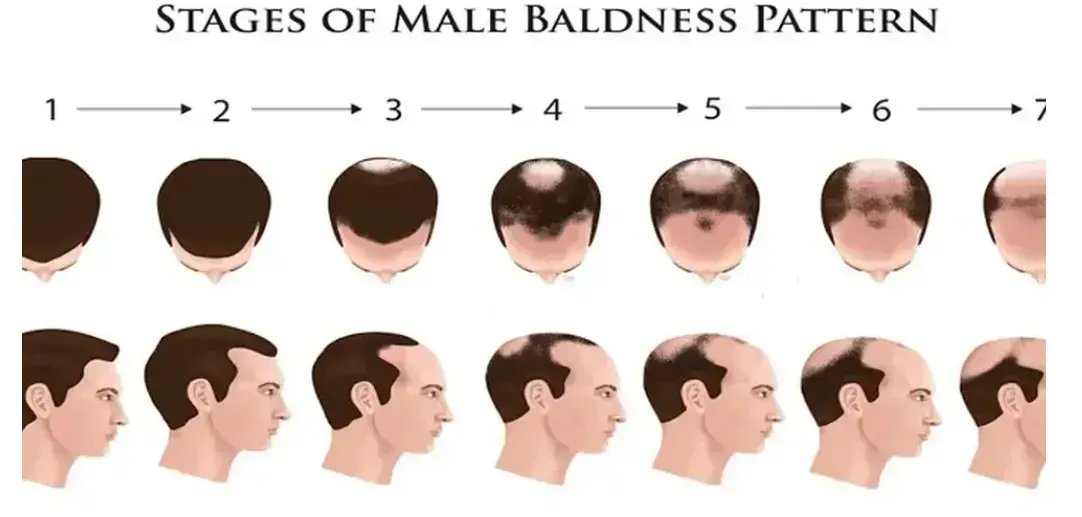
Chart from the web
Related in VitaminDWiki
- Hair loss strongly associated with poor vitamin D receptors
- Redhead – Red hair - vitamin D - a hair adaptation to low UVB
- Vitamin D reduces hair loss - many studies - more vitamin D, less hair loss
Founder of VitaminDWiki found that topical vitamin D with DMSO restored hair loss - Male smokers: 2X increased Risk hair loss (Vitamin D reduced by smoking)
- Temporary hair loss (Telogen Effluvium) is 15X more likely if poor Vitamin D Receptor