
Low vitamin D (<20 ng) linked to softer muscles on ultrasound in young adults - observational
Does 25(OH)D deficiency affect muscle elasticity, physical function, pain, and quality of life? A shear-wave elastography-based cross-sectional study
Osteoporosis International, published online 06 October 2026, https://doi.org/10.1007/s00198-026-08231-y
Lütfiye Parlak, Nusret Seher, Funda Levendoğlu, Ezgi A. Tezcan, Esra Öz, Mehmet S. Durmaz, İlknur A. Gezer
Summary by Claude Opus 5.5 - October 2026
Young adults with vitamin D below 20 ng/mL had noticeably softer muscles, about 20% lower stiffness in the forearm, upper arm, and shin. Their muscles were the same size as everyone else's, and their grip strength and walking speed were normal.
This cross-sectional study at a university hospital in Konya, Turkey, compared 80 adults aged 18–45:
- 40 with 25(OH)D under 20 ng/mL (median 12.4)
- 40 with 25(OH)D of 20 ng/mL or above (median 25)
None had taken vitamin D in the previous 3 months. Stiffness was measured with shear-wave elastography, an ultrasound method that reports stiffness in kilopascals (kPa). The paper calls this "elasticity," and a lower number means softer muscle.
Results:
- All three muscles were less stiff in the low-D group, in both women and men (e.g., biceps 23.4 vs 30.4 kPa; all p < 0.001).
- Each 10 ng/mL higher 25(OH)D went with about 3.5 kPa stiffer muscle, after adjusting for age, sex, BMI, activity level and muscle size.
- Stiffness correlated very strongly with 25(OH)D (r = 0.87–0.92).
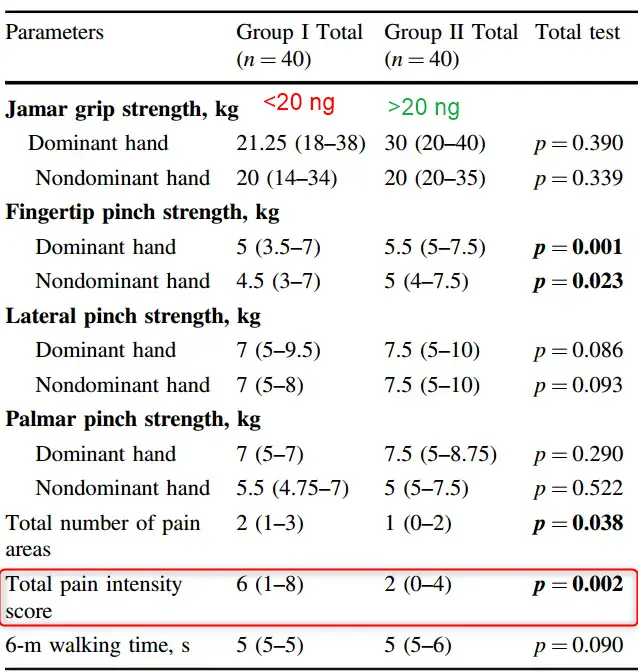
- Fingertip pinch strength was slightly lower, and pain was more widespread and more intense (pain score median 6 vs 2).
- There was no difference in muscle size, grip strength, other pinch tests, 6-meter walk time, physical activity, or any SF-36 quality-of-life score, including its pain subscale.
Ultrasound stiffness cut-offs (23.5–26.5 kPa) identified deficiency with AUC 0.94–0.96.
What this does NOT show
- It does not show cause and effect. A single snapshot can't tell whether low vitamin D softens muscle, and sun exposure and the season of the blood draw were not recorded.
- It does not show that softer muscle is harmful, since function was mostly unchanged.
- It does not show whether supplementing would change stiffness, because no one was given vitamin D.
- It says nothing about higher levels, because the "adequate" group's median was only 25 ng/mL.
- It does not show that ultrasound could replace a blood test. The cut-offs were derived and tested on the same 80 people, so their accuracy is probably overstated.
- Correlations this strong are unusual for a single biological marker. With one center, one machine, and no reported agreement between the two radiologists, the result needs independent replication.
Related in VitaminDWiki
- Overview Muscles and Vitamin D
- More fast twitch muscles (IIA) are associated with higher levels of Vitamin D
- Low Vitamin D breaks down muscle by interfering with protein - Editorial
- Sarcopenia (muscle loss) is reduced by vitamin D and many other supplements
- Vitamin D and physical activity synergistically improve muscle health
- Widespread pain, arthritis pain and muscle pain are associated with low vitamin D – meta-analysis
- Overview Pain and Vitamin D