
Loss of smell related to low Vitamin D or Zinc
Olfactory impairment if < 10 ng of Vitamin D - June 2026
Serum vitamin D levels and olfactory function in adults: a cross-sectional study with dose-response and ROC analysis
Eur Arch Otorhinolaryngol 2026 Jun 1. doi: 10.1007/s00405-026-10327-4. PDF behind paywall
Esin Baran 1, Burak Numan Ugurlu 2, Eda Simsek 3
Purpose: The purpose of this study was to examine the relationship between serum 25(OH)D levels and olfactory function in adults, given the emerging recognition of vitamin D as a neurosteroid with potential influence on sensory pathways. Specifically, the study aimed to determine whether vitamin D status is associated with olfactory threshold and identification performance, to explore the presence of a biologically plausible dose-response pattern, and to assess the predictive value of serum vitamin D levels for olfactory dysfunction.
Methods: In this cross-sectional study, 161 adults were enrolled, including 98 with vitamin D deficiency and 63 with sufficient levels. Serum 25(OH)D was measured by HPLC and categorized into four groups (< 10, 10-20, 20-30, ≥ 30 ng/mL). Olfactory threshold and identification were assessed using the Sniffin' Sticks rapid screening kit. Group comparisons, subgroup analyses, correlation tests, multiple linear regression, and ROC analysis (threshold < 7) were performed.
Results: Vitamin D-deficient participants had significantly lower threshold and identification scores than controls (p = 0.008 and p < 0.001). Both scores increased stepwise across vitamin D subgroups (p < 0.001). Serum 25(OH)D correlated positively with threshold (r = 0.302) and identification (r = 0.432) (both p < 0.001); in the deficiency group, the correlation persisted only for threshold. Vitamin D was an independent predictor of identification (β = 0.041; p < 0.001). ROC analysis indicated that severe vitamin D deficiency (cutoff ≈ 10 ng/mL) was strongly associated with threshold-level olfactory impairment (AUC 0.636; specificity 95%).
Conclusion: Serum vitamin D level is associated with olfactory function, particularly odor identification, and shows a biologically plausible dose-response pattern. Vitamin D appears to be a specific risk indicator rather than a standalone diagnostic marker for olfactory dysfunction.
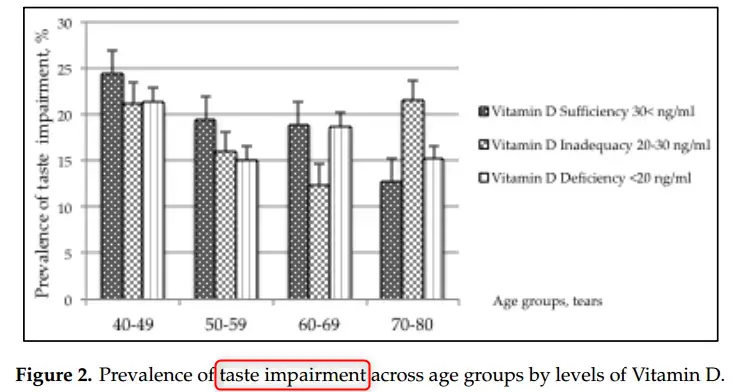
2X more likely to have taste impairment if aged 70–80 if Vit D 20-30 ng - April 2020
Age-related Smell and Taste Impairments and Vitamin D Associations in the U.S. Adults National Health and Nutrition Examination Survey
Galya Bigman
A possible correlation between vitamin D deficiency and loss of smell: 2 case reports – 2011
2 people reported increased ability to smell after increasing vitamin D levels
With 10,000 IU of vitamin D daily her ability to smell started to return after a few months
Vitamin D and smell - consistently associated but unproven .pdf
Claude AI Deep Research Oct 2026
VitaminDWiki Observations
Loss of taste and smell sensitivity after chemotherapy, which is associated with low Vitamin D
Loss of smell associated with obesity – which is associated with low Vitamin D
Loss of smell is an early indication of both Parkinson’s and Alzheimer’s diseases, which are associated with low Vitamin D
Loss of smell and taste is associated with Multiple Sclerosis, which is associated with low Vitamin D
See also VitaminDWiki
96 percent of ear, nose, throat children had less than 30 ng of vitamin D – Jan 2013
Nasal polyposis greatly decreased by 4,000 IU of vitamin D for 4 weeks - 2014
Off topic: Women can learn a smell 100,000 X better then men – Aug 2017
See also web
- Serum 25-hydroxyvitamin D3 level may be associated with olfactory dysfunction in de novo Parkinson's disease Aug 2018 doi: 10.1016/j.jocn.2018.08.003.
- Olfaction: Smell of Change in the Air Aug 2017
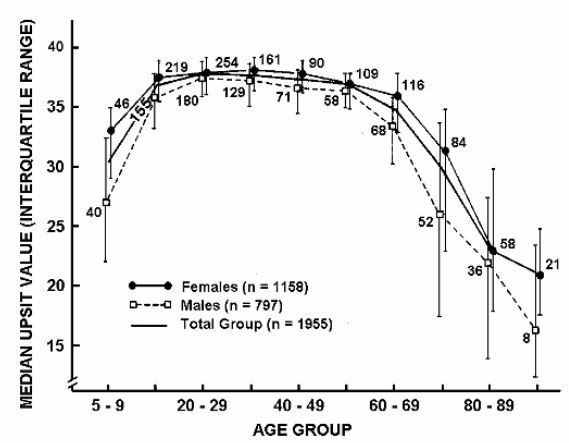
- Note: Women can smell better than men
- Serum 25-hydroxyvitamin D3 level may be associated with olfactory dysfunction in de novo Parkinson's disease Nov 2018
See also: smell and Zinc on the web
Zinc and Taste Disturbances in Older Adults: A Review of the Literature.
Consult Pharm. 2016 May;31(5):267-70. doi: 10.4140/TCP.n.2016.267
- According to the National Health and Nutrition Examination Survey III, 35% to 45% of adults 60 years of age or older had zinc intakes below the estimated average requirement of 6.8 mg/day for elderly females and 9.4 mg/day for elderly males. Zinc deficiency may lead to
- loss of appetite,
- impaired immune function,
- weight loss,
- delayed healing of wounds,
- eye and skin lesions, and
- smell and taste disturbances.
- Older adults are especially affected by changes in taste sensations because of age-related gustatory dysfunction, use of multiple medications, increased frailty, and zinc deficiency . This article reviews the finding of clinical studies investigating the use of zinc supplementation for improvement with taste disturbances in older adults.
- - - - - - - - - - - - - -
- Common Signs of Nutrient Deficiency 2014
- Low Zinc is another possible cause (link includes other symptoms of low zinc )
Why Can't I Smell Anything? --Top 10 Causes and Remedies updated Feb 2017
- “1% to 2% percent of people in North America report a “smell Disorder”:
- “anosmia,” = the inability to detect odors,
- “hyposmia,” -decreased ability to detect odors
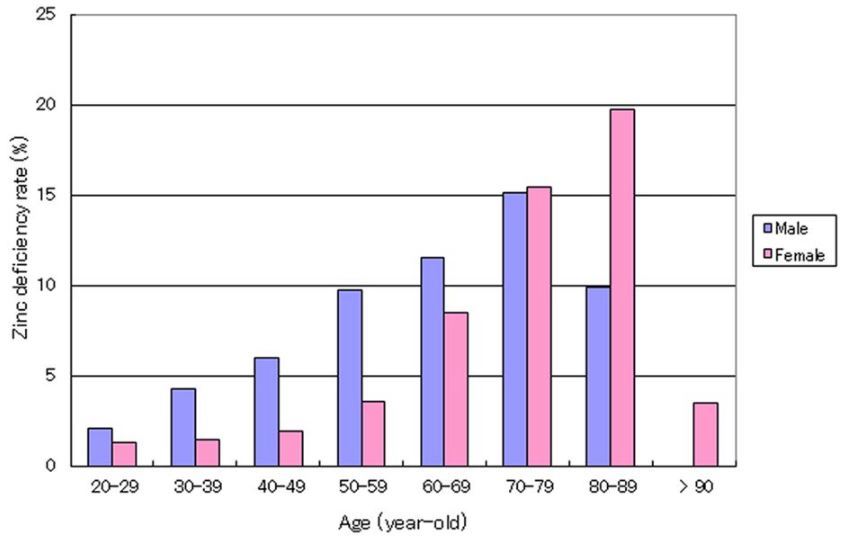
- Note: Zinc deficiency increases with age
Natural Cures for Loss of Smell lots of user discussion
- Castor Oil, Garlic, Zinc , Omega-3, Alpha Lipoic Acid , Borax, .
- Infants and elderlies are susceptible to zinc deficiency Feb 2016
- Zinc measured in hair from 20,000 Japanese, Full PDF online
22% of people have problems smelling - June 2026
When the ability to smell goes away- Nothing about Vitamin D