Live significantly longer if you have more good T-cells
A Tale of Two T Cells - Oct 2026
Key points of his Substack post - without hyperlinks
Primacy of the thymus gland. The study identified the decline in naive T cells and recent thymic emigrants as the basis of the aging clock, predicting chronological age.
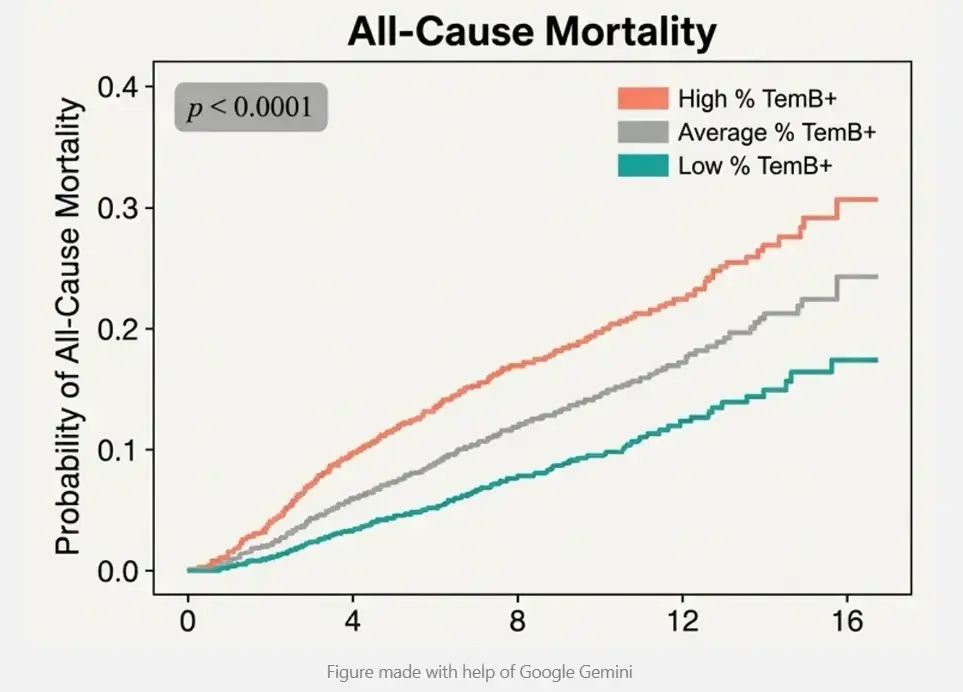
It’s not just that we lose naive T cells as the thymus involutes, but it’s about the type of cells that come in to replace them. And it turns out there’s a critical bifurcation between TemK+ and TemB+ cells. The difference in the granules of these cells can account for inciting or fostering inflammation. Extensive characterization of the TemB+ cells from mice showed their propensity to be leaky, exhausted, and tissue disruptive.
Viral exposure, most notably by CMV blood positivity, affects the bifurcation path to promote TemB+ cells.. The other main influence on promoting TemB+ instead of TemK+ were chronic diseases, notably cardiovascular and metabolic.
The discovery in the work using single-cell RNA sequencing in >12 million white blood cells of the bifurcation and link to outcomes might not have been made with traditional methodologies of cell sorting, flow cytometry, or pooled sequencing. This is yet another reinforcement of getting “granular” (no pun intended with granules) with respect to learning from single-cell data.
A new protein blood test emerges from this body of work, the percent of TemB+, or ratio of TemB+ to TemK+. It might be considered a master indicator of unfavorable immune system aging. This could lead to a simple and inexpensive window into a person’s immune status and the researchers in the current study are indeed pursuing that goal. For people found to have an unfavorable immune status, we know of ways that can be improved with lifestyle factors and vaccines, and much more will be done in the years ahead to find other means.
Here in late 2026 we have no way of assessing a person’s immune system in the clinic, as I’ve previously written on “Why We Need an Immunome.” Ironically, we have so many ways to control the immune system, releasing its brakes (think immune checkpoint inhibitors and ten other classes of interventions) and B-cell depletion or “inverse” vaccines to induce tolerance in autoimmune conditions. We can dial it up or down but can’t measure it!
In recent months we have seen 2 new practical ways to get at this crucial assessment:
(1) AI analysis the thymus gland from a low resolution chest CT (See “Your Thymus and Your Healthspan”) and
(2) Proteomic clocks of the immune system and immune cells (see “Medicine is Moving from Calendars to Clocks”) from a blood test.
Both these immune system assessments are now moving towards commercial availability. The current study represents a 3rd path. In short, we’re getting there!
Related in VitaminDWiki
- Vitamin D appears to keep the thymus young and self-tolerant – strong mouse evidence, a big human gap
- Immune cell profile improves around 38–41 ng/mL of Vitamin D - observation of 316 healthy adults
- T cells (which need Vitamin D) have won 5 Nobel Prizes
- T-cells increased with monthly doses of 140,000 IU vitamin D
- Vitamin D helps T-cell and immune system – overview