
If born in the winter, 11 percent more likely to be vitamin D deficient as an adult
Birth season and vitamin D concentration in adulthood
Annals of Translational Medicine, Vol 3, No 16 (September 2015) doi: 10.3978/j.issn.2305-5839.2015.09.30
Giuseppe Lippi glippi@ao.pr.it, Patrizia Bonelli, Ruggero Buonocore, Rosalia Aloe
Laboratory of Clinical Chemistry and Hematology, Academic Hospital of Parma, Parma, Italy
Contributions: (I) Conception and design: G Lippi; (II) Administrative support: G Lippi, P Bonelli; (III) Provision of study materials or patients: P Bonelli, R Aloe; (IV) Collection and assembly of data: P Bonelli, R Buonocore, R Aloe; (V) Data analysis and interpretation: P Bonelli, R Aloe; (VI) Manuscript writing: G Lippi, P Bonelli, R Aloe; (VII) Final approval of manuscript: G Lippi, P Bonelli, R Aloe.
Background: Recent evidences suggest that the season of birth may influence human development and vulnerability to develop certain diseases.
Methods: A retrospective analysis was hence carried out in the laboratory information system of the University Hospital of Parma (North-West Italy), to retrieve values of total serum vitamin D (25-hydroxyvitamin D) measured in a the whole cohort of unselected outpatients age 18 years and older referred for routine health check-up during January to December 2014. Vitamin D was then stratified according to birth season.
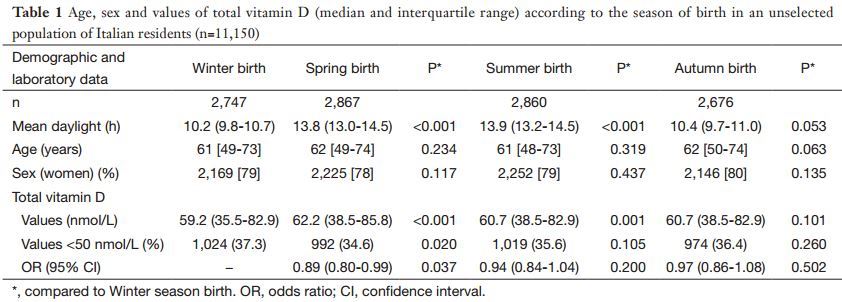
Results: The study population consisted in 11,150 unselected Italian residents (median age 62 years; 8,592 women and 2,558 men). Serum vitamin D values were found to be significantly lower in subjects born in winter than in those born in spring and summer. More specifically, winter season birth was associated with 11% increased risk of developing vitamin D deficiency later in life compared to spring birth . Daily sunlight hours at birth independently predicted vitamin D concentration in adulthood.
Conclusions: The results of this large, cross-sectional retrospective investigation attest that subjects born in winter have a total vitamin D concentration in adulthood that is significantly lower than those born in seasons with longer daylight periods.
Download the PDF from VitaminDWiki
Hypothesis by VitaminDWiki
The fetus developes so as to mimic the vitamin D levels during gestation.
If hypothesis is correct, then seasonal affect could be cancelled
If there had been supplementation during pregnancy
If the person supplements slightly more during his/her life
By the way - I was born in the Spring (3/30/46), so I supplement a bit more than if I had been born in the Fall
See also VitaminDWiki
Season of Birth category listing has items along with related searches
Season of birth associated with Pneumonia (10 %) and Multiple Sclerosis (30 %) – May 2013
Association between season of birth and suicide – perhaps vitamin D – Sept 2012
Odds of living to 100 increase by 40 % if had been born in the fall – 2011
Diseases correlated to month of birth – 2008 which has many charts, such as the following:
