
High intensity exercise increases Vitamin D Receptor activation for a few hours - Dec 2025
High-Intensity Interval Exercise Drives Vitamin D Receptor Expression in Skeletal Muscle via Recruitment of Non-Parenchymal Cells, Not Upregulation in Muscle Fibers
Nutrients . 2025 Nov 28;17(23):3733. doi: 10.3390/nu17233733
Kenneth Ladd Seldeen 1 2, Ni Wang 1, Rupadevi Muthaiah 1, Owen Paul Treanor 1 2, Anna Leigh Davis 1 2, Lee Daniel Chaves 1 2, Ramkumar Thiyagarajan 1, Brandon J Marzullo 3, Donald Albert Yergeau 3, Bruce Robert Troen 1 2

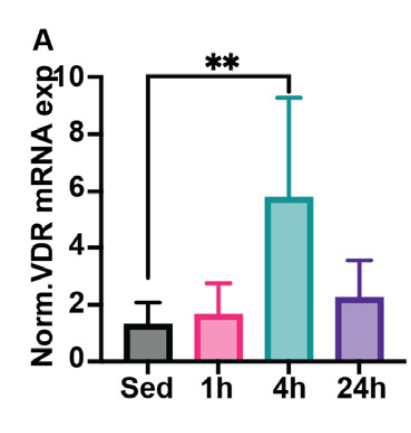
3X increase in VDR 4 hours after HIIE
Background: High-intensity interval exercise (HIIE) is gaining interest as an alternative to traditional moderate-intensity exercise due to its shorter exercise regimens. Yet, it still induces significant muscular adaptations, including metabolic remodeling, enhanced mitochondrial biogenesis, and improved endurance capacity. Exercise has been shown to increase vitamin D receptor (VDR) expression acutely; however, the role of this effect and whether it occurs during HIIE remain to be elucidated.
Objectives/Methods: Here, we investigated the time-dependent effects of a single bout of high-intensity interval exercise (HIIE) on systemic inflammatory cytokine profiles and gene expression, including VDR, in aged skeletal muscle. Sedentary aged mice (male C57Bl/6J at 24 months of age) were provided a 10-min HIIE session, and blood and tissues were harvested at 1-, 4-, and 24-h post-exercise, and compared with sedentary mice.
Results: Our findings indicate that HIIE elicits a transient systemic inflammatory response peaking at 4 h post-exercise and returning to pre-exercise levels by 24 h. Using principal component analysis, we identified a similar pattern in the mRNA profiles, with clear clusters separating sedentary groups at 1 and 4 h after acute HIIE, but not after 24 h. Although VDR mRNA follows this pattern, protein expression, as determined by Western blot and immunohistochemical analysis, reveals persistence at 24 h. As VDR was localized to the periphery of muscle fibers, we investigated and found that VDR co-localizes with PAX7 (a marker for satellite cells) and F4/80-expressing macrophages. This suggests that the observed increase in VDR expression following exercise may be attributed to ancillary cell response during muscle remodeling.
Conclusions: Together, these results provide novel insights into the transient molecular changes occurring 1 and 4 h after HIIE, which subsequently return to baseline after 24 h. This highlights the potential of HIIE in muscle adaptation and recovery, particularly in older individuals.
HIIE and VDR Perplexity AI
Yes, High-Intensity Interval Exercise (HIIE/HIIT) activates the Vitamin D Receptor (VDR), primarily by acutely upregulating its expression.
Research indicates this activation is transient, creating a window of heightened sensitivity to Vitamin D that lasts for at least 1 to 3 hours after a single session.
Key Findings: The "For a While" Window
Evidence suggests that HIIE acts as a potent stimulus that temporarily increases the number of Vitamin D Receptors in skeletal muscle tissue.
- 1-Hour Post-Exercise: A specific study on HIIT found that VDR expression is significantly increased one hour after a single session. This acute upregulation sensitizes the muscle to circulating Vitamin D during the immediate recovery window.[1][2]
- 3-Hour Duration (Resistance Context): While specific to resistance exercise (which shares the anaerobic/mechanical stress component of HIIE), VDR protein expression has been observed to spike immediately post-exercise and remain elevated for 3 hours.[3]
- Chronic Adaptation: Repeated bouts (e.g., a 6-week HIIT protocol) also lead to a sustained increase in baseline VDR expression.[2][1]
Mechanisms of Activation
In the context of your research into Vitamin D mechanics, it is important to distinguish between "activation" (ligand binding) and "expression" (receptor density). HIIE appears to drive both:
1. Receptor Upregulation (Sensitivity)
The primary "activation" seen in literature is an increase in VDR density. This is likely a repair signaling response. Skeletal muscle upregulates VDR to facilitate protein synthesis and hypertrophy pathways (like mTOR) necessary for repairing the micro-damage caused by high-intensity exertion.[4][5] * The p73 Pathway: One identified mechanism for VDR induction is via p73 (a p53 family member). DNA damage or cellular stress—physiological states induced by high-intensity exercise—can trigger p73, which in turn upregulates VDR expression. This suggests the cellular stress of HIIE is the direct trigger for VDR spikes.[6][7]
2. Ligand Availability (Functional Activation)
HIIE may also trigger the actual binding of Vitamin D to the receptor by increasing the local availability of the ligand (Vitamin D itself). * Intramuscular Release: Exercise has been observed to trigger the release of 25(OH)D stored in muscle tissue or fat, transiently increasing circulating levels.[8][9] * Conversion: High-intensity activity may stimulate the local expression of CYP27B1 (the enzyme that converts inactive 25(OH)D to active 1,25(OH)2D) within the muscle, allowing for autocrine/paracrine activation of the VDR right where it is needed for muscle repair.[10]
Summary Table: HIIE Impact on Vitamin D System
| Effect | Duration/Timing | Mechanism |
|---|---|---|
| VDR Upregulation | Elevated at 1 hr, lasts ~3 hrs | Cellular stress (p73), repair signaling (Pax7/mTOR)[3][1] |
| Ligand Release | Immediate / Acute | Release of stored 25(OH)D from muscle/fat tissues[8][9] |
| Chronic Change | Sustained (after ~6+ weeks) | Adaptation to repeated training stimulus[11][2] |
Researcher's Takeaway: The "activation" you are asking about is likely a functional sensitization mechanism. By increasing VDR expression immediately post-exercise, the body prepares the muscle to utilize available Vitamin D for rapid genomic actions related to tissue repair and satellite cell mobilization (Pax7).[12]
1 2 3 4 5 6 7 8 9 10 11 12 13 14 15 16 17 18 19 20 21 22 23 24 25 26 27 28 29 30 31 32 33 34 35 36