
Exercise: a non-supplement way to slow the winter loss of vitamin D - review
Physical activity plays a direct role in the regulation of vitamin D metabolism and status
Frontiers in Endocrinology, 23 November 2026, https://doi.org/10.3389/fendo.2026.2023205
Dylan Thompson, Oliver Perkin, Sophie E. Davies, Martin Hewison, Kerry S. Jones
Speculation
Summary by Claude - November 2026
Bottom line: In two small, carefully controlled UK trials, mostly moderate exercise (about brisk-walking intensity) raised active vitamin D (1,25(OH)₂D₃) after a single session, and 10 weeks of regular exercise kept it from falling over winter — with no supplements and no weight loss. The usual 25(OH)D blood test also fell less, but not significantly.
This peer-reviewed Perspective adds no new data; the authors summarize their own two randomized trials:
- One workout (Davies 2024 crossover RCT, 33 healthy adults): 60 minutes of moderate treadmill exercise vs. 60 minutes of sitting. 25(OH)D rose briefly; 1,25(OH)₂D₃ was still about 13 pmol/L higher an hour later. No blood was drawn between 1 and 24 hours, so how long the boost lasts is unknown.
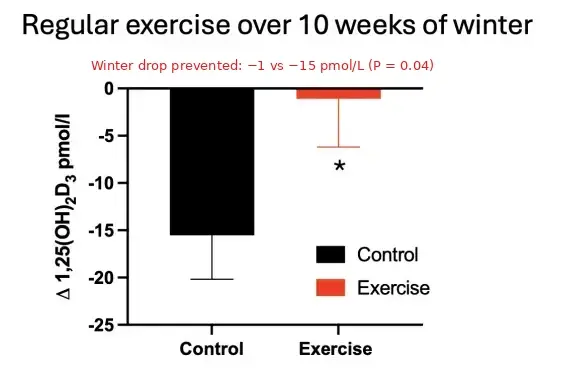
- 10 weeks of winter (Perkin 2025 VitaDEx RCT, 41 sedentary adults, average BMI 34): 4 indoor cardio sessions a week (~166 min), no vitamin D supplements or sunbeds, food adjusted to hold weight steady; starting 25(OH)D about 55 nmol/L (22 ng/mL). Active 1,25(OH)₂D₃ fell 15% in controls but was essentially unchanged with exercise (P = 0.04). 25(OH)D fell 25% (14 nmol/L, 5.6 ng/mL) in controls vs. 15% (8 nmol/L, 3.3 ng/mL) with exercise (P = 0.07).
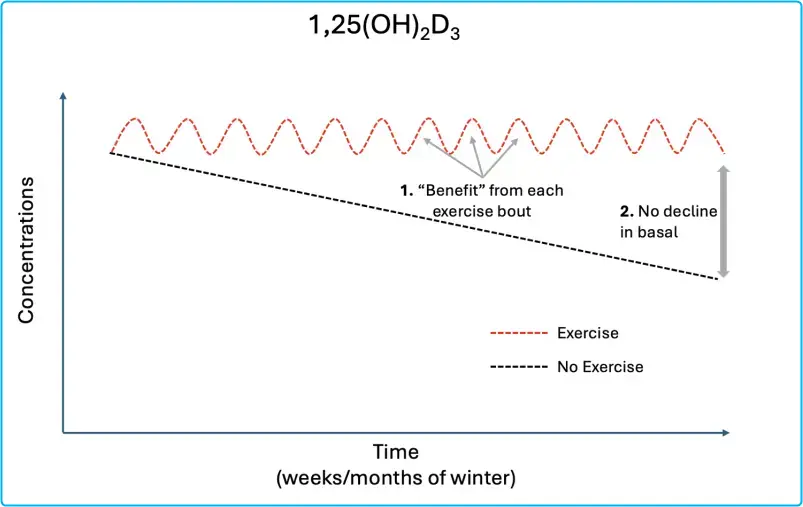
The authors call this "two for the price of one": a brief rise after each session on top of a steadier winter baseline (the drawing below is conceptual, not measured data). They note that vitamin D supplements generally do not raise 1,25(OH)₂D₃, so exercise may act on a different part of the system. Their proposed mechanism — vitamin D released from fat during exercise — is unproven: fat-tissue vitamin D fell equally in both groups.
What this does NOT show
- Any health outcome — only blood levels were measured.
- A significant change in the trial's main outcome, 25(OH)D; the 1,25(OH)₂D₃ result was secondary, with wide uncertainty (0.5 to 26.8 pmol/L).
- That exercise can replace supplements — 25(OH)D still fell in the exercise group.
- Results for lean, older, or already-supplemented people, or for other seasons — or independent confirmation, since the authors reviewed their own trials.
Sources: