
Estradiol 13% lower per doubling of vitamin D in women (borderline after adjusting for weight)
Sex-Specific and Nonlinear Associations Between Serum 25-Hydroxyvitamin D and Sex Hormones in US Adults
International Journal of Endocrinology, 2026 (accepted Oct 17, 2026), https://doi.org/10.1155/ije/8944835
Yi Han, Simin Gao
Summary by Claude Opus 5.5 - November, 2026
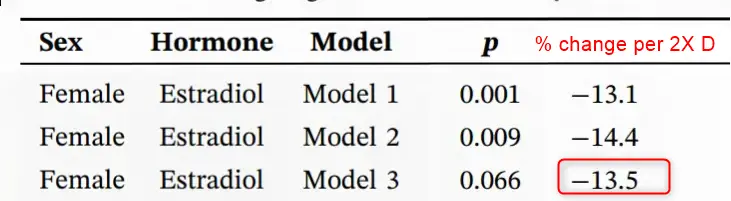
Bottom line: US women with more vitamin D in their blood had more SHBG (sex hormone–binding globulin) and less estradiol. The SHBG link held after adjusting for weight and waist size: about 11% more SHBG per doubling of 25(OH)D. Estradiol was about 13.5% lower per doubling. Adding weight barely changed that estimate (−14.4% → −13.5%), but it widened the uncertainty, leaving it borderline (p = 0.066). In men, vitamin D's apparent links with testosterone, estradiol and SHBG became non-significant once body fat was accounted for.
The study: Cross-sectional analysis of NHANES 2021–2023: 4,801 US adults aged 20+ (2,632 women, 2,169 men). Vitamin D and hormones came from one blood draw; no one was given vitamin D. Women's median 25(OH)D was 15 ng/mL in the deficient group, 25 ng/mL insufficient and 40 ng/mL sufficient. "Per doubling" means, for example, going from 20 to 40 ng/mL.
Fully adjusted results (age, race, education, income, smoking, alcohol, BMI, waist):
| Hormone | Women: % change per 2× D | Women p | Men: % change per 2× D | Men p |
|---|---|---|---|---|
| SHBG | +10.8% | 0.028 | +2.3% | 0.293 |
| Estradiol | −13.5% | 0.066 | −3.0% | 0.200 |
| Free testosterone index | −12.0% | 0.054 | +1.3% | 0.617 |
| Total testosterone | −2.5% | 0.457 | +3.7% | 0.237 |
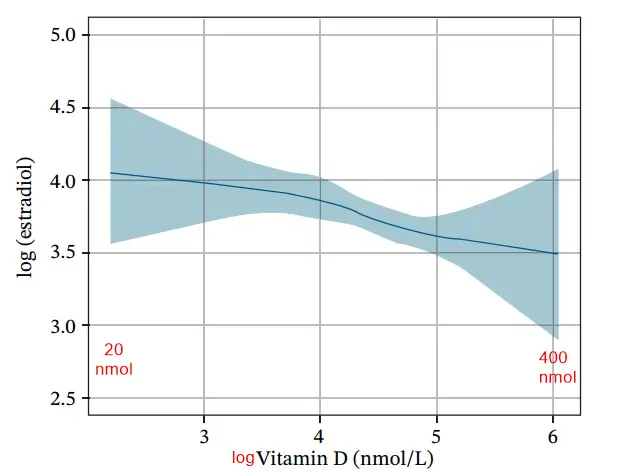
Shape of the curves in women: SHBG was lowest at about 20–24 ng/mL (50–60 nmol/L) and rose above that. The free testosterone index fell until about 40–48 ng/mL, then leveled off. Estradiol declined in a roughly straight line. An earlier study of young women found about 3% lower luteal-phase estradiol per 10 nmol/L more 25(OH)D Knight 2010. That works out to about 14% across 20 → 40 ng/mL, close to this paper's figure.
What this does NOT show
- That taking vitamin D changes sex hormones. A one-time snapshot cannot separate cause from effect, and the authors call the curve shapes "hypothesis-generating."
- Whether menopause explains the estradiol result. The highest vitamin D group was 14 years older than the lowest (54 vs 40), and menopause status was not analyzed.
- The role of birth-control pills, hormone therapy, pregnancy or menstrual-cycle phase. None was adjusted for, and estrogen-containing pills raise SHBG and have been linked to 20% higher 25(OH)D.
- Where the vitamin D came from (sun or supplements), or the effects of sun exposure, diet and exercise.
- A separate free-testosterone finding. The index is testosterone divided by SHBG, so it falls automatically when SHBG rises.
- Stronger proof from the bootstrap check. Its smaller p-values (estradiol p = 0.011) ignored the NHANES survey design.
Related in VitaminDWiki
- Estrogen has a bidirectional relationship with Vitamin D, VDR, and Vitamin D Binding protein
includes RCT data on estradiol and SHBG in postmenopausal women - The menstrual cycle is regulated by vitamin D
- Oral contraceptives may reduce or increase vitamin D
- Analysis of 280 Breast Cancer meta-analyses – umbrella
high SHBG was a "convincing" protective factor - Vitamin D Danger - Women need 70 ng for optimal Estrogen - video and transcript
- Total Testosterone increased if take more than 4,000 IU vitamin D daily – meta-analysis
- Vitamin D and fertility: a systematic review