Dr. Rosen, chair of Endocine Society Task Force, wants more vitamin D evidence
Clifford J. Rosen seems to speak both for the Institute of Medicine AND the Endocrine Society - strange
The Nonskeletal Effects of Vitamin D: An Endocrine Society Scientific Statement
Clifford J. Rosen , John S. Adams, Daniel D. Bikle, Dennis M. Black, Marie B. Demay, JoAnn E. Manson, M. Hassan Murad and Christopher S. Kovacs
Tufts University School of Medicine (C.J.R.), Boston, Massachusetts 02111; UCLA-Orthopaedic Hospital Department of Orthopedic Surgery (J.S.A.), University of California, Los Angeles, California 90095; University of California (D.D.B.), San Francisco, California 94121; Department of Epidemiology and Biostatistics (D.M.B.), University of California, San Francisco, California 94143; Endocrine Unit (M.B.D.), Massachusetts General Hospital, Harvard Medical School, Boston, Massachusetts 02114; Harvard Medical School (J.E.M.), Brigham and Women's Hospital, Boston, Massachusetts 02215; College of Medicine (M.H.M.), Mayo Clinic, Rochester, Minnesota 55905; and Memorial University of Newfoundland (C.S.K.), St. John's, Newfoundland and Labrador, Canada A1B 3V6
Address all correspondence and requests for reprints to: Clifford J. Rosen, M.D., Maine Medical Center Research Institute, 81 Research Drive, Scarborough, Maine 04074-7205. E-mail: crofen@gmail.com.
Significant controversy has emerged over the last decade concerning the effects of vitamin D on skeletal and nonskeletal tissues. The demonstration that the vitamin D receptor is expressed in virtually all cells of the body and the growing body of observational data supporting a relationship of serum 25-hydroxyvitamin D to chronic metabolic, cardiovascular, and neoplastic diseases have led to widespread utilization of vitamin D supplementation for the prevention and treatment of numerous disorders. In this paper, we review both the basic and clinical aspects of vitamin D in relation to nonskeletal organ systems. We begin by focusing on the molecular aspects of vitamin D, primarily by examining the structure and function of the vitamin D receptor. This is followed by a systematic review according to tissue type of the inherent biological plausibility, the strength of the observational data, and the levels of evidence that support or refute an association between vitamin D levels or supplementation and maternal/child health as well as various disease states. Although observational studies support a strong case for an association between vitamin D and musculoskeletal, cardiovascular, neoplastic, and metabolic disorders, there remains a paucity of large-scale and long-term randomized clinical trials. Thus, at this time, more studies are needed to definitively conclude that vitamin D can offer preventive and therapeutic benefits across a wide range of physiological states and chronic nonskeletal disorders.
Received January 5, 2012; Accepted April 18, 2012.
Paper is behind a paywall
Conclusions of the paper from CBC News
Vitamin D pills, gels or ointments may be useful in treating skin disorders such as psoriasis but large, placebo-controlled clinical trials are needed to test if it works to prevent or treat skin cancer.
There's no strong evidence that vitamin D supplementation reduces the risk of Type 2 diabetes or metabolic syndrome, a group of risk factors like high blood pressure, high blood sugar, excess abdominal fat, abnormal cholesterol levels and obesity that occur together.
The supplements are likely to reduce the risk of falls, especially in those who have low levels and are also taking calcium pills.
Observational evidence is strongest for vitamin D reducing colorectal cancer but the proof is weak or inconsistent for cancer overall and breast and prostate tumours.
There's not enough evidence from clinical trials to support taking vitamin D to lower cardiovascular disease risk.
– – – – – – – – –
Recent publication by Clifford J. Rosen
IOM committee members respond to endocrine society vitamin D guideline.
J Clin Endocrinol Metab. 2012 Apr;97(4):1146-52. Epub 2012 Mar 22.
Rosen CJ , Abrams SA, Aloia JF, Brannon PM, Clinton SK, Durazo-Arvizu RA, Gallagher JC, Gallo RL, Jones G, Kovacs CS, Manson JE, Mayne ST, Ross AC, Shapses SA, Taylor CL.
Maine Medical Center Research Institute, 81 Research Drive, Scarborough, Maine 04074, USA. crofen@gmail.com
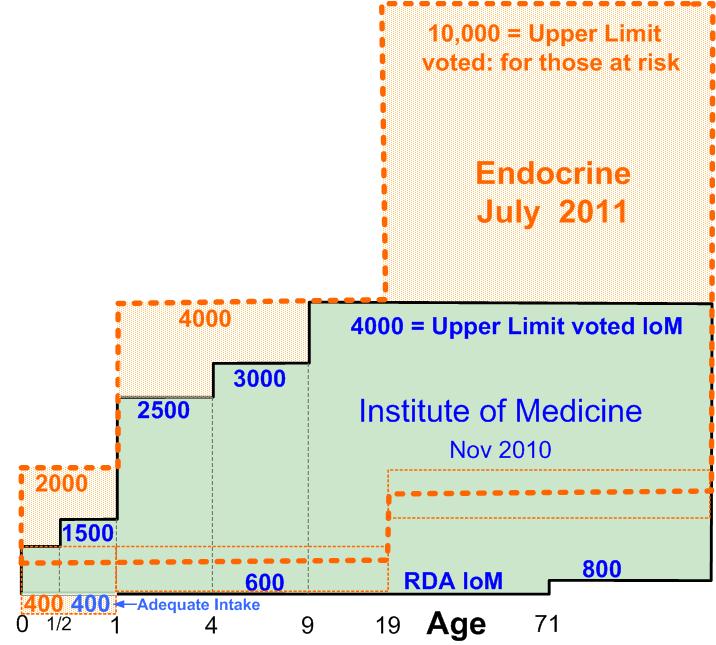
In early 2011, a committee convened by the Institute of Medicine issued a report on the Dietary Reference Intakes for calcium and vitamin D. The Endocrine Society Task Force in July 2011 published a guideline for the evaluation, treatment, and prevention of vitamin D deficiency. Although these reports are intended for different purposes, the disagreements concerning the nature of the available data and the resulting conclusions have caused confusion for clinicians, researchers, and the public. In this commentary, members of the Institute of Medicine committee respond to aspects of The Endocrine Society guideline that are not well supported and in need of reconsideration. These concerns focus on target serum 25-hydroxyvitamin D levels, the definition of vitamin D deficiency, and the question of who constitutes a population at risk vs. the general population.
PMID: 22442278
– – – – – – – – – – – –
See also VitaminDWiki
Vitamin D insufficiency - NEJM Jan 2011 by Clifford J. Rosen
Google site search for (CJ OR Clifford) rosen 77 items in VitaminDWiki May 2012
Endocrine Society recommend higher vitamin D levels – June 2011 which has the following chart