
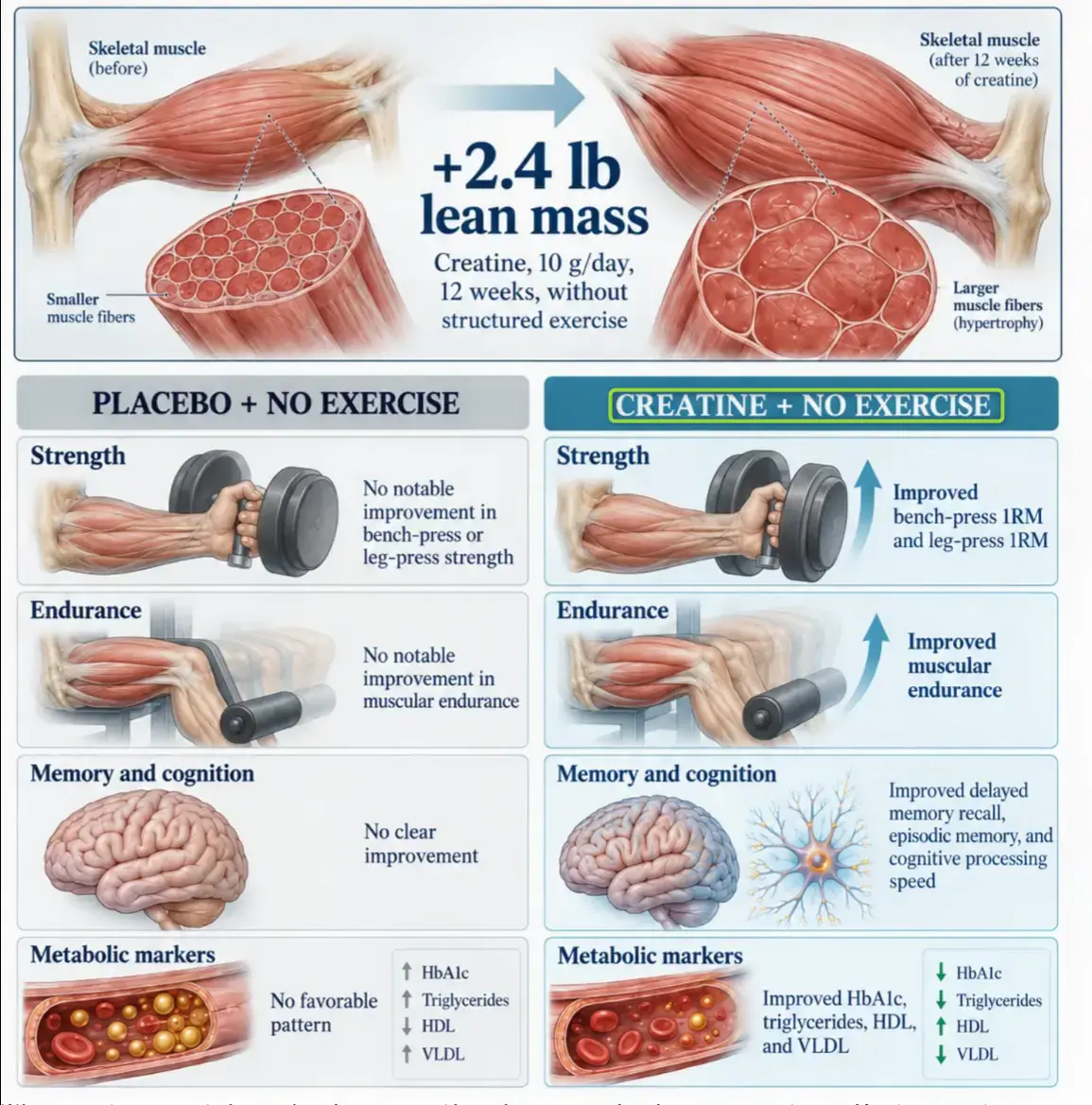
Creatine 10 g/day added about 1 kg of lean mass in 12 weeks in sedentary 45–65-year-olds, even without exercise - RCT
Effects of creatine supplementation with and without exercise and diet intervention on body composition, cognitive function, and markers of health in middle-aged and older adults
Journal of the International Society of Sports Nutrition, 11 Aug 2026, https://doi.org/10.1080/15502783.2026.2716273
Jisun Chun, Yuhang Liu, Giuliet L. Kibler, Hudson Lee, Khatereh Babakhani, Nathaniel Rhoades, Ian Bivins, Joungbo Ko, Broderick Dickerson, Drew E. Gonzalez, Ryan J. Sowinski, Chris J. Rasmussen, Richard B. Kreider
Summary by Claude Opus 5.5 - October 2026
In sedentary middle-aged adults, 10 g/day of creatine monohydrate for 12 weeks added about 1 kg of lean mass and increased strength, with or without an exercise program. The reported memory and blood-marker benefits are scattered and much less certain.
Study: This was a randomized, double-blind, placebo-controlled trial. 73 people enrolled and 64 were analyzed (40 women and 24 men; average age 54.5; average BMI about 30). Each person first chose either a supervised program or no program. The program was resistance plus aerobic training 3×/week with a 300–500 kcal/day calorie deficit. Within each choice, people were randomized to creatine (2 × 5 g/day) or a maltodextrin placebo. Vitamin D status was not measured.
Results at 12 weeks
- Lean mass (by DXA scan) rose 1.3 kg with exercise + creatine and 1.1 kg with creatine alone. Neither placebo group changed.
- Body fat fell 3.2 percentage points with exercise + creatine, versus 1.9 with exercise + placebo.
- Leg-press and bench-press gains were larger with creatine. Judging from the figures, creatine alone roughly matched exercise + placebo. Aerobic capacity (VO₂peak) did not change.
- Most of the 8 cognitive tests showed no creatine effect. A few pairwise gains appeared, but tension and self-rated forgetfulness were worse in the creatine-only group. The authors state: "Individual cognitive and biomarker findings should be interpreted as exploratory."
- HbA1c fell in the creatine-only group, while fasting glucose did not change.
- Creatinine rose slightly and calculated eGFR fell by up to 20%. This is expected because creatine breaks down into creatinine. Cystatin C, which isn't affected by creatine, was not measured.
- Side effects matched placebo.
What this does NOT show
- It says nothing about people in their 70s–80s or frail adults, because everyone was aged 45–65.
- Not all of the "lean mass" is necessarily muscle.
DXA counts water, and creatine draws water into muscle. - It does not show that creatine burns more fat. Fat-mass loss with exercise + creatine did not differ significantly from exercise + placebo. The larger drop in body-fat percentage came mostly from added lean mass.
- The findings may not be robust. Groups had only 13–20 people, dozens of outcomes were tested with no correction for multiple comparisons, and the trial was registered after enrollment began.
- The senior author chairs the scientific advisory board of AlzChem, which supplied the creatine.
Note
- Only the supplement was randomized. Participants chose for themselves whether to exercise, so the comparisons between the exercise and no-exercise arms are observational.
- There are conflicts of interest. Senior author Kreider chairs the scientific advisory board of AlzChem, which supplied the creatine. He co-founded the society that publishes the journal, and he is the only author credited with the formal analysis.
- The trial was registered retrospectively: first enrollment was July 2024, but it wasn't submitted to the registry until April 2025.
- The lean-mass gain in the exercise + creatine group peaked at 6 weeks (+1.69 kg) and then fell to +1.27 kg at 12 weeks. A fast early rise followed by a dip is the typical pattern of water loading.
- The creatine-only group ate significantly more calories and carbohydrate than the other groups, which may have contributed to its lean-mass gain.
- Nearly all the multivariate cognitive tests were null. The Discussion claims a picture-recognition benefit that the Results section says was not significant. I kept the summary to what the Results support.
- The paper contradicts itself on diet. Methods say "all participants" followed the calorie-deficit diet, but Results describe the no-exercise groups as keeping their usual intake.
- This trial used 10 g/day, double the usual 3–5 g dose
Related in VitaminDWiki
- Sarcopenia (muscle loss) is reduced by vitamin D and many other supplements
- Sarcopenia with obesity is more likely if dark skin, diabetes, OR COPD (all associated with low vitamin D)
- Added 1 lb of muscle to sarcopenia adults in 13 weeks with just 800 IU vitamin D and protein – RCT
- Skeletal Muscles regenerated with Vitamin D supplementation – review
- Omega-3 improves elderly muscles – 2 meta-analyses
- Protein aids muscle gain – meta-analysis
- Dietary Protein, Muscle and Physical Function in the Very Old
The founder of VitaminDWiki has noticed significant muscle growth after taking Protein + Creatine along with intense exercise