
Anorexia and bulimia: age-adjusted cases up 21% since 1990
Global Burden of Anorexia Nervosa and Bulimia Nervosa, 1990 to 2023, With Forecasts to 2050 = A Global Burden of Disease Study 2023 Analysis
JAMA Psychiatry Oct 2-26 doi: 10.1001/jamapsychiatry.2026.3457
Ruhai Bai, PhD1,2; Wanyue Dong, MD3; Xu Wang, PhD4 et al
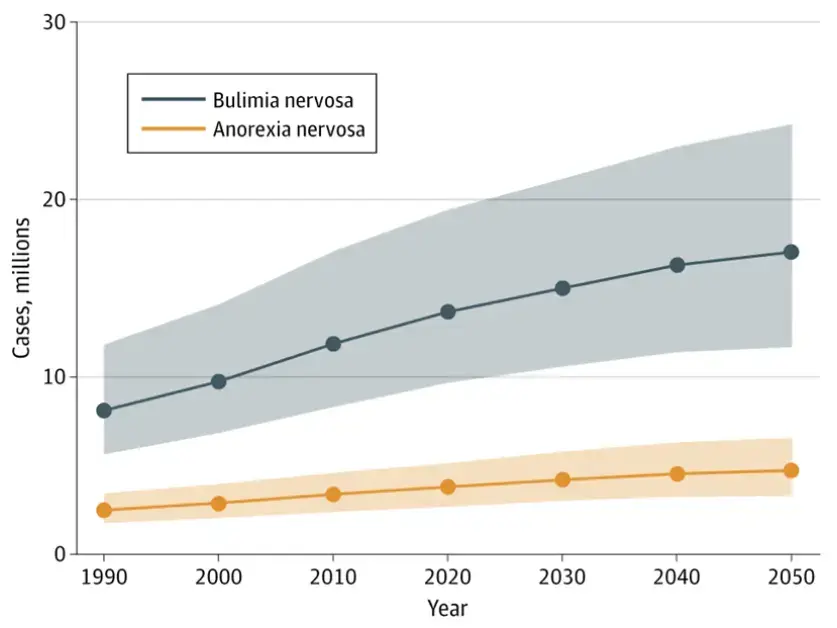
How much have eating disorders increased?
Claude AI - Oct 2026
The article is wrong on one point: 71% is not the rise in incidence (new cases). It's the rise in the number of people living with anorexia or bulimia. Since 1990, the global number of prevalent cases increased by 71.0%, while age-standardized prevalence and DALY rates rose by about 21%. [Bai 2026]
- Population growth and aging explain most of the 71%. The rise in risk per person is about 21% over 33 years, roughly 0.6% a year. In the full text, age-adjusted prevalence rose 17% for anorexia and 21.7% for bulimia. [Bai full text]
- Even the 21% may not be a true increase. The authors say it could reflect real change, changing diagnostic criteria, social shifts or the structure of their model, and they can't separate these.
- Only two disorders were counted. Binge eating disorder (the most common one) and "other specified" eating disorders were left out, and atypical anorexia falls in that second group. That's why Levinson says the true burden is higher.
COVID-19 did cause a real, sharp jump in new diagnoses among young people. The incidence of eating disorders during the covid pandemic increased and those diagnosed had an increased risk of attempting suicide. [Taquet 2022 summary]
How much is due to GLP-1 drugs?
For 1990–2023: essentially none.
- Semaglutide was approved for weight loss in 2021, and mass use came later. Most of the 33-year rise happened before that.
- The paper's forecasts were built on 1990–2019 data, and it doesn't mention GLP-1s at all.
Since about 2022: the warning signs are real, but no study yet shows the drugs cause new cases.
- Levinson's survey [Peiper 2026]: 32.1% reported lifetime use of a GLP-1 receptor agonist, while 22.0% reported current use. About 10% reported misuse. But use was highest in binge eating disorder (54.6%) and lowest in anorexia (11.2%). That pattern is what you'd expect from heavier patients with a medical reason to take the drugs, not necessarily from abuse.
- Off-label prescriptions [Cosmos/Obesity 2026]: 1.8% of GLP-1 recipients had eating disorders, compared with 0.3% of non-recipients. These were existing histories, so the likely direction is people with eating disorders seeking the drugs, not the drugs causing the disorders. The researchers could not reliably distinguish between different types of eating disorders. [Gizmodo]
- New diagnoses after starting a GLP-1 [TriNetX/ISPOR 2024]: 1.23% of patients with prior mental health history (384 patients) and 0.51% without (160 patients) were diagnosed with an ED within two years of treatment. There was no comparison group of non-users, so these numbers can't be blamed on the drug.
- Severe obesity cohort [Maynard]: GLP1-RAs may not significantly worsen ED risk or psychological distress in adults with Class 3 obesity.
- Binge eating may improve on the drugs [Richards 2023]: Patients receiving semaglutide only exhibited greater reductions in BES scores compared to the other groups.
My read: the effect is probably uneven rather than a simple increase.
- GLP-1s likely trigger relapses and worsen restrictive disorders (anorexia and atypical anorexia), especially with easy online and compounded access.
- At the same time, they may reduce binge eating disorder, which is far more common.
- Total case counts could therefore change little, while the mix shifts toward the deadliest disorder.
That's why experts are now pushing for screening. In a recent expert consensus, 94.7% agreed that clinicians should assess every individual for a current or previous eating disorder before initiating a GLP-1RA. [Delphi consensus]
Levinson's prediction that cases may double again is based on what she sees in her clinic, not on population data.
Sources:
- [Peiper/Levinson, JAMA Psychiatry 2026 – Healio]
- [Off-label GLP-1 study – MedBound Times]
- [Off-label GLP-1 study – Gizmodo]
- [TriNetX ISPOR 2024 abstract]
- [Maynard et al., Int J Eat Disord]
- [Richards et al., Obesity Pillars 2023]
- [Taquet 2022 – ACAMH summary]
- [GLP-1 eating disorder Delphi consensus, World Psychiatry 2026]
- [MIT Technology Review article]
People with anorexia nervosa have lower levels of vitamin (Need gut-friendly form?) meta-analysis Nov 2014
Vitamin D status in anorexia nervosa: A meta-analysis
https://doi.org/10.1002/eat.22370 PDF
Nicola Veronese MD, Marco Solmi MD, Wanda Rizza MA, Enzo Manzato MD, Giuseppe Sergi MD, Paolo Santonastaso MD, Lorenza Caregaro MD, Angela Favaro MD, PhD, Christoph U. Correll MD
Objective In anorexia nervosa (AN), osteoporosis and osteopenia are common, which have been associated with low circulating levels of vitamin D (VitD) in other settings. We aimed to meta-analyze cross-sectional studies reporting on VitD parameters in patients with AN and healthy controls (HCs).
Method Electronic PubMed search from database inception until December 31, 2013 and meta-analysis of cross-sectional studies comparing serum levels of 25-hydroxyvitamin D (25OH-D), 1,25-dihydroxyvitamin D (1,25OH-D) and dietary VitD between patients with AN and HCs, before or after VitD supplementation. We calculated random effects standardized mean differences (SMDs) ±95% confidence intervals (CIs) as effect size measures.
Results Out of 1,739 initial hits, 15 studies with a total of 927 participants (AN = 408 and HCs = 519) were meta-analyzed. In the unsupplemented state, both serum 25OH-D (studies = 4; n = 168; SMD = −0.43; 95%CI: −0.83 to −0.03; p = .03) and 1,25OH-D levels (studies = 4; n = 113; SMD = −1.06; 95%CI: −1.47 to −0.66; p < .00001) were significantly lower in AN than HCs. In AN patients treated with cholecalciferol supplementation, serum 25OH-D levels were significantly higher than in HCs (studies = 5; n = 449; SMD = 0.66; 95%CI: 0.01–1.31; p = .05).
Paradoxically, despite lower 25OH-D and 1,25OH-D levels, AN patients reported similar intake of VitD compared to HCs (studies = 6; n = 314; SMD = 0.33; 95%CI: −0.16, 0.81; p = .19).
Discussion Although AN patients reported similar dietary VitD intake compared to HCs, AN patients had significantly lower 25OH-D and 1,25OH-D levels without supplementation. Conversely, supplementation with cholecalciferol fully normalized VitD serum levels. Future studies are needed to clarify the role of VitD supplementation in AN for improving bone health. © 2014 Wiley Periodicals, Inc. (Int J Eat Disord 2015; 48:803–813)
Related in VitaminDWiki
- Anorexia nervosa and Vitamin D - several studies
- 2.8 X higher risk of eating disorder in teen girls if mom had low Vitamin D while pregnant
- Adults with eating disorders consumed less than 400 IU of vitamin D – meta-analysis
- Gut-Friendly Vitamin D greatly increases vitamin D absorption for those with poor guts
- Liposomal Vitamin D appears to have a 3X faster and better response
somewhat gut friendly