
Acute Respiratory Infections in children admitted to the hospital were 2X worse if low Vitamin D
Prevalence of Vitamin D Deficiency and its Association with Disease Severity in Children Hospitalized with Acute Respiratory Infections - 2025
Curr Health Sci J, vol. 51, no. 4, 2025 DOI 10.12865/CHSJ.51.04.07
Background: Vitamin D deficiency (VDD) is highly prevalent in pediatric patients, and it has been implicated in the pathogenesis and clinical severity of acute respiratory infections (ARI). Objectives: To evaluate the prevalence of VDD and its association with ARI disease severity and clinical outcomes in hospitalized pediatric patients.
Methods: A 4-year prospective case-control study, conducted between 2021 and 2024, in two Romanian pediatric hospitals, included 400 inpatients, aged 0-18 years, admitted for ARI. Patients were stratified into cases with a low level of vitamin D (n=200) and controls with a normal vitamin D (n=200). Clinical severity of ARI, inflammatory biomarkers, presence of fever, need for supplemental oxygen, and length of hospital stay were recorded and analyzed in both cases and controls.
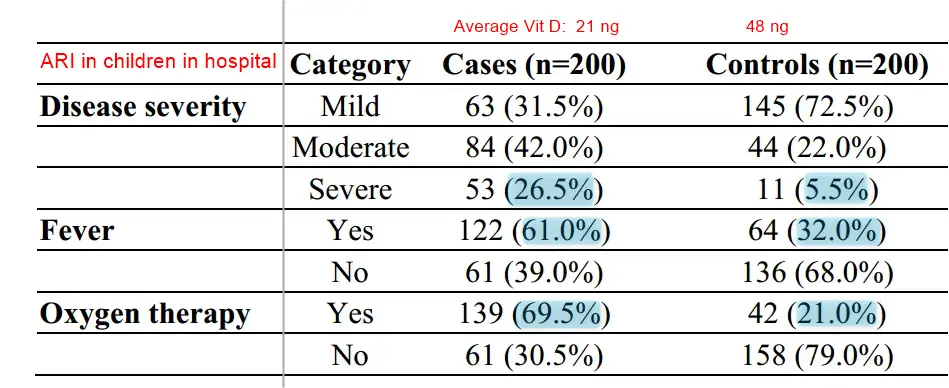
Results: Low serum vitamin D levels were significantly associated with
- severe ARI (26.5% vs. 5.5%),
- fever at admission (61.0% vs. 32.0%), and
- increased requirement for oxygen therapy (69.5% vs. 21.0%).
Cases also exhibited
- higher C-reactive protein levels (3.50 vs. 1.64mg/L),
- higher clinical severity scores (3.77 vs. 1.62), and
- longer hospital length of stay (4.68 vs. 2.89 days).
Conclusions: Vitamin D deficiency was strongly associated with increased disease severity and adverse clinical outcomes in pediatric inpatients with ARI.
Related in VitaminDWiki
- Treat 10 people with Vitamin D in the winter to prevent 1 Acute Respiratory Infection - meta-analysis 2026
- Cost-effective to give Vitamin D to all children to prevent acute respiratory infection
- Respiratory infection in infant was 7 X more likely if low cord Vitamin D
- Fewer respiratory infections if optimal level of vitamin D (more than 47 ng)
Respiratory infections reduced by 63 percent with 4000 IU vitamin D daily - RCT
- Click on Tag at page bottom for more titles