
1 in 4 N.F.L. Players Gets Brain Disease (C.T.E.)
Study’s Alarming Finding: At Least 1 in 4 N.F.L. Players Gets Brain Disease - NYT Aug 2026
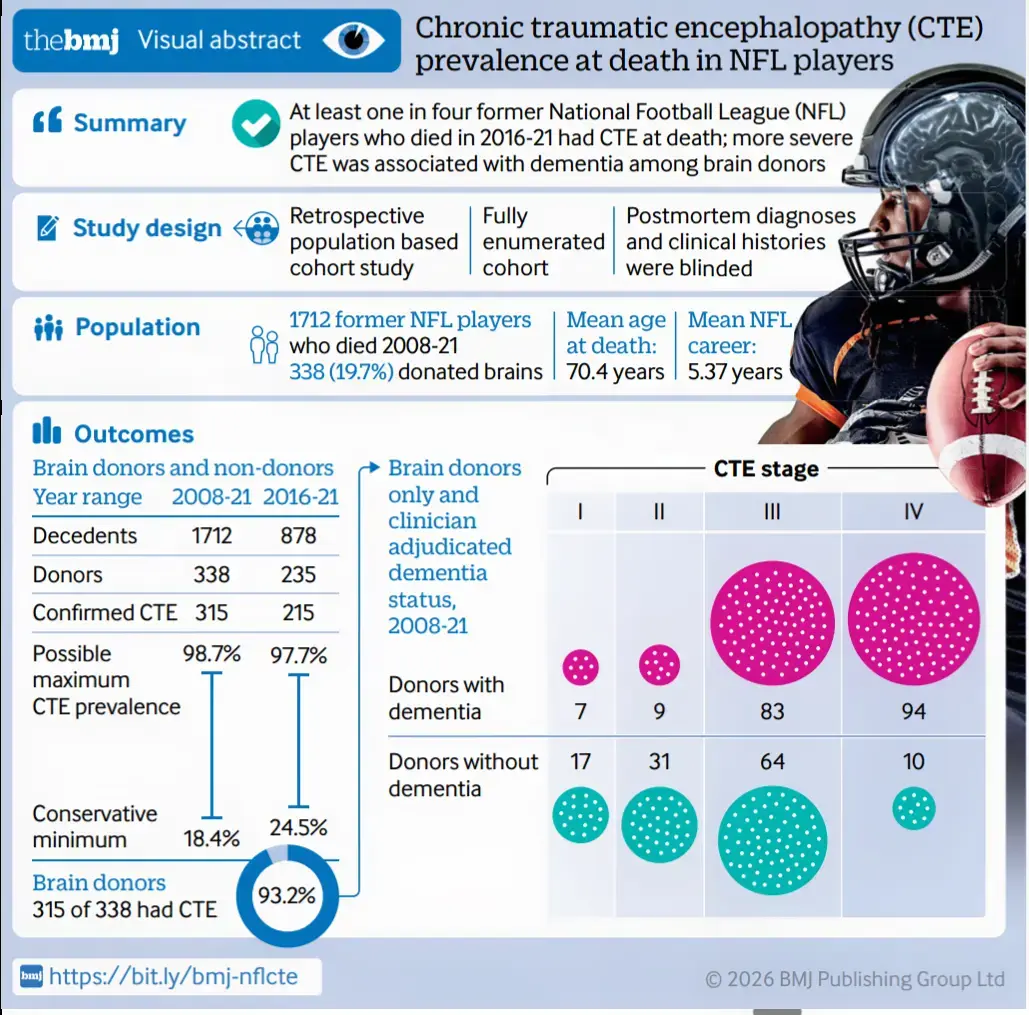
Prevalence of chronic traumatic encephalopathy at death in National Football League players: retrospective population based cohort study, 2008-21
BMJ 2026; 394 doi: https://doi.org/10.1136/bmj-2026-100418
CTE Summary by ChatGPT
CTE (chronic traumatic encephalopathy) is a progressive neurodegenerative disease associated with repeated head impacts, including concussions and impacts that do not cause obvious concussion symptoms.
It is particularly important in sports such as American football, boxing, hockey, soccer, rugby, and other activities involving repeated blows to the head.
What happens in CTE?
The characteristic abnormality is accumulation of an abnormal form of the protein tau in the brain. Over many years, tau can become abnormally phosphorylated and form clumps around small blood vessels and in characteristic regions of the brain.
Over time, this can be associated with:
- Memory loss
- Difficulty concentrating and thinking
- Impaired judgment
- Depression or apathy
- Irritability and impulsivity
- Problems with balance and movement
- Eventually, dementia in some people
The disease is generally thought to develop years or decades after the repetitive head impacts, rather than immediately following a concussion.
An important distinction: CTE vs. concussion
A concussion is an injury event. CTE is a long-term neurodegenerative disease that has been associated with repetitive head impacts.
Having one or even several concussions does not mean that a person will develop CTE. In fact, researchers still cannot reliably predict which individuals exposed to repetitive head impacts will eventually develop it.
And the number of diagnosed concussions isn't necessarily a good measure of exposure. A person can experience hundreds or thousands of subconcussive impacts without recognizing them as concussions.
Can CTE be diagnosed in a living person?
This is one of the major difficulties.
At present, definitive CTE can only be diagnosed after death by examining brain tissue. Researchers look for a characteristic pattern of abnormal tau deposits.
Doctors can diagnose and treat symptoms in a living person and may suspect that past repetitive head trauma is contributing to those symptoms, but there isn't currently a sufficiently validated blood test, brain scan, or other test that can definitively diagnose CTE during life.
How common is it?
This is surprisingly difficult to determine.
Studies of brains donated by former athletes have found CTE at substantial rates, particularly among former professional football players. But these brain banks are not representative samples of all people who played sports—families often donate brains because the person had concerning neurological or behavioral symptoms.
Consequently, you cannot take the percentage of CTE found in donated brains and say, for example, "X% of football players get CTE."
CTE has stages
Researchers have described four pathological stages, based largely on the amount and distribution of abnormal tau:
| Stage | General description |
|---|---|
| Stage I | Small, relatively localized tau abnormalities |
| Stage II | More extensive abnormalities |
| Stage III | Substantial spread of tau and brain changes |
| Stage IV | Widespread severe tau pathology, often accompanied by substantial brain degeneration |
Importantly, pathological severity and symptoms don't always correspond perfectly. Some people with substantial CTE pathology had relatively few symptoms during life, while others with symptoms may have had relatively limited pathology.
What causes the damage?
The leading hypothesis is that repetitive acceleration/deceleration and rotational forces on the brain produce microscopic injury. Repeated injury may trigger abnormal protein processing, inflammation, disruption of axons, and eventually abnormal tau accumulation.
One particularly interesting aspect is that the total number and type of head impacts may matter more than the number of diagnosed concussions.
Is CTE unique to football? - No.
CTE has been reported in people with histories of repeated head impacts from:
- Boxing
- American football
- Ice hockey
- Rugby
- Soccer
- Wrestling
- Military blast exposure
- Other contact/collision sports
But again, the precise relationship between exposure and eventual disease remains an active area of research.
A very important recent development
Researchers now distinguish CTE pathology from the clinical syndrome that can occur during life.
You may encounter the term TES — traumatic encephalopathy syndrome. TES refers to a proposed clinical syndrome involving combinations of cognitive, behavioral, mood, and/or neurological problems in someone with substantial repetitive head-impact exposure.
That distinction is useful because CTE itself is a pathological diagnosis, whereas TES is an attempt to identify people who might have the disease while they are still alive.
One thing that makes CTE especially interesting
CTE is somewhat different from Alzheimer's disease.
Alzheimer's is characterized primarily by amyloid-β plaques and tau neurofibrillary tangles, whereas CTE has a distinctive distribution of abnormal tau associated with repetitive trauma.
However, older people can have CTE pathology together with Alzheimer's, Lewy body disease, vascular disease, and other brain pathologies. So the real-world picture can be considerably more complicated than "CTE versus Alzheimer's."
Compare CTE with TBI
TBI is an injury event or spectrum of injuries, whereas
CTE is a chronic neurodegenerative disease that can develop after repeated head impacts.
They overlap, but they are not the same thing.
CTE vs. TBI
| Feature | TBI — Traumatic Brain Injury | CTE — Chronic Traumatic Encephalopathy |
|---|---|---|
| What is it? | Injury to the brain caused by a blow, jolt, blast, or penetrating injury | Progressive neurodegenerative disease associated with repetitive head impacts |
| Typical cause | One event can be enough | Usually years of repeated head impacts |
| Number of impacts | Can occur after one significant injury | Risk increases with cumulative repetitive impacts |
| Concussion | A form of mild TBI | Repeated concussions can contribute, but concussions are not required |
| Symptoms | Often begin immediately or within hours/days | May emerge years or decades later |
| Course | Often improves over days–months; some produce persistent disability | Potentially progressive over many years |
| Main pathology | Axonal injury, inflammation, vascular injury, neuronal injury, etc. | Characteristic abnormal phosphorylated tau (p-tau) accumulation |
| Dementia | Severe/repeated TBI can increase dementia risk | Severe CTE is strongly associated with dementia |
| Diagnosis during life | Usually possible using history, examination and imaging/testing | Definitive CTE diagnosis currently requires examination of brain tissue after death |
| Treatment | Acute management + rehabilitation and symptom treatment | No proven disease-modifying treatment yet |
| Does everyone with it develop CTE? | No | No—many people exposed to repeated impacts do not develop CTE |
The NINDS consensus criteria emphasize that CTE is specifically associated with repetitive head impacts, including impacts that did not produce a clinically recognized concussion or TBI. (PubMed Central (PMC))
The relationship is roughly:
Head impact → TBI/concussion in some cases → repeated impacts → cumulative brain damage → in some people, CTE
But there is an important complication: repeated head impacts can damage the brain even when there is no diagnosed TBI or concussion. Studies have found early neuronal loss, inflammation, and vascular changes before the characteristic CTE tau pathology appears. (National Institutes of Health)
One TBI vs. repeated TBI
This is particularly important.
A person could have:
One serious TBI → substantial brain damage → long-term cognitive/motor problems → increased risk of later neurodegenerative disease
without having CTE.
Conversely:
Thousands of relatively mild/subconcussive impacts → cumulative microscopic injury → neuroinflammation and other brain changes → increased risk of CTE
even though the person may remember very few actual concussions. The amount of repetitive head impact exposure appears to be more important for CTE risk than simply counting diagnosed concussions. (National Institutes of Health)
CTE is more than "old TBI"
This distinction is worth emphasizing.
TBI is fundamentally an injury. CTE is classified as a neurodegenerative disease. Its defining pathological feature is an unusual pattern of phosphorylated tau around small blood vessels and at the depths of cortical sulci. (PubMed Central (PMC))
And there is an important new finding from 2026: an NIH-supported study of 614 donated brains found that severe CTE (stages III–IV) was strongly associated with dementia, whereas mild CTE (stages I–II) was not associated with measurable cognitive, functional, or dementia symptoms in that study. Stage IV CTE was associated with about 4.5 times the likelihood of a dementia diagnosis compared with people without CTE. (National Institutes of Health)
That is an important correction to the sometimes-heard statement that "CTE causes dementia." The relationship is much clearer for advanced CTE than for early CTE.
Another important distinction: TES vs. CTE
There is a terminology issue that can cause considerable confusion:
- CTE = the pathological disease found in the brain after death.
- TES (traumatic encephalopathy syndrome) = the clinical syndrome that researchers use to describe living people who have substantial repetitive head-impact exposure plus progressive cognitive and/or neurobehavioral problems.
A person can therefore have symptoms and meet criteria for TES without doctors being able to say with certainty that the person has CTE. (PubMed Central (PMC))
In a nutshell
I'd summarize the difference this way:
TBI is the damage caused by a traumatic event;
CTE is a potentially progressive brain disease associated with accumulating many such impacts over time.
And perhaps the most interesting research question now is what happens in the brain between the repetitive impacts and eventual CTE. NIH research in 2025–2026 suggests that inflammation, blood-vessel abnormalities, and neuronal loss can appear years before the characteristic tau pathology of CTE. (National Institutes of Health)
If you'd like, I can next compare CTE, TBI, Alzheimer's disease, Parkinson's disease, and vascular dementia—including the differences in tau, amyloid, neuroinflammation, mitochondria, and blood-brain-barrier damage. That comparison is quite revealing.
Rugby players: More than half of donated brains had CTE - Sept 2026
Related in VitaminDWiki
- Result of 5 years of Vitamin D given to athletes in a high school: $60 million in scholarships, almost zero concussions, etc.
- Concussions (traumatic brain injury) getting big press coverage, vitamin D might be both a cause and a solution
- Traumatic brain injury treated by Vitamin D Progesterone Omega-3 and glutamine
- Dementia risk increased 2.4 X following TBI, even if had not lost consciousness
- TBI reduced 5X by 300,000 IU of vitamin D (injection) – RCT
- Dementia risk reduced 29 percent by just 10 hours of computer brain plasticity training – RCT
Brain plasticity might reduce CTE: low cost, low risk
founder of VitaminDWiki has been using Posit Science brain training since before 2010